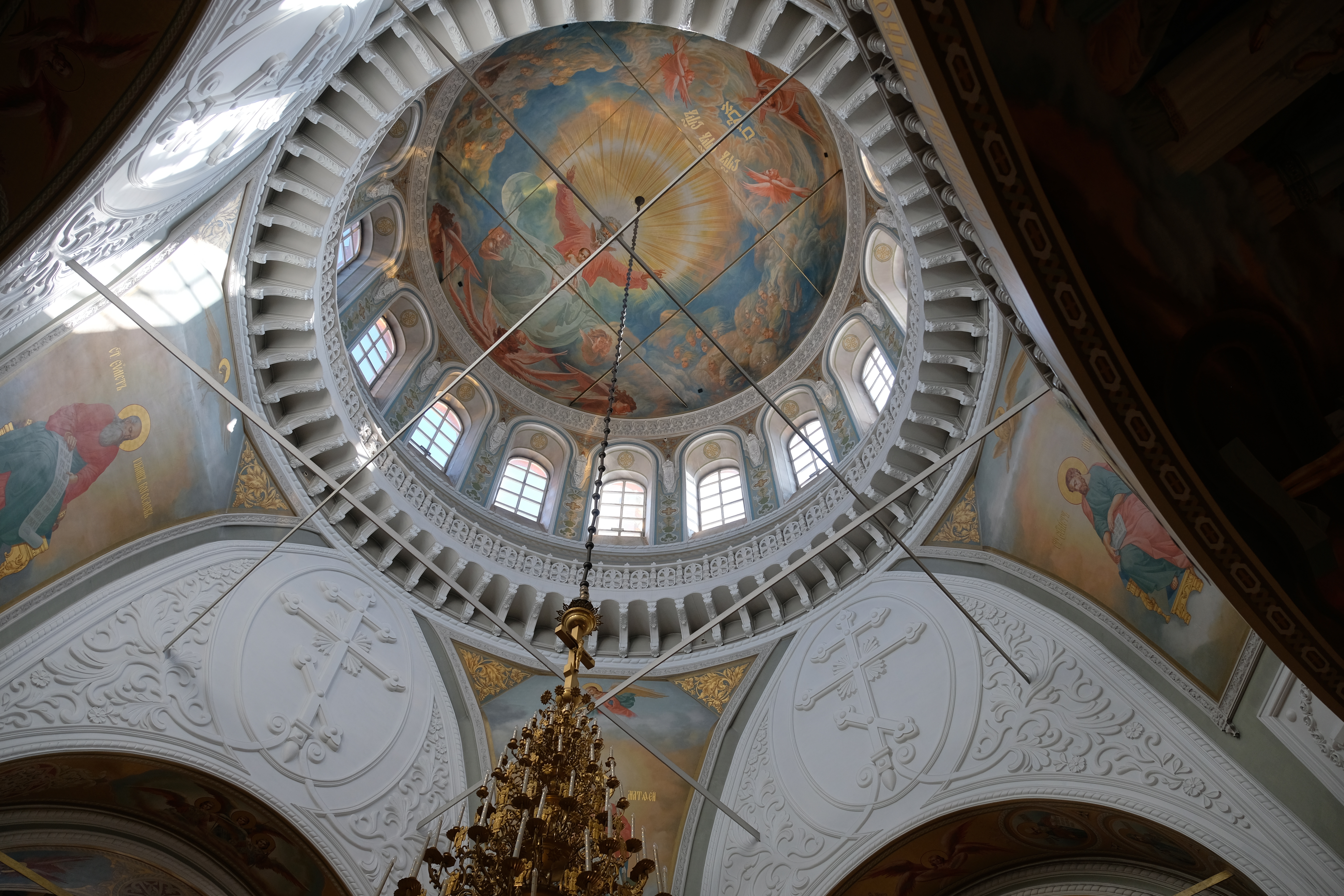
St. Michael's Cathedral (Izhevsk)
The first version took ten years to build. The second took three. In between, there was nothing — or rather, there was a deliberate emptiness, the kind a demolished cathedral leaves in a city's skyline and in its people's memory. St. Michael's Cathedral in Izhevsk, a red-brick Russian Revival church that rises 67 meters to the tip of its tent-like roof, was erected between 1897 and 1907, torn down by the Soviet government in 1937, and rebuilt to the original drawings between 2004 and 2007. The building stands twice: once in the historical photographs that survived its destruction, and once in the brick and gilt that replaced what was lost.
Charushin's Vision in Red Brick
The cathedral's architect was Ivan Charushin, a figure little known outside the history of Russian provincial design. Working from Vyatka (now Kirov), Charushin drew a church that reached back to the Muscovite traditions of the seventeenth century. The tent-like roof — a form borrowed from the wooden churches of northern Russia and translated into masonry — dominates the composition, rising 67 meters above the surrounding streets. Massive chapels encircle the main structure, their gilded bulbous domes catching light from every direction. Slender belfries rise like candles beside the heavier volumes. The porches feature sharply pitched roofs that echo the steep angles of churches built centuries before Peter the Great imposed his westward-looking aesthetic on Russian architecture. In Charushin's design, the past was not nostalgia but argument — a statement that Russian sacred architecture had its own logic, its own beauty, independent of European fashions.
The Archangel and the Arms Factory
Izhevsk owes much of its existence to weapons manufacturing. The city's arms factory, established in 1807, grew in part through the patronage of Grand Duke Mikhail Pavlovich, a son of Emperor Paul I. The Grand Duke's patron saint was Michael the Archangel, and when the city's Orthodox community commissioned a cathedral worthy of Izhevsk's growing importance, the choice of dedication was predetermined. The cathedral thus carried a double significance: it was a house of worship and a marker of the imperial connection that had made the city's industrial rise possible. The Archangel Michael, patron of warriors, watched over a city that armed them. Construction began in 1897 and was completed by 1907, the church growing alongside the factory that justified its ambition.
1937: The Emptiness
Twenty-two years after its completion, the cathedral was destroyed. The Soviet campaign against religious architecture spared neither the obscure nor the magnificent, and St. Michael's fell in 1937, its red-brick walls reduced to rubble and memory. What replaced it was not another building but an absence — a gap in the skyline that persisted for nearly seventy years. The demolition was typical of its era: swift, ideologically motivated, and total. Yet Charushin's original drawings survived, preserved through the decades of Soviet rule in archives that outlasted the structure they described. Those drawings would prove essential when, after the fall of the Soviet Union, the question of what had been lost began to produce a different answer than what the demolition's architects had intended.
Resurrection in Three Years
Reconstruction began in 2004 and was completed in 2007, following Charushin's original plans with remarkable fidelity. The red brick, the tent-like roof, the gilded domes, the candle belfries, the sharp-pitched porches — all were rebuilt to match the photographs and architectural drawings that had survived from the early twentieth century. The result is not a replica in the dismissive sense. It is a cathedral that carries the weight of its own absence. Visitors who know the history see two buildings superimposed: the one that stood for twenty-two years, and the one that has stood since 2007. St. Michael's now rivals the older Alexander Nevsky Cathedral as the principal Orthodox church of Udmurtia, a distinction earned not just through its architecture but through its story of destruction and return. In a city defined by what it manufactures, the cathedral is defined by what it endured.
From the Air
St. Michael's Cathedral stands in central Izhevsk at approximately 56.85°N, 53.21°E. The red-brick structure with its 67-meter tent-like roof and gilded domes is a prominent visual landmark from the air, particularly in clear conditions at lower altitudes. Izhevsk Airport (USII) is the nearest field. The cathedral is located within the urban core of Izhevsk, a city of approximately 650,000 in the Udmurt Republic, situated between the Volga basin and the Ural Mountains.