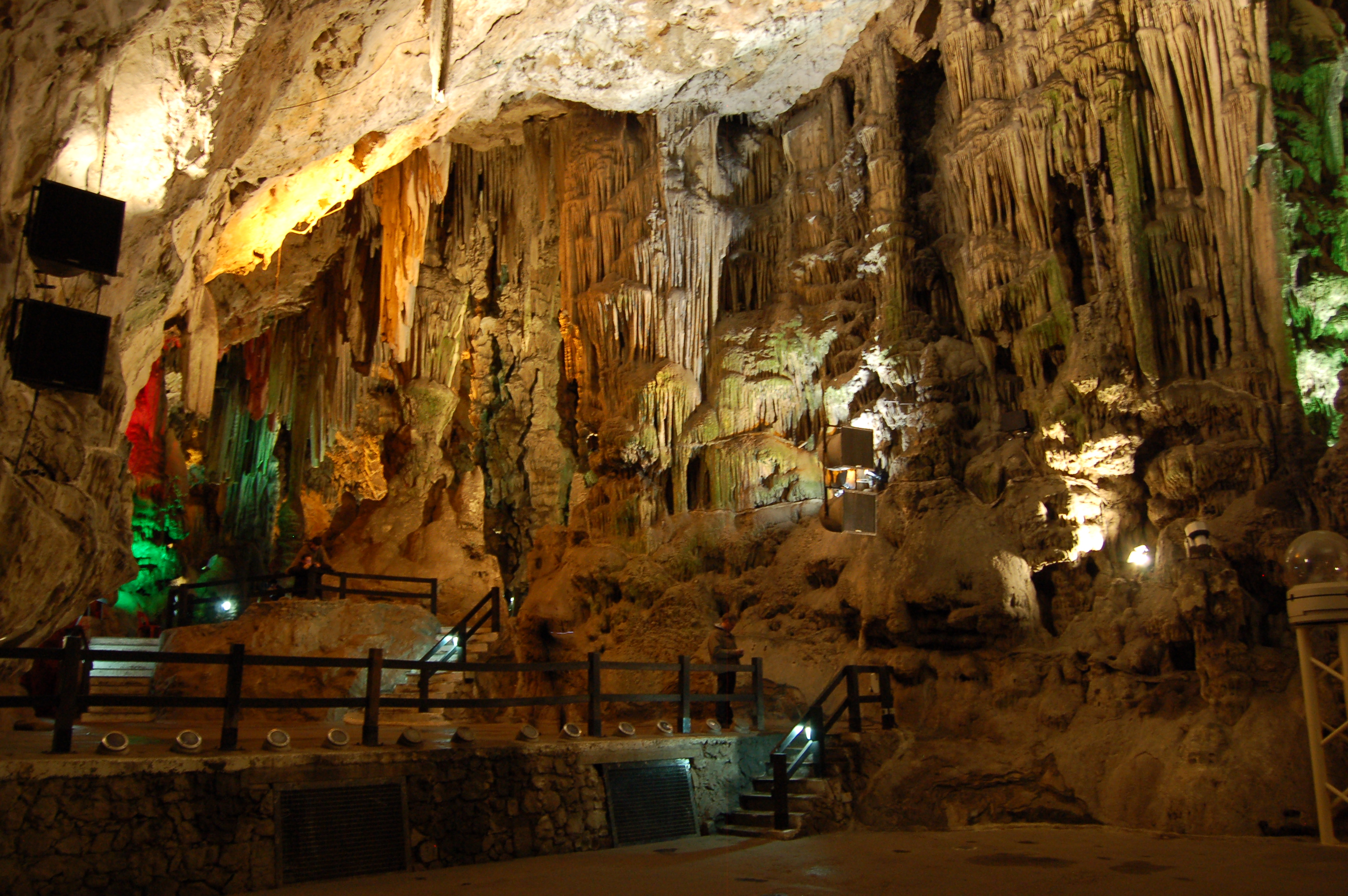
St. Michael's Cave
The Ancient Greeks believed it was an entrance to the underworld. The Phoenicians and Romans explored its passages and left artifacts behind. Pomponius Mela, a geographer born in nearby Algeciras, described it in 45 AD as "a mountain with wonderful concavities, which has its western side almost opened by a large cave which may be penetrated far into the interior." Two thousand years later, nearly a million visitors walk through St. Michael's Cave each year, making it the most visited of the more than 150 caves inside the Rock of Gibraltar -- and one whose history reaches far deeper than its stalactites.
An Archangel's Namesake
The cave's name traces to a grotto on Monte Gargano in Apulia, Italy, where the archangel Michael is said to have appeared. Gibraltar's first historian, Alonso Hernandez del Portillo, recorded the Spanish name Cueva de San Miguel and suggested the connection in his Historia de la Muy Noble y Mas Leal Ciudad de Gibraltar. The cave sits more than 300 meters above sea level in the Upper Rock Nature Reserve, formed over millennia as rainwater seeped through the limestone, turning into weak carbonic acid that gradually dissolved the rock. Tiny cracks grew into long passages and vast chambers. The stalactites and stalagmites that now draw visitors are simply traces of dissolved rock, deposited drop by drop from the ground above over tens of thousands of years.
Prehistory Underfoot
In 1974, a Neolithic bowl was discovered inside the cave, confirming what the archaeological record had already suggested: prehistoric humans knew this place well. Cave art depicting an ibex drawn in charcoal was found on one wall, dated to the Solutrean period between 15,000 and 20,000 years ago. Given that two Neanderthal skulls have been discovered elsewhere on Gibraltar, it is possible that Neanderthals were among the first to set foot inside the cave around 40,000 BC. The artifacts span thousands of years -- stone axes, arrowheads, shell jewelry, bone needles, and a large collection of pottery have all been recovered from the cave system.
The Officers Who Never Returned
The cave system's depths inspired one of Gibraltar's most persistent legends: that the Cathedral Cave was bottomless, connected by a subterranean tunnel 24 kilometers long running beneath the Strait of Gibraltar to Morocco. This, supposedly, is how the Barbary macaques arrived on the Rock. The legend gained a darker edge sometime before 1840, when a Colonel Mitchell and a second officer ventured into the cave's deeper passages and were never seen again. Their disappearance prompted extensive explorations in 1840, 1857, and 1865, but no trace was found. A scientific expedition between 1936 and 1938 explored every known part of the cave system and again turned up no human remains. Whatever happened to the two men, the cave kept its secret.
From Battlefield to Concert Hall
Military use of St. Michael's Cave may date to 711 AD, when the Berber general Tariq ibn Ziyad led the Umayyad conquest of Hispania. A defensive wall of Moorish origin protected the entrance until recently. In 1704, shortly after the Anglo-Dutch capture of Gibraltar, 500 Spanish troops hid inside the cave overnight before attempting a surprise assault on the garrison -- a bold plan that ultimately failed. During the Second World War, the entire cave was prepared as an emergency military hospital, though it was never used for that purpose. Today the cave's main chamber serves as a performance venue, hosting concerts and the annual Gibraltar World Music Festival. Colored lights illuminate the formations, and visitors can read displays documenting the cave's layered history -- from the world of Pomponius Mela to the world of Mark Steel, who recorded a BBC Radio 4 comedy episode here in 2016.
From the Air
Located at 36.13°N, 5.35°W, roughly halfway up the western slope of the Rock of Gibraltar at over 300 m elevation. Not directly visible from the air, but the Rock itself is unmistakable. Nearest airport: Gibraltar International (LXGB). Accessible by cable car from the city of Gibraltar; the upper cable car station at Signal Hill (387 m) is nearby.