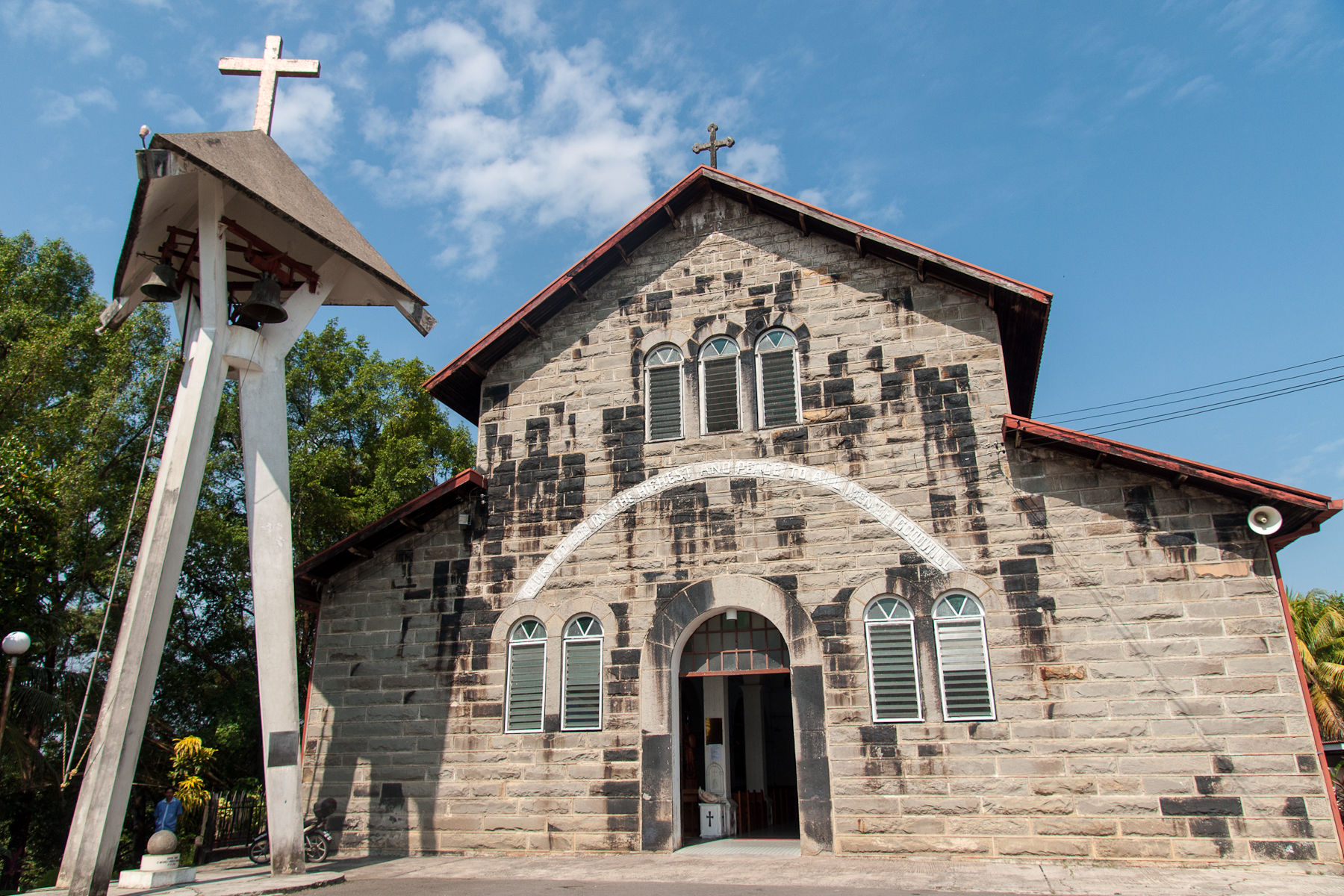
St. Michael's Church, Penampang
According to the oral tradition of the Mill Hill Missionaries, the priests who first came to Penampang in 1886 found themselves oppressed by what they called territorial spirits, the unseen forces that the local Kadazan-Dusun recognized as part of the landscape's spiritual ecology. The missionaries prayed the rosary and invoked the Archangel Michael. Whether or not the spirits relented, the name stuck. St. Michael's Church stands today on a steep hill in Donggongon, the oldest church in the district of Penampang and the second-oldest stone church in all of Sabah. Its cemetery holds the grave of a politician who died in a plane crash and, in the old tradition of the Kadazan-Dusun, burials in clay jars.
Missionaries on the Moyog
Fr. Alexander Prenger led the first Mill Hill Missionaries to Penampang in 1886, establishing a base at Kampung Inobong. But Prenger and his colleagues soon decided they needed a location closer to the coast and the Moyog River, the main artery of transportation for the local population. They chose Kampung Dabak, a low hill surrounded by rice paddies where the river was accessible from the coastal town of Kasigui, then the only settlement in Penampang District. In 1890, Fr. Rientjes arrived from Sandakan to help and was placed in charge of the Penampang Mission. That same year, construction of the first wooden church began. When Prenger was recalled to teach at Mill Hill College in London in July 1890, Rientjes was left alone, serving both Penampang and Inobong, walking between the two parishes on alternating Sundays.
Stone by Stone
By the early 1920s, the wooden church could no longer hold the growing congregation. In February 1922, it was extended by 33 feet, but the expansion was temporary relief. Fr. August Wachter, who had dreamed of a proper stone church since at least April 1929, initiated the project in the early 1930s. He invited Brother Aegidius Leiter, a master builder, to oversee the construction. The foundation stone was laid on 29 September 1936, the Feast of St. Michael, in a ceremony that fused Catholic liturgy with the practical business of building on a steep Bornean hillside. Then the war intervened. Construction halted during the Japanese occupation, and the stone church was not completed until 1947. Its survival through the war years, when so much of Sabah's built environment was destroyed, gave the building a significance beyond its original purpose.
The Architecture of Endurance
The church sits at the top of a steep hill, built from local stone in a style that owes more to European mission architecture than to any Bornean precedent. Inside, a nave and two aisles stretch beneath flat wooden ceilings. Arched windows line the upper walls, flooding the interior with the filtered light of the equatorial highlands. Twenty double rows of wooden benches fill the nave, with the right aisle reserved for the choir and band. The chancel is adorned with a scene of the Last Supper. A gallery, accessible by a narrow spiral staircase, overlooks the entrance. Outside, a bell tower built after the war in memory of Fr. Wachter takes the form of a concrete tripod topped with a tetrahedron-shaped roof and a cross. Its three bells must still be rung by hand. At the tower's base sits a spherical time capsule, poured in concrete on 31 December 2000.
The Hill of the Dead and the Living
The cemetery tells its own layered story. In a small park-like enclosure beside the church lie two graves: Rev. Fr. Anthony Paul Michael, whose bones were recovered in Tenom, and Datuk Peter Mojuntin, a Sabah government minister who died in the Double Six Crash of 6 June 1976, the same plane crash that killed Chief Minister Fuad Stephens. Below the hill, the larger cemetery holds both conventional graves and traditional Kadazan-Dusun burials in clay jars, a practice that predates Christianity on Borneo by centuries. The coexistence of these burial traditions within a single church ground captures something essential about Penampang's identity. The missionaries came to convert, but the culture they encountered was too deep to be replaced. It was absorbed, adapted, and given a place beside the altar. St. Michael's School, founded at the foot of the hill in 1888, continues to serve the community as SM St. Michael, one of the oldest continuously operating schools in Sabah.
From the Air
Located at 5.91°N, 116.11°E on a steep hill in Donggongon, Penampang District. The stone church and its bell tower are visible on the hilltop above the surrounding rice paddies and low-rise development. Nearest airport is Kota Kinabalu International Airport (WBKK), approximately 12 km to the northwest. The Moyog River runs nearby. Look for the hilltop church complex with its distinctive tripod bell tower south of the main Kota Kinabalu urban area. Best viewed at 2,000-4,000 feet AGL.