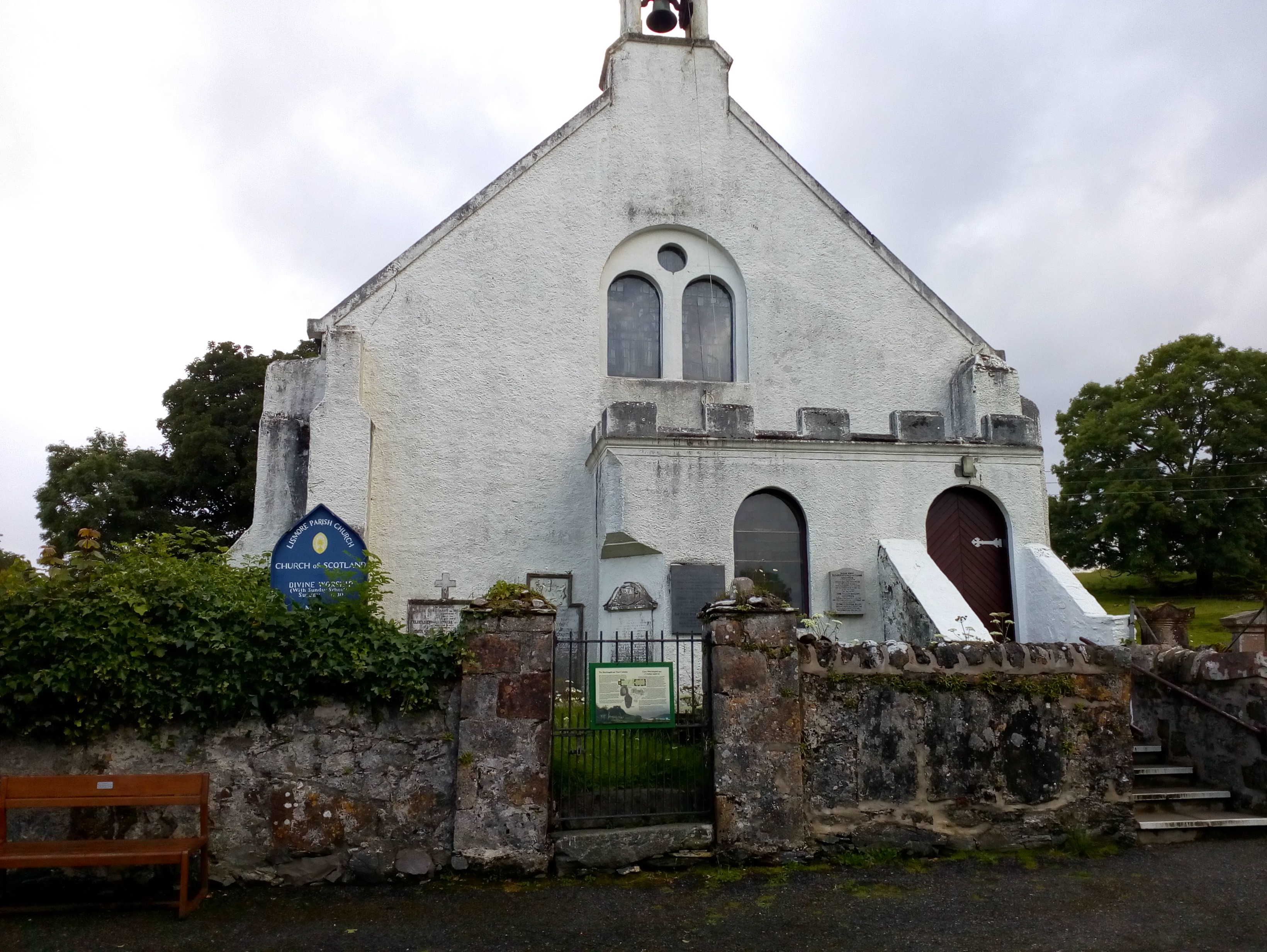
St Moluag's Cathedral, Lismore
To modern eyes, Lismore seems an odd place for a cathedral. A narrow island ten miles long in Loch Linnhe, just off the coast of Oban, it lacks the size, the population, and the urban infrastructure that the word 'cathedral' conjures. But in an era when the fastest and most reliable transport was by water, Lismore was ideally situated -- a natural crossroads in the sea lanes connecting Argyll to the wider world. Saint Moluag, who died in 592 AD, founded a monastery here that became a major center of Christianity in Scotland. The cathedral that rose on the same site in the thirteenth century was the seat of the medieval bishopric of Argyll, and its choir -- lowered, re-windowed, and wrapped in eighteenth-century design -- still serves as Lismore's parish church today.
Moluag's Island
Saint Moluag -- Mo-Luoc in Old Irish -- was a contemporary of Columba, and the two saints are said to have raced to reach Lismore first. Moluag reportedly won by cutting off his finger and throwing it ashore, claiming the island by the earliest contact of his flesh with its soil. The story is almost certainly apocryphal, but it captures the competitive zeal of early Celtic Christianity, when rival monastic foundations vied for territory and converts across the Hebrides. Moluag's monastery became a center of learning and worship that endured for centuries, laying the foundation for the later medieval diocese. The island's location -- accessible by water from every direction, central to the communities scattered along the Argyll coast and islands -- made it a logical seat for ecclesiastical authority in a region where roads did not exist and the sea was the highway.
Scotland's Most Impoverished Diocese
The Diocese of Argyll was, by all accounts, Scotland's poorest. The medieval cathedral that served as its seat was very modest in scale -- nothing like the grand cathedrals of St Andrews or Glasgow. Robert Hay suggests that building began during the term of Bishop Laurence de Ergadia, who held office from 1262 to 1299, with a western tower added under Bishop Martin between 1342 and 1387. The cathedral reflected the resources of its diocese: sufficient for worship and the requirements of a bishop's seat, but without the ambition or the funding for architectural grandeur. What it lacked in scale, it compensated for in persistence. The building survived the centuries better than many of its wealthier counterparts.
From Cathedral to Parish Church
In 1749, the choir was converted into a parish church. The building was lowered, new windows were installed, and the nave and western tower were reduced to their foundations. The result is a structure that wears its history in layers: eighteenth-century practical modifications wrapping thirteenth-century stonework, with medieval grave slabs preserved inside and in the adjoining graveyard. The chief surviving medieval features include three doorways -- one blocked, another originally the entrance through the pulpitum -- a piscina, and a triple-arched sedilia. These fragments of the original cathedral sit quietly within a building that now serves a congregation of the Church of Scotland, linked with Appin Parish Church on the mainland. The transformation from Catholic cathedral to Protestant parish church, played out across centuries of reformation and adaptation, is visible in every altered window and every repurposed stone.
An Island That Connects
Lismore today has a population of roughly 200, served by a ferry from Oban. The cathedral-turned-parish-church stands as a reminder that this small island was once the spiritual center of an entire region -- not despite its isolation but because of its accessibility by water. Fourteen centuries separate Moluag's monastery from the present-day congregation, yet the thread of continuous worship on this site has never been entirely broken. The grave slabs in the church floor, the medieval stonework within the eighteenth-century walls, the view from the doorway across Loch Linnhe to the mountains of Morven -- all of it carries the weight of a place that was chosen, built upon, rebuilt, and chosen again. Lismore's cathedral is no longer a cathedral, but it remains what Moluag intended: a place of gathering on an island where the sea brings people together.
From the Air
Located at 56.53N, 5.48W on the island of Lismore in Loch Linnhe, just off the coast of Oban in Argyll. The church is a small structure visible on the island's interior. Nearest airport is Oban Airport (no ICAO code); nearest major airports are Glasgow (EGPF) and Inverness (EGPE). Best viewed at 2,000-4,000 feet with Lismore island, Loch Linnhe, and the Morven hills visible.