Stånga Church
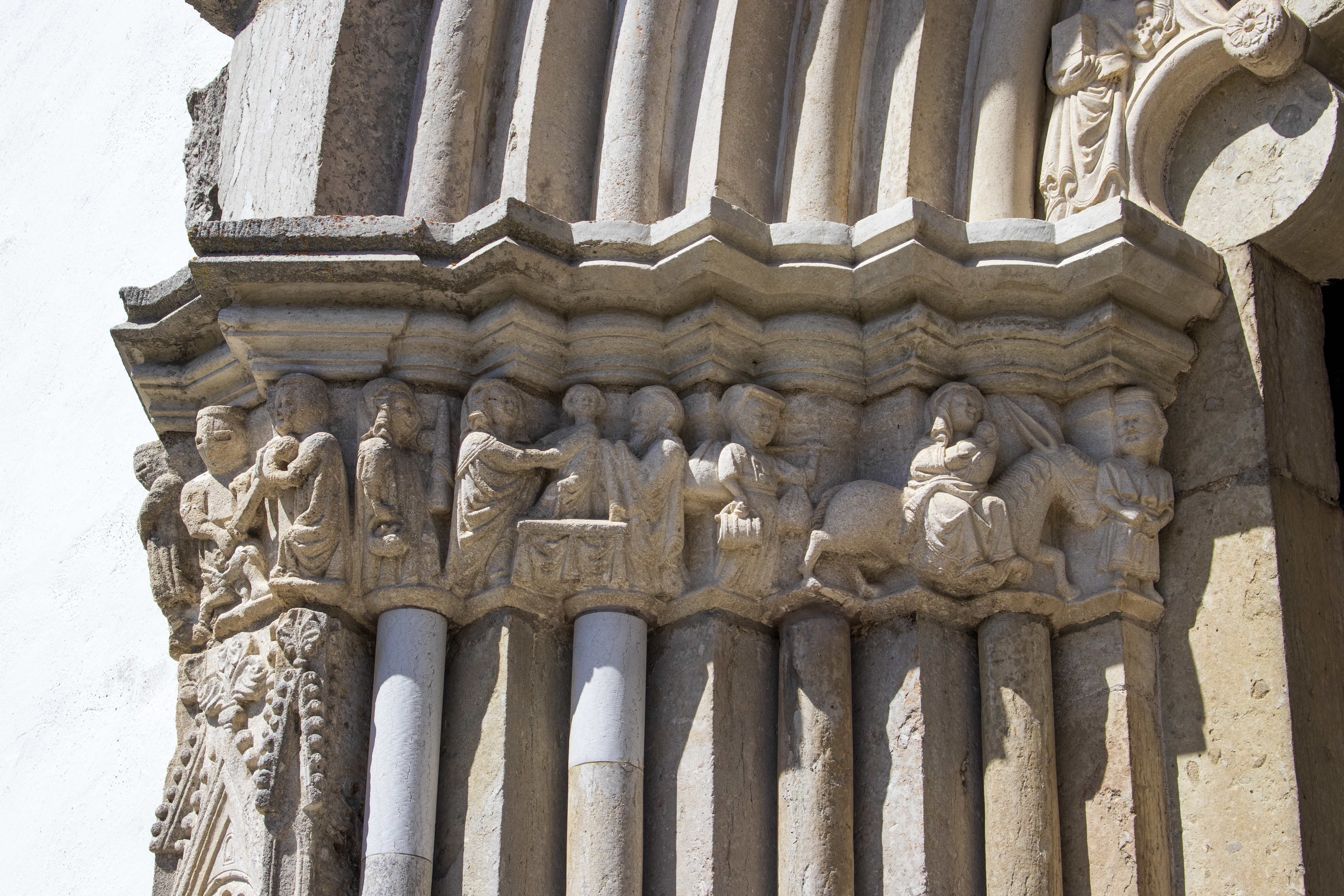
The sculptures are in the wrong place. Anyone who studies the massive limestone figures embedded in the south wall of Stånga Church can see this immediately. They sit awkwardly against the whitewashed facade, anchored shallowly, clearly not designed for this location. These monumental Gothic works, depicting the Adoration of the Magi, the Flagellation of Christ, and the Descent from the Cross, are unlike anything else in Scandinavia. The Swedish National Heritage Board calls them one of the most unusual works of art from the Middle Ages in Sweden. What happened here in the 14th century remains a mystery, a grand architectural vision interrupted and improvised into the church we see today.
Before the Cross
Long before Christian stonemasons arrived, this ground held meaning for the people of Gotland. Archaeological excavations have unearthed buckles, buttons, and jewelry chains from the 11th and early 12th centuries, evidence of burial practices predating any church. The site was likely a pagan sacred place before the Christianization of Scandinavia. A wooden church rose here around the beginning of the 12th century, eventually replaced by a Romanesque stone structure in the first half of the 13th century. The present tower began construction in the middle of that same century, probably replacing a smaller predecessor. Layer upon layer of faith and construction, each generation building upon the last.
The Great Interruption
Something ambitious was planned for Stånga in the mid-14th century. Craftsmen from a workshop that had built several other churches on Gotland arrived to construct a new Gothic nave. The tower was heightened. The intent, scholars believe, was to rebuild the entire edifice into a grand Gothic church. Then work stopped. No one knows why. What remained were awkward compromises and ad-hoc solutions. The nave appears wedged between the chancel and tower, smaller than originally planned. Gargoyles identical to those properly placed in tower positions at Dalhem, Gothem, and Öja churches ended up immured beside the chancel portal. And those monumental sculptures, possibly intended for a tower that was never built, or perhaps for a completely different church like Källunge, were simply placed where they could fit. The result is one of the most remarkable ecclesiastical monuments on Gotland.
Fortress and Sanctuary
The five-storey tower of Stånga Church stands among the tallest on Gotland, rivaling only Dalhem, Rone, and Öja. Its defensive features reveal the uncertainties of medieval island life. The first storey contains narrow openings, one possibly designed as an arrowslit, suggesting the tower could serve as refuge during times of danger. The second storey has a larger round-arched opening that once worked with a mechanical winch to hoist goods into storage, perhaps the church tithe collected from local farmers. Church bells hang in the fourth storey, their sound carried through twelve Gothic openings, three on each face of the tower. An octagonal wooden spire crowns the structure, renewed over the centuries.
Treasures Within
Step inside and centuries of devotion surround you. The baptismal font, created by the Romanesque sculptor Hegvald in the late 12th century, is one of his best-preserved works, its sides carved with scenes from the New Testament alongside beasts and human figures. A Romanesque rood cross of painted and gilded oak, dating to around 1250, still rests on its original pedestal, an unusual survival. The 15th-century wooden crucifix has been incorporated into a Baroque altarpiece made in Burgsvik during the late 17th century. The wooden pulpit bears the date 1723 and the monogram of Frederick I of Sweden. Fragmentary murals whisper from the apse and tower ground floor. The nave, supported by a single central pillar, holds four bays beneath its vaulted ceiling.
Stones that Endure
In 1864, the chancel and apse were rebuilt after structural damage threatened collapse. The congregation chose to recreate them as closely as possible to their medieval form, a 19th-century act of preservation that kept the Romanesque spirit alive. Major renovations followed in 1929-30 and 1962-63, each time renewing the whitewash that protects the grey limestone walls. Today Stånga Church belongs to the Diocese of Visby within the Church of Sweden, an ecclesiastical monument recognized by the Swedish National Heritage Board. Those misplaced sculptures still stand beside the main portal, a testament to medieval ambitions that exceeded resources, to plans that changed for reasons now lost, and to the human instinct to complete what was started, even imperfectly.
From the Air
Located at 57.28°N, 18.47°E on the Swedish island of Gotland in the Baltic Sea. The whitewashed church with its tall five-storey tower is visible from cruising altitude against the flat Gotlandic landscape. Nearest airport is Visby Airport (ESSV), approximately 30 km northwest. Best approached from the south or east to see the distinctive tower profile. The church sits in the village of Stånga in the southeastern part of the island.