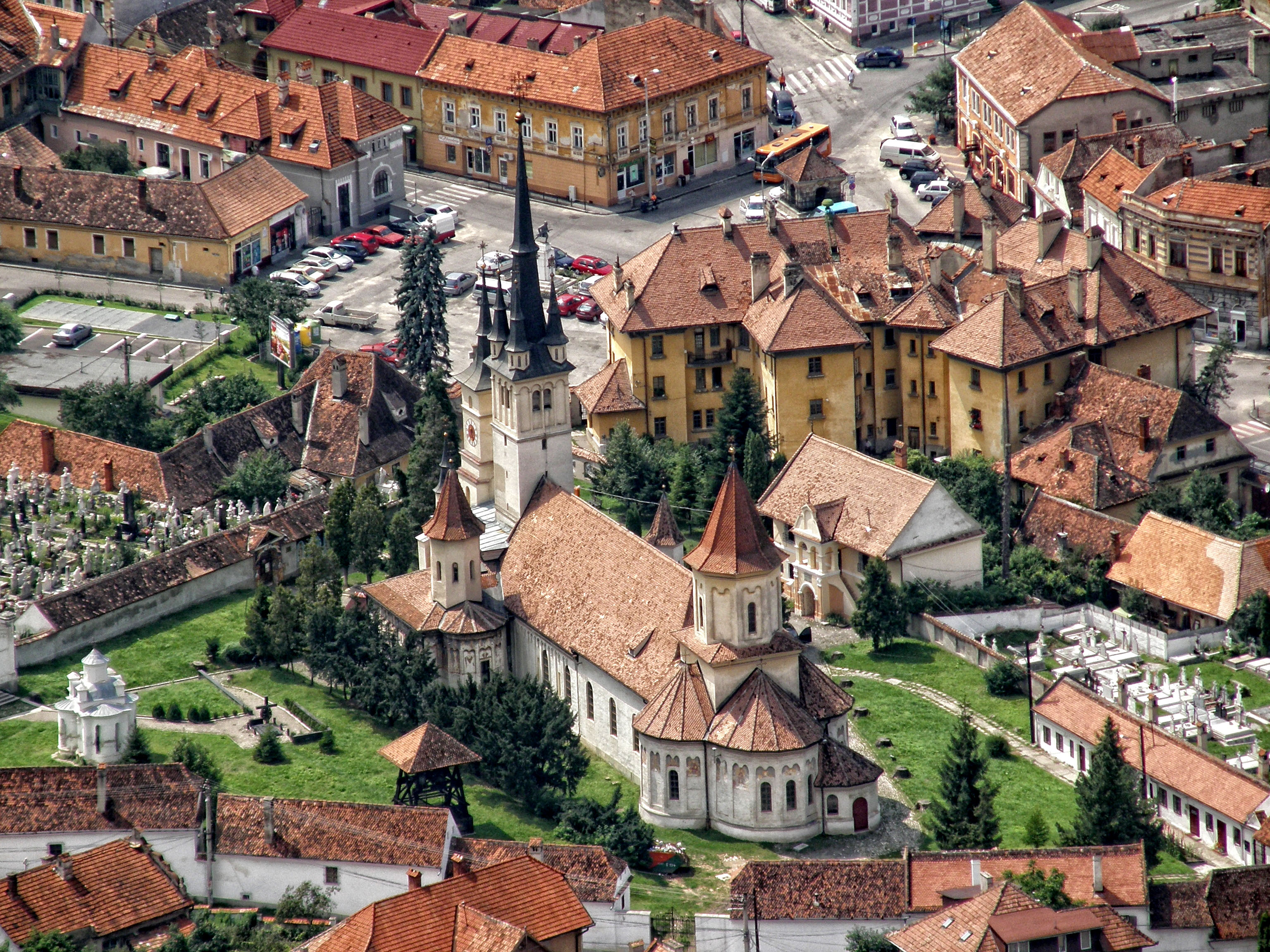
St. Nicholas Church, Brasov
In 1399, Pope Boniface IX issued a papal bull mentioning a church in the Schei district of Brasov -- a place of worship for those the Vatican called "schismatics." The Orthodox Romanians living outside the Saxon-controlled city walls had been gathering at this site since at least 1292, when a wooden cross marked the spot. By the time the stone church was completed in 1519, St. Nicholas had already been a center of Romanian identity for two centuries, a place where the act of worship was inseparable from the assertion that Romanians belonged in a city whose German-speaking rulers would have preferred to keep them out.
Built by Voivodes, Adorned by Princes
The church's construction history reads like a roll call of Romanian rulers. In 1584, Voivode Petru Cercel built the porch and choir and decorated the altar with icons. Between 1595 and 1597, Moldavian Voivode Aron Voda added the bell tower and commissioned the first interior paintings. The pisanie above the door depicts both rulers. A tower chapel dedicated to Saint John the Baptist followed in 1651. The northern chapel, completed in 1733-1734, was built with help from Lady Ancuta, daughter of the great prince Constantin Brancoveanu, and its iconostasis carries Brancovenesc motifs. The southern chapel, funded by local merchants between 1750 and 1752, added a third worship space. Michael the Brave, Petru Rares, and Gheorghe Stefan all sent gifts over the centuries. Each addition was both architectural and political -- a statement that Romanian culture, though excluded from the Saxon city proper, was building something permanent just outside its gates.
Where Gothic Met Baroque
St. Nicholas Church began as a Gothic structure and was later redecorated with Baroque elements, creating an architectural hybrid that reflects the centuries of its evolution. The stone-and-brick building has a rectangular nave with a circular apse on the east side. Two towers dominate the western facade: a larger central tower crowned with four turrets and a smaller entrance tower flanked by two more. The pronaos and porch sit at the western end, while the north and south chapels extend the church's footprint. The result is less a single building than an accretion -- each generation adding its layer without erasing what came before. The Baroque ornamentation sits on Gothic bones, and the whole structure carries the weight of seven centuries of continuous use.
Murals That Tell a Nation's Story
The current paintings date to 1739, but the church has been repainted and augmented many times since. In 1849, the renowned muralist Misu Popp worked with Constantin Lecca on the interior frescoes. In the 20th century, Costin Petrescu and students from the Fine Arts Academy added murals that transform the church walls into a visual history of Romania. The northwest wall depicts Michael the Brave's entry into Brasov. The front wall shows four founding Voivodes alongside an allegorical scene of deacon Coresi's printing press. The south wall captures the coronation of King Ferdinand in Alba Iulia, while the east wall celebrates Metropolitan Andrei Saguna. In the northern chapel, painters from Craiova created scenes of the Apocalypse, the First Council of Nicaea, and a remarkable mural called the "Wheel of the World," which depicts the rotation of the Earth around the Sun performed by the saints -- a striking blend of astronomy and theology painted in the 1730s.
The Birthplace of Romanian Printing
Next to the church stands the First Romanian School, constructed in 1495 under the church's auspices. Romanian-language classes began there in 1583, but the building's most transformative moment came earlier, in the 16th century, when deacon Coresi established a printing press and produced the first books in the Romanian language. A school of copyists was also founded to translate religious and cultural texts into Romanian, making St. Nicholas a center not just of worship but of literacy. In the 19th century, the church helped fund the Romanian Gymnasium of Brasov in 1851 and established the first local public library. Today the church archive holds some 2,800 old books and manuscripts dating to the 15th century. A statue of Coresi stands in the churchyard, near the cemetery where former Prime Minister Nicolae Titulescu and other notable Romanians are buried. The district of Scheii Brasovului, once a neighborhood of exclusion, became a cradle of Romanian cultural life.
From the Air
Located at 45.64°N, 25.58°E in the Scheii Brasovului district of Brasov, Romania. The church complex is visible in the southern part of the city, at the base of Tampa Mountain. Brasov sits at approximately 600 m elevation in a valley surrounded by the Carpathian Mountains. Nearest airport: LRBS (Bucharest Baneasa) is approximately 170 km south; there is no major commercial airport at Brasov. The Black Church (Biserica Neagra), another Brasov landmark, is approximately 1 km to the north in the old Saxon city center.