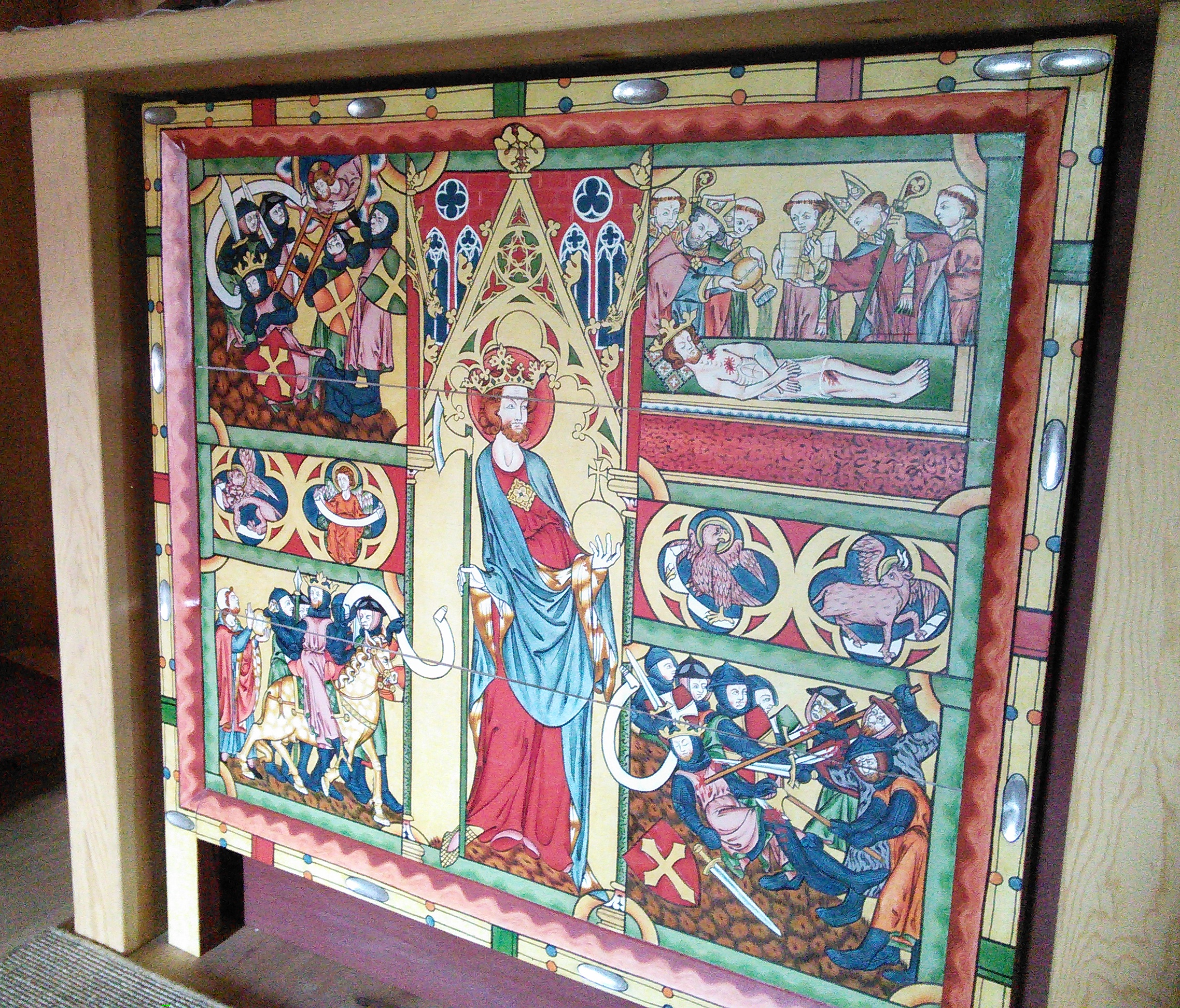
St. Olav's Shrine
Nobody knows where he is. Olav Haraldsson, the warrior king turned patron saint who defined Norway's medieval identity, rests somewhere beneath or beside Nidaros Cathedral in Trondheim -- but the exact location of his grave has been a mystery since 1568. For five centuries before that, his shrine behind the cathedral's high altar drew pilgrims from across Northern Europe, making Trondheim one of Christendom's great destinations. The shrine itself -- three nested caskets sheathed in silver and studded with jewels -- was the most valuable object in all of medieval Norway. Its destruction during the Reformation did not end the saint's hold on the national imagination. If anything, the mystery only deepened it.
A King Becomes a Saint
Olav II Haraldsson fell at the Battle of Stiklestad on 29 July 1030, fighting to reclaim his throne. He was thirty-five years old and had fought in twenty major battles. That night, a farmer named Torgils Holmuson and his son Grim placed the king's body in a simple wooden coffin, rowed it downriver to Trondheim, and buried it in a sandy bank along the Nidelven. The following year the coffin was exhumed and moved to St. Clement's Church, where on 3 August 1031 Bishop Grimkjell examined the body and found it, by the accounts of the time, intact and sweet-scented, with hair and nails still growing. He declared Olav a saint. Snorri Sturluson recorded what followed: the coffin was placed above the high altar, covered in costly cloths, and miracles began almost immediately. Within a generation, the veneration of St. Olav had spread far beyond Norway's borders, and a cathedral rose over the spot where the king had first been buried.
Five Centuries of Pilgrimage
The shrine that grew around the saint's remains was extraordinary even by medieval standards. Three shrines nested one inside the other, the outermost covered entirely in silver, the whole ensemble glittering with jewels accumulated over centuries of royal and ecclesiastical patronage. Archbishop Erik Valkendorf reportedly paid twenty lasts of butter -- an enormous sum -- for a single jewel fixed to one end of the shrine in the early 1500s. Nidaros Cathedral became the northernmost great pilgrimage site in Europe, drawing travelers who had walked or sailed for weeks to kneel before the relics. The high choir of the cathedral, the soaring octagonal space behind the altar, was built specifically to house the shrine. For five hundred years, St. Olav's resting place defined both the spiritual and political character of Norway. The shrine opens and closes the Middle Ages as a historic period in the country -- its creation marking the dawn, its destruction marking the end.
The Reformation Unravels Everything
When the Protestant Reformation swept through Scandinavia in the 1530s, Norway's last Catholic Archbishop, Olav Engelbrektsson, saw the threat clearly. He moved the shrine from Nidaros Cathedral to his fortress at Steinvikholm, further east in the Trondheimsfjord, hoping to protect it. But in April 1537, with Danish-Norwegian forces closing in, the archbishop fled to the Netherlands, where he died the following February. His garrison at Steinvikholm soon capitulated, and everything fell into Danish hands. What happened next is documented in fragments. The silver was stripped from the shrine and shipped to Copenhagen, where it was melted down to fund the Danish king's wars. The saint's body was returned to Nidaros Cathedral in 1564, placed in a coffin that was buried somewhere in or near the building. By 1568, the location of that grave had already been lost. Rumors circulated for centuries: one claimed the shrine itself sank in a shipwreck off Agdenes in the Trondheimsfjord on its way to Denmark. The truth is more prosaic, and more final. The silver became coins. The jewels scattered.
Searching for the Lost King
The mystery has never stopped tugging at Norwegian consciousness. In 2013, archaeologists at Nidaros Cathedral's Restoration Works announced they might have found evidence of St. Olav's original burial site. In 2014, researchers in Oslo reported discovering what they believed to be a bone of the saint in a church there. A crystal fragment surfaced that some scholars thought could be a relic from the original shrine. None of these findings have been conclusive. The cathedral itself, rebuilt and restored many times since the Middle Ages, guards its secrets beneath layers of stone and centuries of reconstruction. Today the high altar still stands where tradition says Olav was first buried, and pilgrims still walk the ancient routes to Trondheim. The shrine is gone, but the pull it created endures -- a gravitational force that shaped the map of Northern European devotion for half a millennium and continues to draw visitors to this city on the fjord.
From the Air
Located at 63.43N, 10.40E in central Trondheim, Norway. Nidaros Cathedral is visible as the dominant Gothic structure in the city center, identifiable by its green copper roof and octagonal chapter house. Best viewed at 2,000-3,000 ft AGL. Nearest airport: Trondheim Airport Vaernes (ENVA), approximately 19 nm east. The Trondheimsfjord and Nidelven river provide strong visual references for navigation.