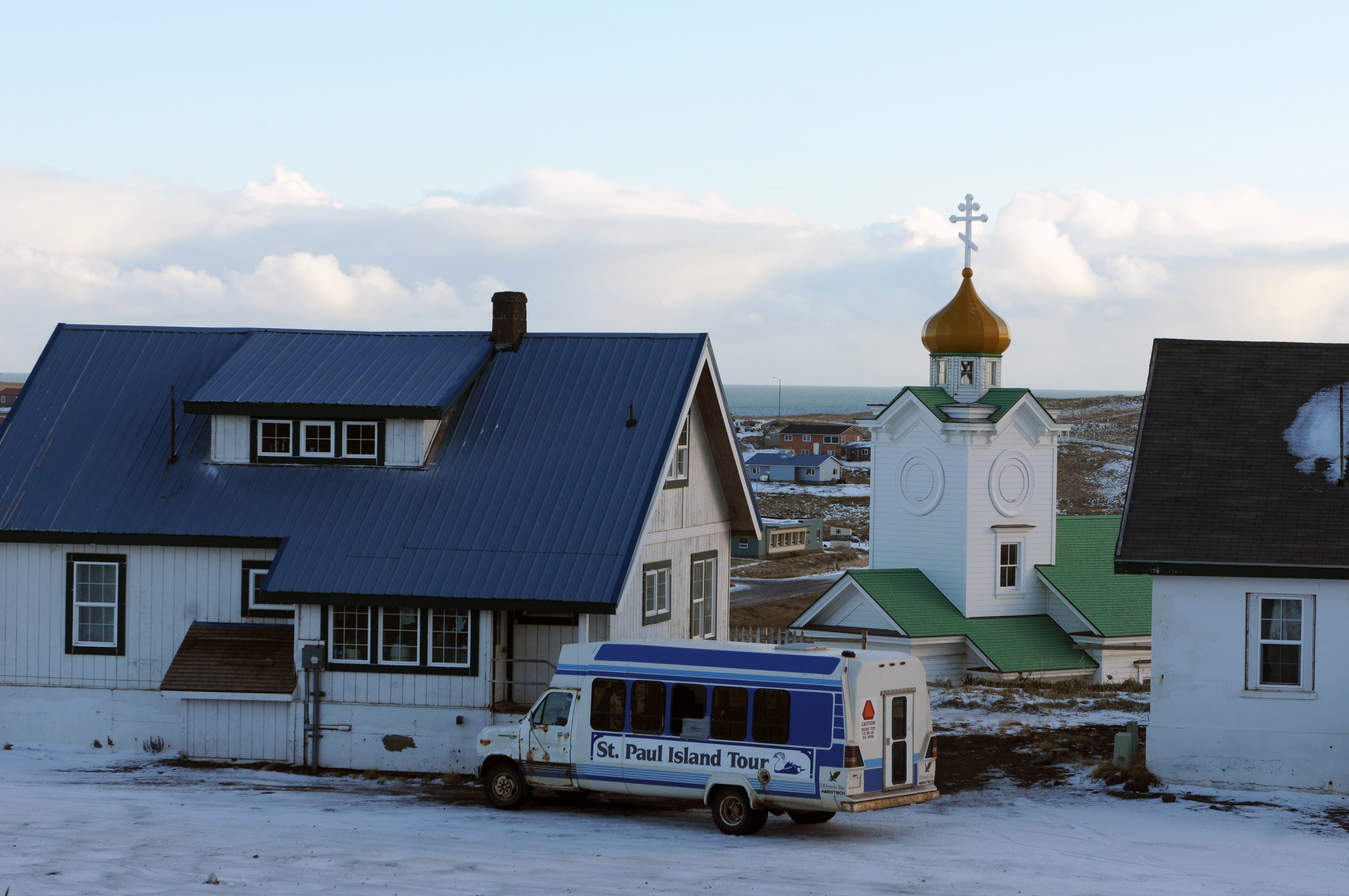
St. Paul Island: Alaska's Fur Seal Capital
Half a million fur seals return to St. Paul Island every summer to breed on the same beaches their ancestors used for millennia. The Pribilof Islands, lost in the Bering Sea 300 miles from mainland Alaska, were discovered in 1786 because Russian fur traders followed the seal migration. What they found was wealth beyond imagination - seals so numerous that hunters could simply club them. The slaughter continued for two centuries, driving populations toward extinction. Protection came in 1911; recovery followed slowly. Now the northern fur seal herd is one of the world's great wildlife gatherings, watched rather than harvested, valuable as spectacle rather than pelts.
The Discovery
Gerasim Pribilof discovered the islands in 1786, sent by Russian fur traders to find where northern fur seals bred. The seals' winter range was known, but their breeding grounds remained mysterious. Pribilof followed the migration and found St. George Island, then St. Paul - volcanic rocks rising from the Bering Sea, treeless, fogbound, and covered with seals. The Russians immediately began harvesting, establishing permanent camps and importing Aleut workers (mostly involuntarily). The islands became one of the world's most valuable fur sources.
The Slaughter
At their peak, the Pribilof fur seal herds numbered over 4 million animals. Unrestricted harvesting reduced them to perhaps 200,000 by 1910. The United States, which purchased Alaska in 1867, continued commercial sealing under increasingly regulated conditions. The North Pacific Fur Seal Convention of 1911 - one of the first international wildlife treaties - protected the herds and banned open-ocean sealing. Commercial harvesting on the Pribilofs continued at controlled levels until 1984, when it finally ended. The herds have recovered to roughly 1 million animals.
The Rookeries
Northern fur seals are pelagic most of the year, ranging across the North Pacific. But they return to ancestral rookeries to breed - males arriving in May to establish territories, females arriving in June to give birth and mate. The beaches become chaotic concentrations of seals: bulls defending harems, pups nursing, juveniles learning to swim. St. Paul hosts the largest concentration, with perhaps 500,000 seals on peak days. The smell is extraordinary; the sound is deafening; the sight is unlike anything else on Earth.
The Community
St. Paul village is home to about 400 people, mostly Aleut descendants of workers brought by the Russians. The community maintains connections to the seals that go beyond wildlife viewing - subsistence harvests of male seals are permitted for food, continuing a relationship that predates commercial sealing. The economy now depends partly on tourism, with birders and wildlife enthusiasts visiting during summer months. The Aleut culture preserved here reflects adaptation to one of the most isolated, extreme environments in North America.
Visiting St. Paul Island
St. Paul Island is accessible by scheduled air service from Anchorage (3 hours). The island has a small hotel and basic services; book accommodations well in advance for summer. Tours to fur seal rookeries are arranged through local guides - independent access to sensitive areas is restricted. Seabird cliffs host millions of nesting murres, puffins, and kittiwakes. The island is treeless, foggy, and windswept; weather changes rapidly. Peak seal numbers occur June through August. Bring layers and rain gear regardless of forecast. The remoteness is part of the experience - this is genuine frontier, accessible only by air, populated by more seals than people.
From the Air
Located at 57.11°N, 170.27°W in the Bering Sea, roughly 300 miles north of the Aleutian chain. From altitude, St. Paul Island appears as a volcanic remnant rising from open ocean - treeless, green with summer vegetation, surrounded by cold sea. The village is visible on the southern coast. Seal rookeries line beaches around the island, visible during breeding season as dark masses of animals. St. George Island is visible 40 miles to the southeast. The isolation is apparent from any altitude - no other land is visible, just the Bering Sea extending to every horizon.