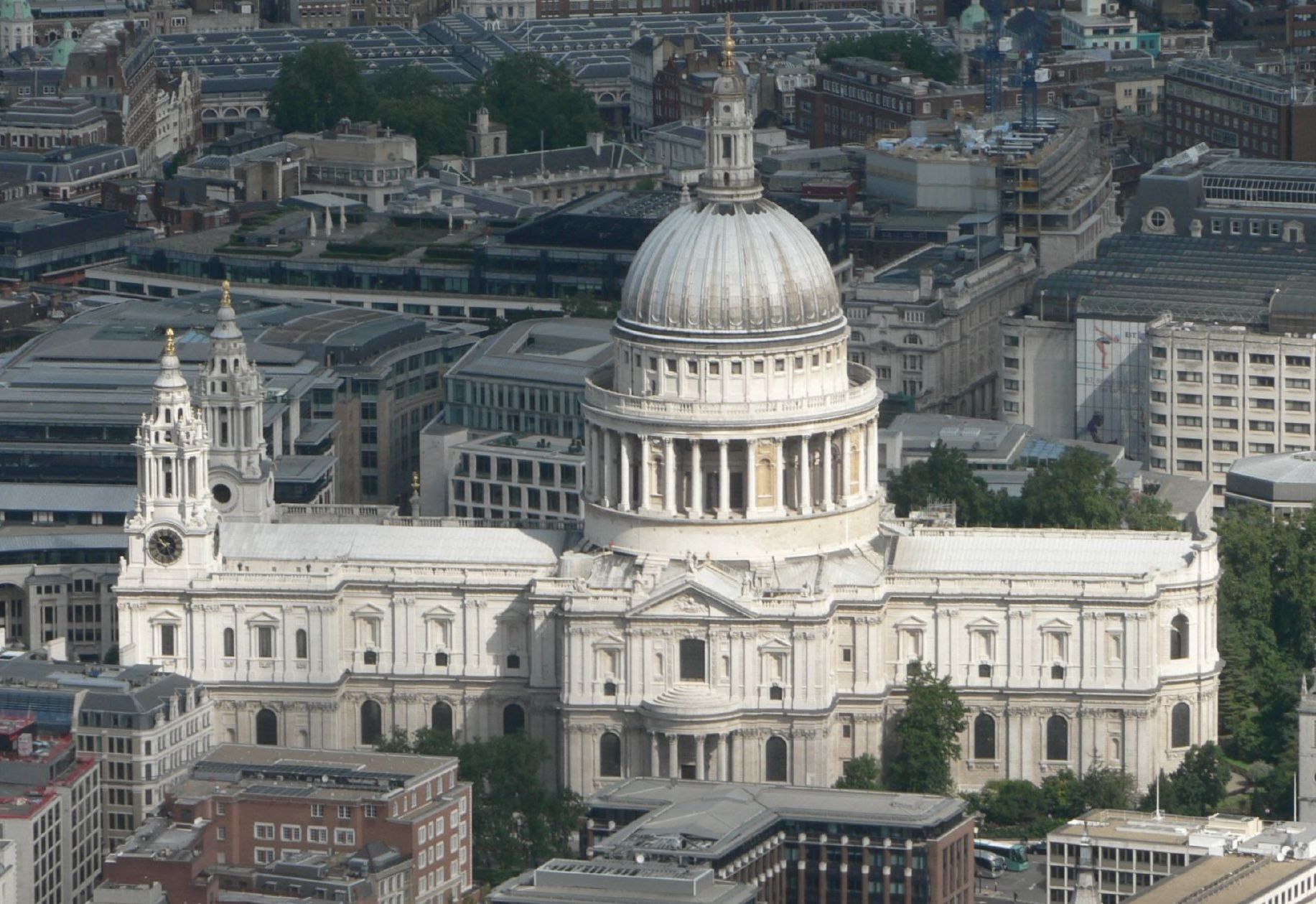
St Paul's Cathedral
On the night of 29 December 1940, German incendiary bombs rained on the City of London in what became known as the Second Great Fire. Fires burned uncontrolled across the Square Mile. But St Paul's Cathedral survived, its dome emerging from the smoke in a photograph by Herbert Mason that became one of the defining images of British wartime resilience. The survival was not luck. Volunteer fire-watchers organised by the cathedral's own clergy patrolled the roofs throughout the Blitz, extinguishing incendiaries before they could take hold. One bomb lodged in the outer dome and was defused in situ. The cathedral had already burned once, in 1666. Its protectors were determined it would not burn again.
Five Cathedrals on One Hill
The site on Ludgate Hill has held a church dedicated to St Paul since AD 604, when the first cathedral was founded as the seat of the Bishop of London. That wooden Saxon building burned in 675 and was rebuilt in stone. The stone church was destroyed by Vikings in 962 and rebuilt again. A Norman cathedral, begun after 1087, grew over the following centuries into Old St Paul's, one of the largest churches in Europe, with a spire that reached 489 feet before lightning destroyed it in 1561. The medieval cathedral was the heart of London's civic and commercial life -- Paul's Walk, its central nave, served as a marketplace and meeting place where lawyers met clients and merchants struck deals. When the Great Fire consumed Old St Paul's in 1666, the opportunity arose to build something entirely new.
Wren's Thirty-Five Year Obsession
Christopher Wren submitted multiple designs before his vision for the new cathedral was approved. His preferred Greek Cross plan, memorialised in the Great Model that still survives, was rejected by the clergy as insufficiently traditional. The Warrant Design, which Wren submitted in 1675, gained royal approval but bore little resemblance to the building he actually constructed -- Charles II had granted him the liberty to make "ornamental" changes, and Wren interpreted this permission with breathtaking latitude. Construction began in 1675 and was not declared complete until 1710, when Wren was 78 years old. He had overseen every detail, from the Portland stone walls to the cathedral's most audacious feature: a dome that appears to be a single structure but is actually three -- an inner dome visible from inside, a brick cone that supports the lantern, and the outer lead-covered dome that defines the London skyline.
The Whispering Gallery and the Weight of the Dome
The dome rises 365 feet from ground to cross and sits on eight arches supported by eight piers. At the base of the inner dome, 99 feet above the cathedral floor, runs the Whispering Gallery, named for its acoustic properties: a whisper spoken against one side of the circular wall can be heard clearly on the opposite side, 112 feet away. Above it, the Stone Gallery and the Golden Gallery offer progressively higher views of the city. The dome's engineering was revolutionary for its era. The brick cone hidden between the inner and outer domes carries the weight of the 850-tonne lantern, distributing forces that would have been impossible for either the visible inner dome or the decorative outer dome to bear alone. Wren, who was a mathematician and astronomer before he was an architect, solved a structural problem that had no precedent in English building.
Cathedral of State and City
St Paul's has served as the stage for national moments that no other London building could accommodate. The funerals of Nelson, Wellington, Churchill, and Thatcher were held here. Charles, Prince of Wales, married Diana Spencer beneath the dome in 1981, watched by a global television audience of 750 million. The cathedral's crypt holds the tombs of Wren himself -- whose epitaph reads, in Latin, "Reader, if you seek his monument, look around you" -- alongside Nelson, Wellington, and scores of other figures from British public life. Yet for all its monumental gravity, St Paul's remains a functioning parish church and Anglican cathedral, holding daily services in a building that draws nearly two million visitors each year. Its dome, protected by sight lines that restrict the height of surrounding buildings, still defines the eastern City skyline, much as Wren intended when he placed it on the highest point in London.
From the Air
Located at 51.514N, 0.098W on Ludgate Hill, the highest point of the City of London. St Paul's dome is one of the most recognisable landmarks from the air, sitting prominently above the surrounding City buildings. The Millennium Bridge provides a visual line south to Tate Modern. Nearest airports: EGLC (London City, 5nm E), EGLL (Heathrow, 15nm W). Best viewed at 1,500-3,000 ft AGL.