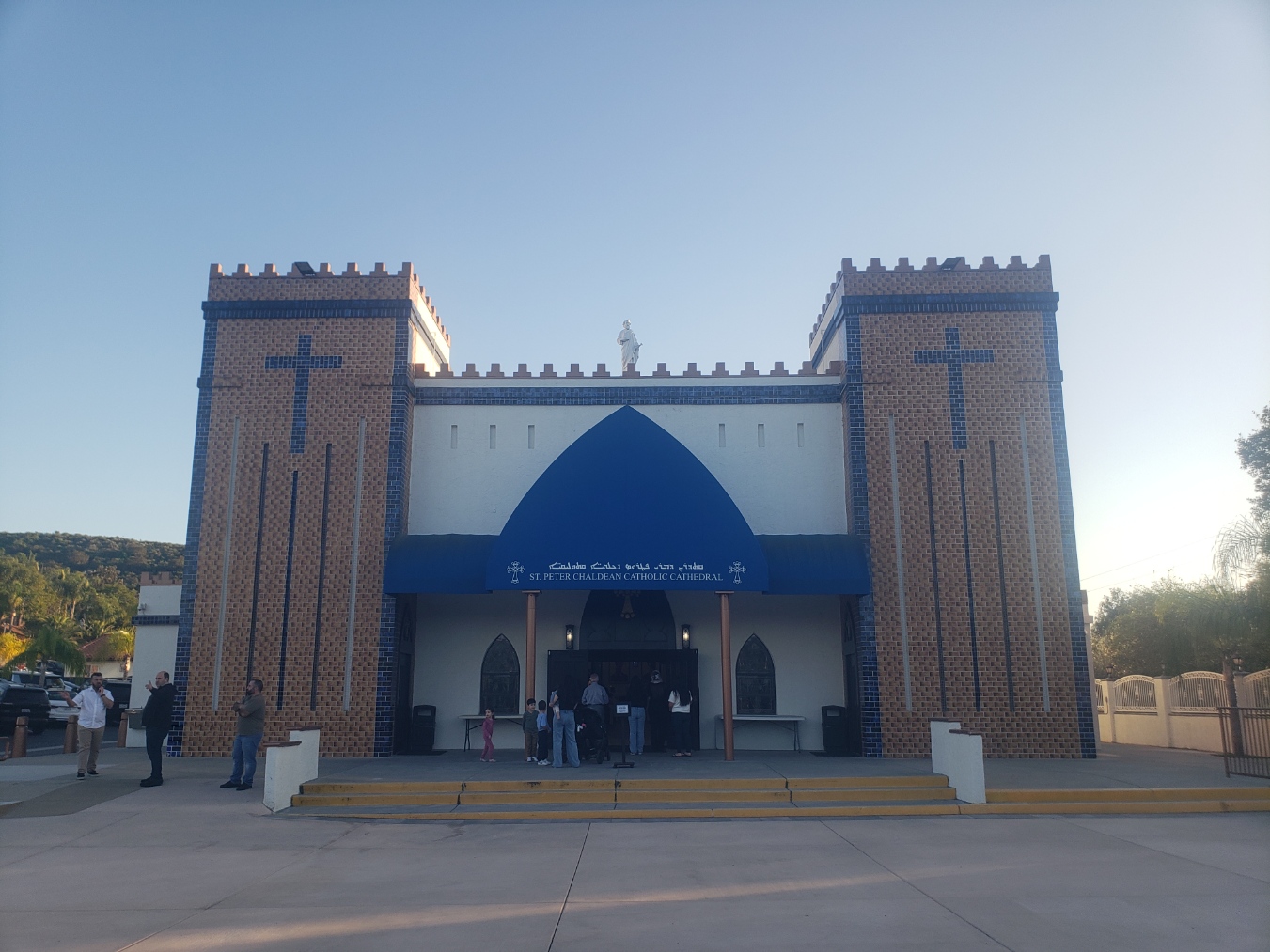
St. Peter Chaldean Catholic Cathedral (El Cajon, California)
When IS (the Islamic State) seized Mosul and the Nineveh Plains in 2014, thousands of Assyrian and Chaldean Christians fled their ancestral homeland, some ending up in refugee camps, others making their way to the established Chaldean community in El Cajon, California. St. Peter Chaldean Catholic Cathedral raised $650,000 for those refugees that year. The cathedral had been serving El Cajon's Chaldean community since 1973, when a parish was established with Father Peter Kattoula as its first pastor. The building was completed and dedicated in September 1983. It became a cathedral in 2002. What it has always been, before and after those institutional designations, is the spiritual and communal anchor for a community that has come to El Cajon in waves, from Iraq and from circumstances that make the journey necessary rather than chosen.
Chaldean Catholics and El Cajon
The Chaldean Catholic Church is an Eastern Catholic church in full communion with Rome, using the East Syriac liturgical rite and tracing its origins to the ancient Christian communities of Mesopotamia. Chaldean Catholics have been present in what is now Iraq for nearly two millennia. The community in El Cajon developed over decades as Chaldean and Assyrian immigrants settled in the broad valley east of San Diego, drawn by established networks, affordable housing, and the presence of the community that had preceded them. El Cajon now has one of the largest concentrations of Assyrian and Chaldean people outside the Middle East. The cathedral is the institutional center of that community's religious life.
A Parish Becomes a Cathedral
The parish of St. Peter was established in 1973 with Father Peter Kattoula as its first pastor. A decade later, the congregation had grown enough to build a permanent church, completed and dedicated on September 10, 1983, seating 600 people. The parish's growth reflected the growth of the Chaldean community in El Cajon through the 1970s and 1980s. When the Vatican established the Eparchy of St. Peter the Apostle in 2002 — the first Chaldean Catholic diocese established in the United States specifically to serve the West Coast Chaldean community — the existing church in El Cajon became the cathedral, the bishop's seat. The eparchy covers the western United States and Alaska.
Vandalism and Response
In September 2020, the cathedral was vandalized with contradictory graffiti — messages that targeted the cathedral from multiple ideological directions simultaneously, suggesting opportunistic rather than ideologically coherent vandalism. The incident prompted law enforcement attention and community response. Vandalism targeting religious sites follows a particular pattern: the act damages a community's sense of safety and belonging, the response typically involves both practical repair and public solidarity. The cathedral's position as the visible center of the Chaldean community in El Cajon made it a notable target, whatever the motivations of the individuals involved.
A Community's Anchor
The $650,000 raised in 2014 for Christian refugees from Mosul and the Nineveh Plains represents the cathedral functioning as what cathedrals have functioned as throughout history: a point of organized communal response to crisis. The Chaldean community in El Cajon had personal connections to the people being displaced — families, former neighbors, members of the same ancient church tradition being driven from lands their ancestors had occupied since before the Arab conquest. The fundraising was not abstract charity but an expression of kinship across an ocean and a centuries-old displacement that had just become acute again. The cathedral held the community together for that response, as it does for ordinary Sundays and feast days and the accumulated life of a diaspora far from home.
From the Air
St. Peter Chaldean Catholic Cathedral is located at approximately 32.754°N, 116.924°W in El Cajon, California. The cathedral is in the residential and commercial area west of downtown El Cajon. Gillespie Field (KSEE) is approximately 5 miles to the north. Nearest airports: KSEE (Gillespie Field) 5 miles north, KSAN (San Diego International) 15 miles west. Best viewed at 1,500–2,500 feet MSL while transiting the El Cajon valley.