St. Peter's Basilica
In 1505, Pope Julius II made a decision that would take more than a century to fulfill and split Christianity in half along the way. He ordered the demolition of the original St. Peter's Basilica, a structure Constantine had built over the apostle's tomb in the 4th century, and its replacement with something grander. The new basilica would take 120 years, exhaust the talents of a dozen architects including Bramante, Michelangelo, and Maderno, and help trigger the Protestant Reformation when the sale of indulgences to fund its construction provoked Martin Luther's fury. The result is the largest church on Earth.
The Bones Beneath
The site's significance predates any building. According to Catholic tradition, the apostle Peter was crucified upside-down in Nero's Circus around 64 AD and buried nearby on the Vatican Hill. Emperor Constantine built the first basilica over the presumed burial site in the early 4th century, and for twelve hundred years that church served as the heart of Western Christendom. By the 15th century, the old basilica was crumbling. Pope Nicholas V began repairs, but it was Julius II who decided that nothing short of total replacement would suffice. His motives were not entirely spiritual: Julius was planning his own monumental tomb, to be sculpted by Michelangelo and housed within the new church. The old basilica came down, and the bones of Saint Peter remained in the ground beneath the construction.
A Parade of Architects
The story of St. Peter's construction is a relay race of architects, each inheriting the unfinished vision of the last. Donato Bramante drew the original plan in 1506: a Greek cross with a massive central dome. He died in 1514 with only the four main piers completed. Raphael succeeded him, shifting the design toward a Latin cross, but died six years later with little built. A succession of architects followed, each adjusting the plans. Then in 1547, Michelangelo took charge at age 72, refusing any salary. He returned to Bramante's centralized plan, simplified it, and designed the dome that would define Roman skylines for centuries. He died in 1564 without seeing the dome completed. Giacomo della Porta and Domenico Fontana finished it in 1590, raising it slightly taller than Michelangelo intended. Carlo Maderno finally extended the nave into a Latin cross and added the controversial facade, completed in 1612. The basilica was consecrated in 1626.
The Dome That Taught the World
Michelangelo's dome rises 136 meters above the basilica floor, its double-shell construction spanning 42 meters in diameter. It was the tallest dome in the world when completed and remains among the most recognizable silhouettes in architecture. The design drew on Brunelleschi's dome in Florence, which Michelangelo studied carefully, but exceeded it in height and visual drama. Sixteen ribs rise from paired columns on the drum to converge at the lantern, creating a vertical thrust that makes the massive structure appear to lift rather than press down. The interior is covered in gold mosaic, and the Latin inscription around the base reads, in letters nearly two meters tall, the words of Christ to Peter: "You are Peter, and on this rock I will build my church." The dome became the model for countless churches and secular buildings, from St. Paul's Cathedral in London to the United States Capitol.
What Lies Within
St. Peter's houses over 100 tombs. Ninety-one popes rest here, along with Holy Roman Emperor Otto II, Queen Christina of Sweden, who abdicated her throne to convert to Catholicism, and the composer Giovanni Pierluigi da Palestrina. Bernini's bronze baldachin rises 29 meters above the papal altar, its twisted columns framing the space directly above Peter's tomb. The basilica's art collection is staggering: Michelangelo's Pieta, carved when he was just 24, depicts Mary holding the body of Christ with a composure that belies the sculpture's emotional weight. It is the only work Michelangelo ever signed, reportedly after overhearing someone attribute it to another sculptor. The facade is 114.69 meters wide and 45.55 meters high, surmounted by thirteen statues: Christ flanked by eleven apostles and John the Baptist.
The Square and the Spectacle
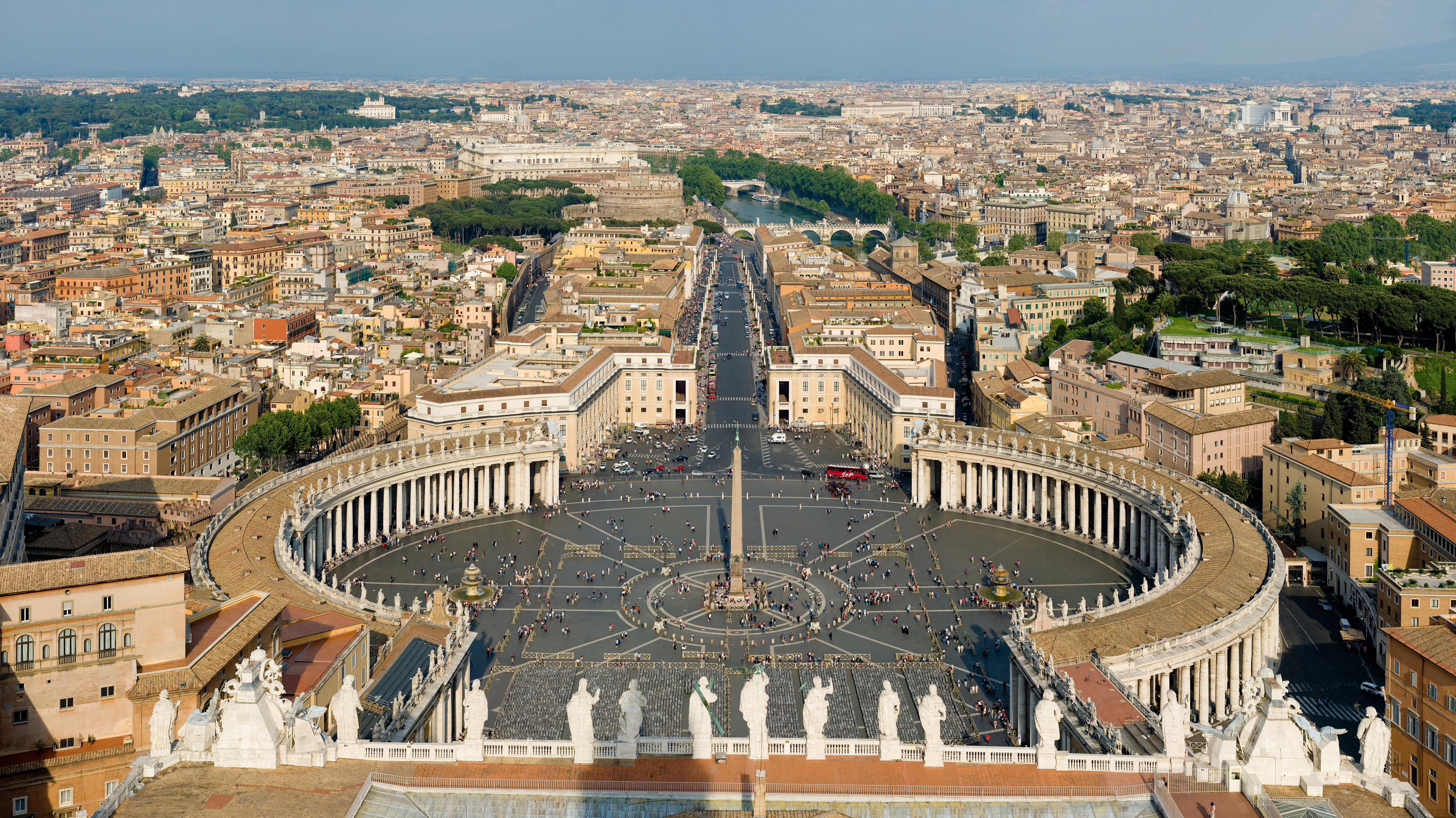
Bernini's colonnade wraps around St. Peter's Square in two sweeping arcs, 284 columns four rows deep, topped by 140 statues of saints. Bernini described the colonnade as the motherly arms of the Church reaching out to embrace the faithful. The elliptical piazza can hold 300,000 people, and it fills for papal audiences, Easter Mass, and the announcement of a new pope. When white smoke rises from the Sistine Chapel chimney, the crowd's eyes shift to the central balcony of the basilica, where the new pontiff will appear for the first time. The building that Julius II imagined as a monument to his own glory became something larger than any single ego. It is a working church, the ceremonial center of a faith practiced by over a billion people, and a monument to 120 years of human ambition, genius, and stubbornness.
From the Air
St. Peter's Basilica (41.902N, 12.453E) is the centerpiece of Vatican City, its dome the most prominent landmark in Rome's western skyline. The elliptical St. Peter's Square extends east from the facade. Castel Sant'Angelo is 600 meters to the east along the Tiber. Rome Fiumicino Airport (LIRF) is 28km southwest; Ciampino (LIRA) is 16km southeast. The dome is visible from considerable distance in clear conditions.