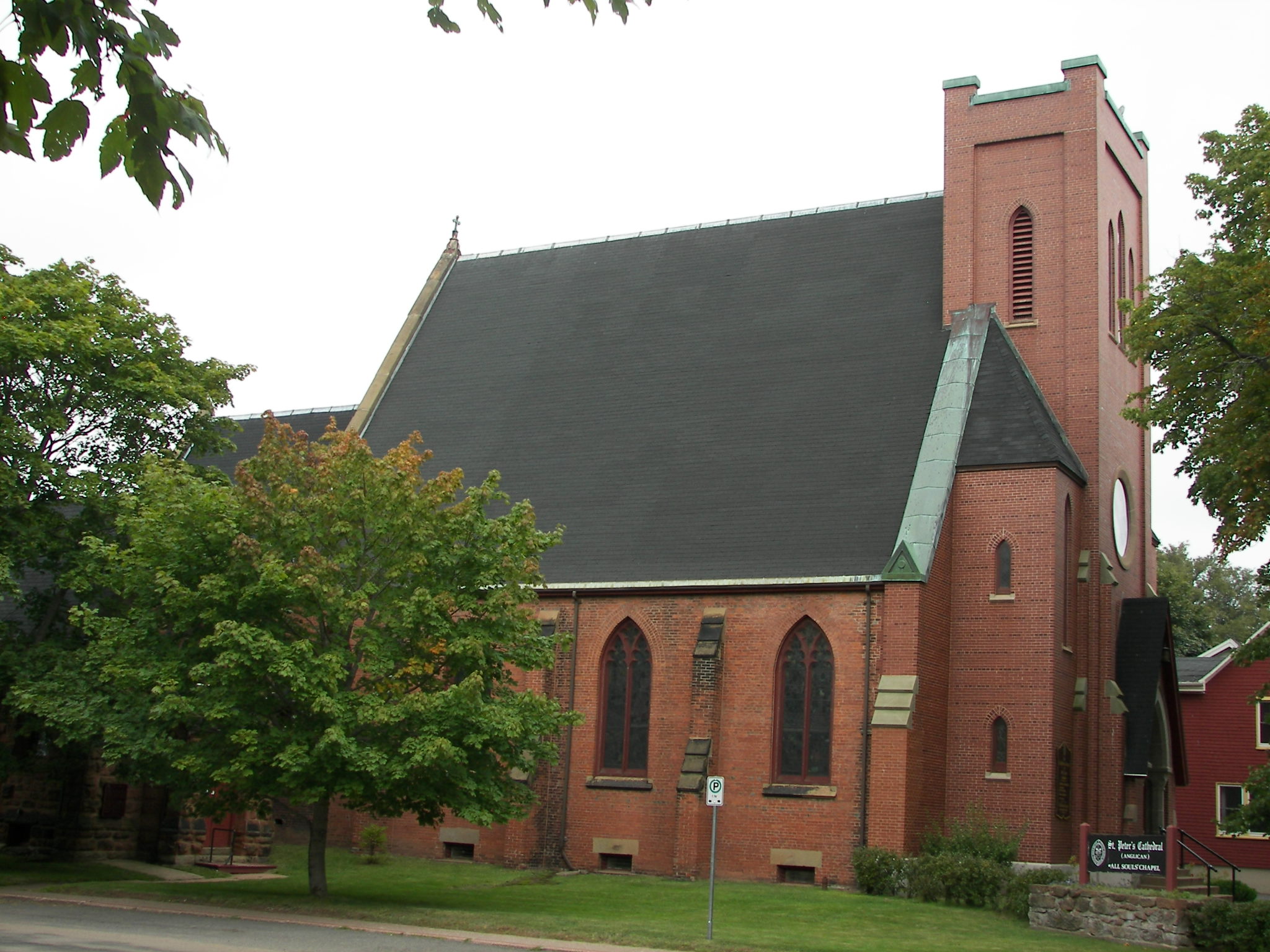
St. Peter's Cathedral (Charlottetown)
Two brothers made a chapel into something extraordinary. William Critchlow Harris designed it, choosing Island sandstone for the exterior and a great arch carved from grey Wallace freestone shipped across the Northumberland Strait. Robert Harris, his brother and one of Canada's most prominent artists, painted 18 works for the interior -- Church Fathers, New Testament scenes, family portraits disguised as Biblical figures, and a majestic circular painting of the Ascending Christ above the altar. Together they transformed a memorial chapel attached to a modest Charlottetown cathedral into a space that earned designation as a National Historic Site in 1990.
Born of the Oxford Movement
St. Peter's Cathedral exists because Charlottetown businessmen travelled to England in the 1850s and came home changed. The Oxford Movement -- a theological revival of Catholic tradition within Anglicanism that had been reshaping English churches since the 1830s -- captivated these Anglican travellers from the Parish of Charlotte. They returned to Prince Edward Island determined to bring its teachings and liturgical practices to their own community. In Bishop Hibbert Binney of the Diocese of Nova Scotia, they found a sympathetic leader. What had been planned as a simple chapel-of-ease for St. Paul's Church became, under Binney's direction, something more ambitious: a cathedral under his own control. Construction began in 1867, and the first services were held on June 13, 1869. Ten years later, on the Festival of St. Peter and St. Paul, the cathedral was formally consecrated.
The Harris Brothers' Chapel
All Souls' Chapel was conceived as a memorial to Father George Hodgson, the cathedral's first priest-incumbent, who served from 1869 to 1885. His successor, Canon James Simpson, joined with the Harris brothers to envision something that would honour Hodgson while transcending the usual memorial. William, who had been among the first class confirmed at St. Peter's in 1869, designed the structure; construction began in 1888, and it opened for worship in November 1889. Robert adorned every available surface. The sanctuary contains three roundels painted into the altar front showing the Crucifixion, Christ at Emmaus, and Christ administering the chalice. The reredos holds statues of Christ flanked by apostles in arched niches. High on the side walls, portraits of St. Luke and St. James the Just serve as memorials to Robert Harris himself and Canon Simpson.
Portraits Hidden in Plain Sight
Robert Harris wove the personal into the sacred throughout the chapel. On the epistle side, a group portrait titled "The Harris Family" shows deceased family members posed as a Holy Land family being blessed by Christ. His mother Sarah Stretch Harris sits at the centre, surrounded by children and grandchildren who died before 1914. The family patriarch, William Critchlow Harris senior, sits back in the shadows -- he had brought the entire family from Liverpool to Charlottetown aboard the barque Isabel in 1856. In another painting, Thomas Harris, the eldest brother, appears as St. Andrew being called by Christ. Even the trees in nearby Rochford Square, planted in 1884, were assigned to individual Harris family members. The chapel is not merely a sacred space but a family portrait gallery rendered in the language of scripture.
Stone, Glass, and Craftsmanship
The great arch separating the sanctuary from the nave was carved from grey Wallace freestone quarried on the Nova Scotia side of the Northumberland Strait. William Harris modelled it after the triumphal arches of fourth-century Roman churches, richly carved with foliage and teardrops symbolizing both the life Christ gives and the sorrows he suffered. The nave windows include work by Kemp and a window from the William Morris Studio showing Christ as Christus Rex -- Christ the King. The woodwork throughout was carved by Messrs Whitlock and Doull, and Lowe Brothers of Charlottetown built the structure. Fine imported encaustic tiles line the upper walls. Every element was crafted by Island artisans or sourced from across the Maritimes, making the chapel a concentrated expression of regional skill and devotion.
A Living Parish
St. Peter's has had only nine rectors since its founding in 1869, each serving long tenures that give the cathedral an unusual continuity. The Anglo-Catholic tradition on which it was founded persists: daily Morning Prayer and Evening Prayer, weekly celebrations of the Holy Eucharist, and the use of the Canadian Book of Common Prayer and The English Hymnal. The kneelers, stitched by women of the congregation, bear the image of the phoenix -- a symbol of resurrection. On the organ sits a Book of Remembrance listing the names of deceased parishioners. The cathedral and its chapel remain both tourist destination and working parish, a place where the art on the walls is not behind glass but part of a daily rhythm of worship that has continued, largely unbroken, for more than 150 years.
From the Air
Located at 46.234N, 63.133W on Rochford Square in Charlottetown, Prince Edward Island. The cathedral faces the square at the corner of All Souls' Lane and Rochford Street, across from the Prince Edward Island Government offices. Not a large structure from the air, but identifiable by its proximity to Rochford Square's green space. Nearest airport is Charlottetown Airport (CYYG), approximately 5 km north. Best viewed at low altitude over downtown Charlottetown.