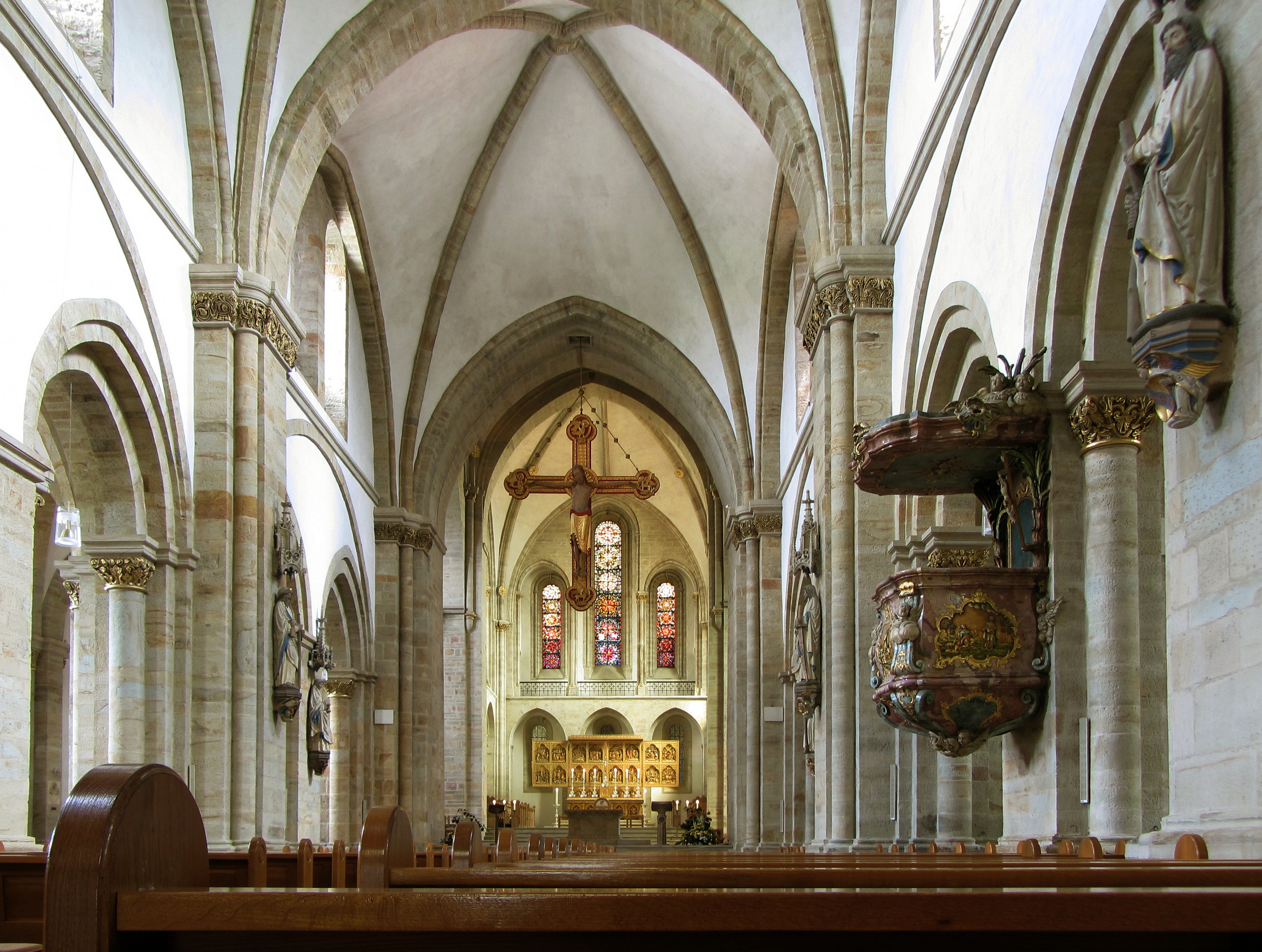
St. Peter's Cathedral, Osnabrück
On October 24, 1648, after five years of meticulous diplomacy across two Westphalian cities, envoys gathered in the cathedral town of Osnabrück to sign a document that would redraw Europe. The Treaty of Westphalia ended the Thirty Years' War, killed off the medieval idea of universal Christian empire, and invented the modern concept of state sovereignty - and St. Peter's Cathedral stood, as it had since the 8th century, presiding over the city whose name became attached to one half of that treaty: the Instrumentum Pacis Osnabrugensis.
Charlemagne's Foundation
The first church on this site went up in 785, only fifteen years after Charlemagne carved a diocese out of the freshly Christianized Saxon territories. Then the Normans came through a century later and destroyed it. The present cathedral grew in fits and starts after a fire around 1100, which is why it reads as a layered manuscript rather than a single statement. The Romanesque crossing tower and northern facade speak the earlier vocabulary - thick walls, round arches, weight pressed into stone. The west facade carries the conversation forward into Gothic, where pointed arches lift the weight upward. The dome above the three-aisled nave rises as high as the pillars that support it - an unusual proportion that gives the interior its peculiar, square gravity.
The Year Europe Changed
When the Thirty Years' War began in 1618 as a Bohemian quarrel, no one imagined it would consume a generation. By the time the diplomats arrived in Osnabrück in 1643, perhaps eight million people were dead and German lands lay devastated. The negotiations were split between two cities so the warring confessions could each have their own ground: Catholics talked at Münster, Protestants at Osnabrück. The Lutheran-Catholic settlement signed in Osnabrück - the Instrumentum Pacis Osnabrugensis - gave equal legal standing to Protestant and Catholic estates within the Holy Roman Empire. It also formally recognized Calvinism, ended Spanish claims on the Dutch Republic, and made each prince sovereign within his territory. Historians still argue about whether 1648 invented the modern state. They don't argue about whether the war was finally, irrevocably over.
What Survived
Walk inside today and the oldest survivors are the baptismal font from 1220 and a triumphal cross carved in 1230 - both nearly eight centuries old, both still in liturgical use. Twelve statues by the Münster sculptor Heinrich Brabender depict Christ and the Apostles, and a broken rood screen from 1664 has somehow endured. The cloister to the south of the nave has cushion capitals matching those of the lost west choir of 1140 - small architectural rhymes across the centuries. During the Second World War, that same cloister, walled off from its courtyard, became an air raid shelter. Above it, incendiary bombs destroyed the baroque domes and several annexes. The Osnabrück Wheel, the great iron clock face on the larger southwest tower, crashed to the ground on September 13, 1944. The Germans pulled it from the rubble after the war and re-erected it at the cathedral's side, where it stands today like a survivor's medal.
The Bells of 1954
When the cathedral rebuilt itself in the postwar years, the Bochumer Verein cast a new ring of six steel bells - the largest, Maria Immaculata, weighs five tons. The smaller five carry names that read like a roster of the diocese's saints and patrons: Petrus, Crispinus and Crispinianus, Wiho, Gosbert, and Adolf von Tecklenburg. They ring in the experimental V7 shape developed at Bochum, the same disposition used at Paderborn Cathedral. There is a particular sound to cast steel bells - cleaner and more bell-like than cast iron, with longer decay than bronze. When the full ring sounds across Osnabrück's old town, it carries the same notes pilgrims would have heard arriving for the 1648 negotiations, even though every actual bell is younger than the diplomats' grandchildren.
From the Air
52.28°N, 8.04°E. The cathedral dominates Osnabrück's old town skyline from cruising altitude in clear weather - look for the distinctive Romanesque crossing tower and twin western towers rising above the Altstadt. Nearest airport: Münster Osnabrück International (FMO/EDDG), about 35 km southwest. Hannover (HAJ/EDDV) is roughly 130 km east. Best viewing on clear afternoons when the sun lights the sandstone from the west.