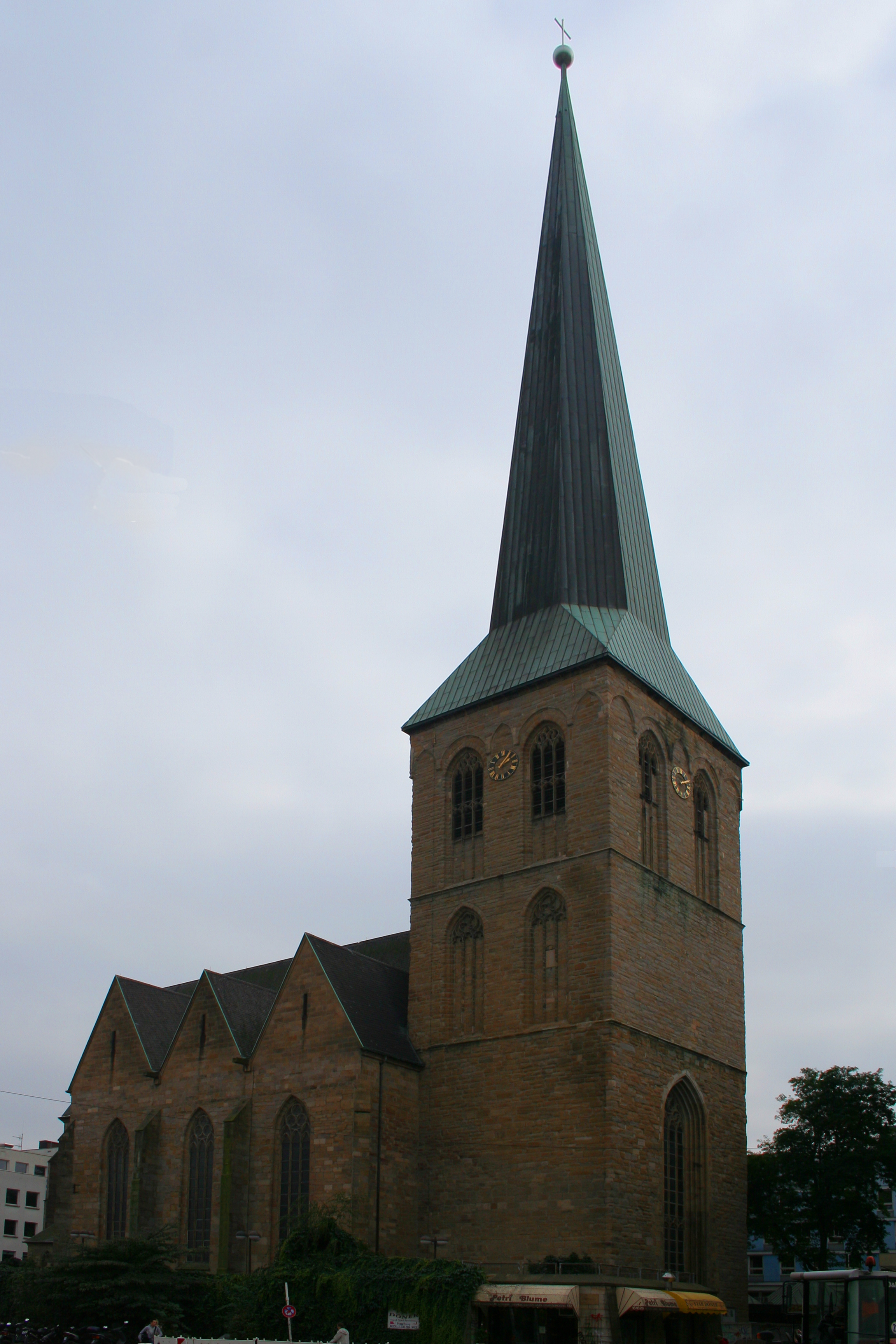
St. Peter's Church, Dortmund
Six hundred and thirty-three. That is the count, verified again every time the altar is restored: 633 separate carved figures, each one gilded, each one telling part of one continuous narrative. They are pressed together across thirty scenes inside a winged wooden cabinet barely larger than a small bedroom. The figures were carved in Antwerp in 1521. They have survived a tower collapse in 1752, the Reformation, four centuries of Westphalian winters, and the night in 1945 when the church around them burned. Westphalians have a name for what stands in the choir of St. Peter's, Dortmund. They call it the Goldene Wunder, the Golden Miracle.
The Quiet Sister Church
St. Peter's, the Petrikirche, is one of three medieval churches strung along the Westenhellweg, the salt-trade road that has bisected Dortmund's centre since the Hanseatic era. Its better-known siblings, St. Reinold's and the Marienkirche, draw more attention. The Petrikirche prefers to be modest from the outside, a three-bay hall church of light sandstone begun in 1322. Westphalian hall-church design fascinates architectural historians for a particular reason: the central nave and the side aisles all reach the same height, and St. Peter's comes closer to that ideal than almost any surviving example. The plan is nearly square, the chancel unusually short, the proportions disciplined. Outside, a row of small pointed gables marches across the transverse roofs. Inside, the eye is pulled instantly forward.
An Altar Made in Antwerp
The Goldenes Wunder is a late Gothic winged altarpiece, an Antwerp retable in the technical phrase, dated 1521. It is not a Westphalian work. Antwerp in the early sixteenth century was the great export workshop of carved altarpieces for northern Europe, and Dortmund, still a wealthy Hanseatic city, could afford the finest of them. Closed, the altar shows the adoration of the Eucharist. Opened once, 36 detailed images come into view. Opened fully, into its feast-day configuration, the altar presents thirty compartments holding 633 gilded oak figures, an entire Passion sequence and Easter cycle rendered in shimmering carved relief. A non-profit association, Das Goldene Wunder in St. Petri eV, exists for the single purpose of raising the money to keep restoring it. The figures are delicate. The gilt flakes. Donors are essential.
The Tower That Argued With Reinold's
For two centuries Dortmund hosted a peculiar civic rivalry: who could build the tallest church spire in town. The contestants were the Petrikirche and St. Reinold's, and they took turns winning. In 1752 the Petrikirche's spire collapsed, ending its bid for a long while. The Second World War brought new ruin: the church burned in 1945, and the historic peal of four bronze bells, which had been spared the wartime metal requisitions, was destroyed in the fire. The four bells had been cast across centuries, the earliest in 1497. Today's chime is five cast steel bells, a leaner, more modern sound. The tower itself stood truncated for decades after the war. Only on 17 November 1981 was the spire restored to its medieval height of about 60 metres, a 15-metre substructure beneath a 48-metre needle topped with globe and cross. Counting the body of the church beneath, the Petrikirche now reaches 105 metres.
The Organ in a Glass Box
The post-war organ was a 17-stop Walcker, a modest instrument that never quite filled the hall. The church spent decades raising money for something better. In 2013 the contract was finally signed, and the solution was unusual: rather than build a new instrument from scratch, Orgelbau Schulte rebuilt a Romantic organ originally constructed in 1868 by the English firm Radcliff and Sagar for St. Mary's, Woodkirk, near Leeds. The Yorkshire church had closed; the organ had to leave Yorkshire. Schulte's workshop in Kurten made new windchests, a new console, a new housing, and on 6 September 2015 the instrument was inaugurated in Dortmund. It stands 7.5 metres high, a 3-by-2-metre cube containing 1,049 pipes, wrapped in gray-glazed birch boards that let visitors see the mechanism inside. The free-standing console connects to the organ by LAN cable. Polarising, the church calls it. Beloved by some. Disliked by others. Now, irreducibly, theirs.
Smaller Congregation, Same Walls
On 1 July 2007 the St. Petri parish merged with the Nicolai and Martin parishes to form a combined Evangelical congregation of about 9,000 members. Fewer Westphalians attend church than once did, and three smaller congregations could no longer sustain three full parishes. The merged community still gathers under the Petrikirche's pointed gables, beneath the carved oak figures that have watched five centuries of services. The church and its historic fountain are protected monuments on the city of Dortmund's list. Eight pfennigs in 882 paid for the first mention of Dortmund. A few centuries of Hanseatic prosperity bought 633 gilded figures from Antwerp. They are still here.
From the Air
St. Peter's Church sits at 51.5147 degrees north, 7.4603 degrees east, in the historic Westenhellweg corridor of Dortmund's old town. The 60-metre spire is one of the easiest church towers to identify in the central skyline, alongside Reinoldikirche and the Marienkirche. Dortmund Airport (EDLW / DTM) is 13 km east; Dusseldorf International (EDDL / DUS) is 60 km southwest. Recommended viewing altitude 800 to 1,500 metres.