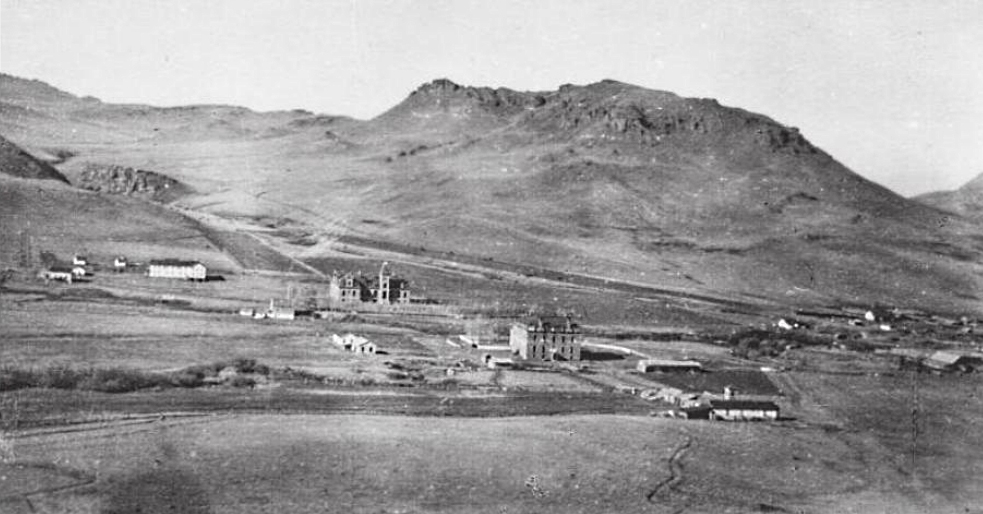
A view of St. Peter's Mission on Birch Creek (now Mission Creek) west of Cascade, Montana, in the United States.  This photograph was taken prior to 1908.
Identifiable structures include the two-story wood frame boys' school (left), the Ursuline stone convent and school (center left), the opera house (center right), and original wood frame girls' school (center right low, with tower).
Catholic Jesuit priests established St. Peter Mission in 1860 on the Sun River about 8 miles (13 km) upriver from Fort Shaw, Montana. They moved the mission 2 miles (3.2 km) downstream in 1862, but this location proved difficult for agriculture. In April 1866 the mission moved again, this time to a position 2 miles (3.2 km) south Bird Tail Rock (which is 15 miles (24 km) south of the town of Simms, Montana). The mission closed almost immediately due to hostility from a nearby Native American tribe, the Piegan Blackfeet, but reopened in 1874. The mission moved again in 1881 to Birch Creek (a point 10.5 miles (16.9 km) west-northwest of Cascade, Montana). The 1881 location is depicted here. At some point between 1874 and 1881, the Jesuits built a wood frame structure to house a school for boys.
In January 1884, the new (and founding) Bishop of the Roman Catholic Diocese of Helena, Jean-Baptiste Brondel, invited the Ursuline religious order of women to join the Jesuits at St. Peter's Mission and assist them in educating the Native Americans. Five Ursuline sisters arrived in October 1884. In 1885, they built several log cabins and a wood frame structure that contained a chapel and classrooms for girls. This structure also had a two-and-a-half story bell tower. The Ursulines built a three-story stone building with basement beginning in 1892, into which the girls' school moved in 1896. This structure was funded by donations from the future Saint, Katharine Drexel, a Philadelphia, Pennsylvania, heiress. This building also served as the nuns' convent. Over time, the Jesuits and Ursulines built a bakery, barn, corral, laundry, and workers' housing. The Ursulines—who believed in music and art training as well as education in reading, math, and science—also built an opera house at St. Peter's in 1896. The Jesuits stopped educating boys, turning that function over to the nuns.
The boys' school closed in 1896, and fire destroyed it in 1908. The Ursulines moved their school into nearby Great Falls, Montana, in 1912. Fire destroyed the stone convent/school and the girls' wood frame school in 1918. St. Peter's was largely abandoned afterward.

The ruins of St. Peter's Mission remained a popular tourist spot for many decades. As of 2010, only the foundations of a few structures remained at St. Peter's.
A view of St. Peter's Mission on Birch Creek (now Mission Creek) west of Cascade, Montana, in the United States. This photograph was taken prior to 1908. Identifiable structures include the two-story wood frame boys' school (left), the Ursuline stone convent and school (center left), the opera house (center right), and original wood frame girls' school (center right low, with tower). Catholic Jesuit priests established St. Peter Mission in 1860 on the Sun River about 8 miles (13 km) upriver from Fort Shaw, Montana. They moved the mission 2 miles (3.2 km) downstream in 1862, but this location proved difficult for agriculture. In April 1866 the mission moved again, this time to a position 2 miles (3.2 km) south Bird Tail Rock (which is 15 miles (24 km) south of the town of Simms, Montana). The mission closed almost immediately due to hostility from a nearby Native American tribe, the Piegan Blackfeet, but reopened in 1874. The mission moved again in 1881 to Birch Creek (a point 10.5 miles (16.9 km) west-northwest of Cascade, Montana). The 1881 location is depicted here. At some point between 1874 and 1881, the Jesuits built a wood frame structure to house a school for boys. In January 1884, the new (and founding) Bishop of the Roman Catholic Diocese of Helena, Jean-Baptiste Brondel, invited the Ursuline religious order of women to join the Jesuits at St. Peter's Mission and assist them in educating the Native Americans. Five Ursuline sisters arrived in October 1884. In 1885, they built several log cabins and a wood frame structure that contained a chapel and classrooms for girls. This structure also had a two-and-a-half story bell tower. The Ursulines built a three-story stone building with basement beginning in 1892, into which the girls' school moved in 1896. This structure was funded by donations from the future Saint, Katharine Drexel, a Philadelphia, Pennsylvania, heiress. This building also served as the nuns' convent. Over time, the Jesuits and Ursulines built a bakery, barn, corral, laundry, and workers' housing. The Ursulines—who believed in music and art training as well as education in reading, math, and science—also built an opera house at St. Peter's in 1896. The Jesuits stopped educating boys, turning that function over to the nuns. The boys' school closed in 1896, and fire destroyed it in 1908. The Ursulines moved their school into nearby Great Falls, Montana, in 1912. Fire destroyed the stone convent/school and the girls' wood frame school in 1918. St. Peter's was largely abandoned afterward. The ruins of St. Peter's Mission remained a popular tourist spot for many decades. As of 2010, only the foundations of a few structures remained at St. Peter's.

St. Peter's Mission

religious-sitehistorymontananative-american-history
4 min read

Mary Fields cursed, smoked cigars, drank whiskey, carried a loaded pistol, and once fought a duel with a man who insulted her in Helena. She was also, in 1895, helping run a Catholic mission for Native American children in the Montana wilderness. The story of St. Peter's Mission - a collection of log cabins, stone schools, and a wooden 'opera house' on Birch Creek west of Cascade - is filled with such contradictions. Here, Jesuit priests who had traveled with nomadic Blackfeet bands built boarding schools. Ursuline nuns from Ohio established themselves on the frontier. Louis Riel, the Metis leader who would later be hanged as a traitor in Canada, taught mathematics to children. And the woman they called 'Stagecoach Mary,' an African American former slave, became an unlikely fixture of mission life.

The Wandering Mission

St. Peter's Mission had no fixed address for its first two decades. The Jesuits established it in 1859 at Priest Butte on the Teton River, near present-day Choteau. When a local herder was killed by Blackfeet within sight of the mission in April 1860, the priests moved downstream. They kept moving - following the shrinking borders of the Blackfeet Indian Reservation as the federal government forced the tribe to cede more land. By 1877, the mission consisted of just two one-room log cabins, one doubling as a church. The priests spent most summers traveling with nomadic Blackfeet bands across the plains. In 1881, the mission finally settled at its permanent location on Birch Creek, where soldiers from nearby Fort Shaw helped the priests build a log chapel that doubled as sleeping quarters.

The Ursulines Arrive

Bishop Jean-Baptiste Brondel invited the Ursuline order to join the Jesuits at St. Peter's in January 1884. Mother Mary Amadeus, born Sarah Therese Dunne in Ohio, led five nuns to Montana that October. The Jesuits gave them $200 in provisions, some cows, wagons, and a farm - and a promise of $200 per year if they would teach the boys. The nuns quickly established a girls' boarding school. When Mother Amadeus fell gravely ill with pneumonia in April 1885, word reached the Ursuline convent in Toledo. Mary Fields, a former slave who had worked for the Dunne family, accompanied Mother Stanislaus to Montana to nurse her friend. Fields stayed, becoming indispensable to mission operations despite - or perhaps because of - her unconventional ways.

Louis Riel's Brief Refuge

In 1883, Father Joseph Damiani offered a teaching position to a controversial figure: Louis Riel, the Metis leader who had led resistance movements against Canadian expansion. Riel, his wife Marguerite, and their son Jean-Louis had been living with nomadic Metis bands. With Marguerite pregnant, Riel decided to settle down. From December 1883, he taught English, French, mathematics, and practical skills - wood carving, metalworking, leather making - to 22 to 25 Metis boys at St. Peter's. The student body soon changed as A'aninin and Piegan Blackfeet boarding students arrived in growing numbers. Riel would leave St. Peter's to lead the Northwest Rebellion in Canada, for which he was executed in 1885.

Rise and Fall

The mission grew into an impressive complex. A four-story stone boys' school with a mansard roof rose in 1887. Philadelphia heiress Katharine Drexel - later canonized as a saint - donated $5,000 for a three-story stone convent completed in 1892. An 'opera house' for musical performances opened in 1896. But federal funding cuts forced the Jesuits to abandon St. Peter's in 1898. The Ursulines continued alone until a fire in January 1908 destroyed the boys' school, priests' residence, and several outbuildings. A second fire in November 1918 consumed the girls' school, ending the mission's educational work. Today, the expanded chapel and the red wooden opera house - now used as a barn - still stand on private ranch land. The cemetery lies uphill behind the chapel, surrounded by a buck fence to keep cattle away, its graves marked by tall monuments, ornate iron fences, and headstones hidden in the high grass.

From the Air

St. Peter's Mission is located at 47.30°N, 111.92°W on private ranch land approximately 10 miles west-northwest of Cascade, Montana. The site is visible from 2,000-3,000 feet AGL along the Mission Road/Simms-Cascade Road corridor. Look for the chapel and red barn-like opera house south of the road. The cemetery is uphill from the main buildings. Great Falls International Airport (KGTF) lies 25nm to the northeast. The Sun River valley provides clear visual reference. Note that the site is on private property - the Klinker Ranch - with limited access.