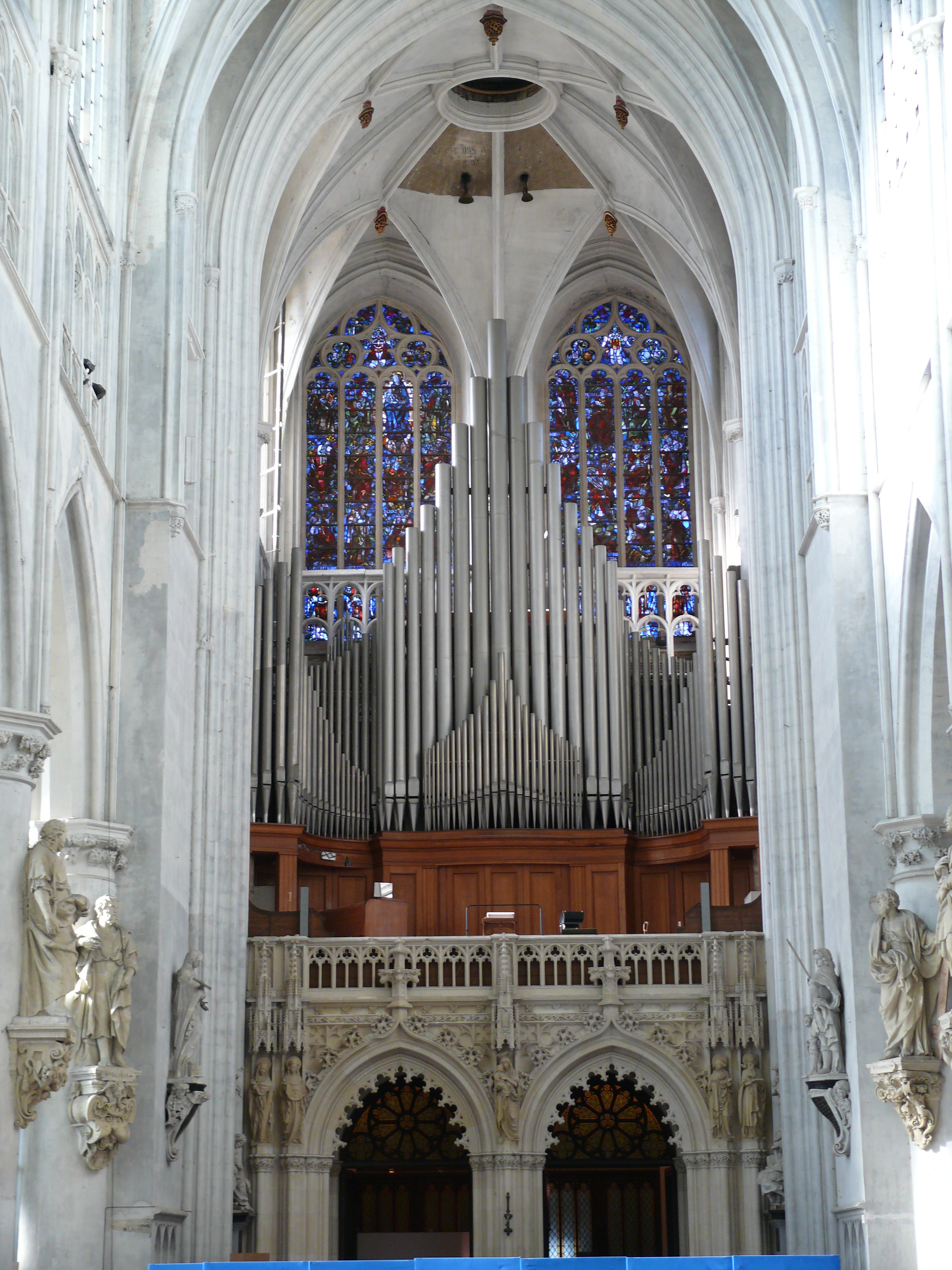
St. Rumbold's Cathedral
Look at an engraving by Wenceslaus Hollar from 1649. It shows a slender Gothic spire rising 167 meters above Mechelen, captioned in Latin: the most elegant tower of St. Rumbold. The drawing is fiction. The tower was designed to look like that, and the design hangs on a wall in the cathedral archives, but the construction stopped in 1520 at ninety-seven meters with only seven meters of the intended seventy-seven-meter spire built. A flat top was laid down as a temporary cap. Five hundred years later it is still temporary. Pilgrims paid for the first phase. The city paid for the second. The money ran out at the third. What stands today is one of the strangest skylines in Europe: a tower that looks unfinished because it is.
Two and a Half Centuries of Building
Construction began shortly after 1200, on wetlands at the edge of what was then a small market town. The choir was consecrated in 1312, when worship could begin in part of the building. After a city fire in 1342, the master mason Jean d'Oisy took over and developed what would become the prototype for Brabantine Gothic, distinct from the French style that dominated north of the Alps. His flying buttresses were heavier, his window tracery denser, his interior columns thicker, with sculpted cabbage-leaf ornaments around each capital. He died in 1375 with the nave still rising. His successors finished the nave vaults in 1437 and the choir vaults in 1451. Then they started on the tower. The tower took another seventy years and was never completed. The whole building, from foundation to abandoned cap, spans 320 years of construction.
Why It Stopped at Ninety-Seven Meters
The chief architect Andries Keldermans understood the engineering problem. Heavy stone towers built on wetland foundations tend to sag or lean over time. In 1454 he started a separate project at Zierikzee in the present-day Netherlands, where the Sint-Lievensmonstertoren was built completely detached from its church, so that any settlement of the tower would not crack the nave. He applied the same principle at Mechelen, where the connection between tower and church was deliberately weakened so the two structures could move independently. Both towers stopped short of their original heights. Both stopped for the same reason: not engineering, money. Stone construction at that scale required pilgrim donations and civic funds at a level that simply could not be sustained into a third century. In 2005, engineers were asked whether modern construction could complete the original 1520 spire. They concluded it could. The city decided not to.
The Moon Extinguishers
Every Flemish town has a nickname for its citizens. In Mechelen they are called Maneblussers, Moon Extinguishers. The story goes that one night in 1687 someone saw an orange glow flickering behind the perpendicular Gothic windows of St. Rumbold's tower and rang the fire alarm. A bucket brigade formed up the 514 steps of the tower, hundreds of citizens passing water hand to hand, until they reached the top and discovered the glow was moonlight breaking through fast-moving clouds. The story was retold so often, by neighbors and rivals from Antwerp and Brussels, that the name stuck. The Mechelen tourist office has long since embraced it. There is a Maneblusser beer brewed at the Het Anker brewery a few blocks from the cathedral, and the city celebrates Maneblusser Day in October. The fire was the moon. The fire brigade was real.
What the Bells Do
The tower contains forty-nine bells. The six largest still swing on ropes, in working order; the rest are fixed in place and struck by the carillon mechanism. The bourdon, named Salvator, weighs eight tons and strikes the hours. It was cast in the seventeenth century and has rung continuously since. Above the swinging bells, thirty-nine more steps up, is a second complete carillon used for the summer concerts and for the recitals of the Royal Carillon School. The carillonneurs come from around the world to play these bells. Pope John Paul II climbed the tower on his sixty-fifth birthday in 1985 and met Jo Haazen, then the city carillonneur. According to Haazen, the pope looked up at the flat top and said simply: your tower is not complete. The pope was right. He was also five hundred years too late to do anything about it.
From the Air
Located at 51.03N, 4.48E in central Mechelen, Belgium. St. Rumbold's tower at 97.28 meters is the most prominent landmark in the entire region, visible from cruising altitude and dominant from any direction at lower altitudes. The flat-topped silhouette is unmistakable; no other church tower in Belgium looks like it. Brussels Airport (EBBR) is 15 km south, Antwerp (EBAW) 18 km north. Recommended viewing altitude 2,000 to 5,000 ft for the tower against the medieval center, and to see the river Dijle loop that defines the old city footprint. In clear weather the tower is visible from cockpit height all the way to the Antwerp city skyline.