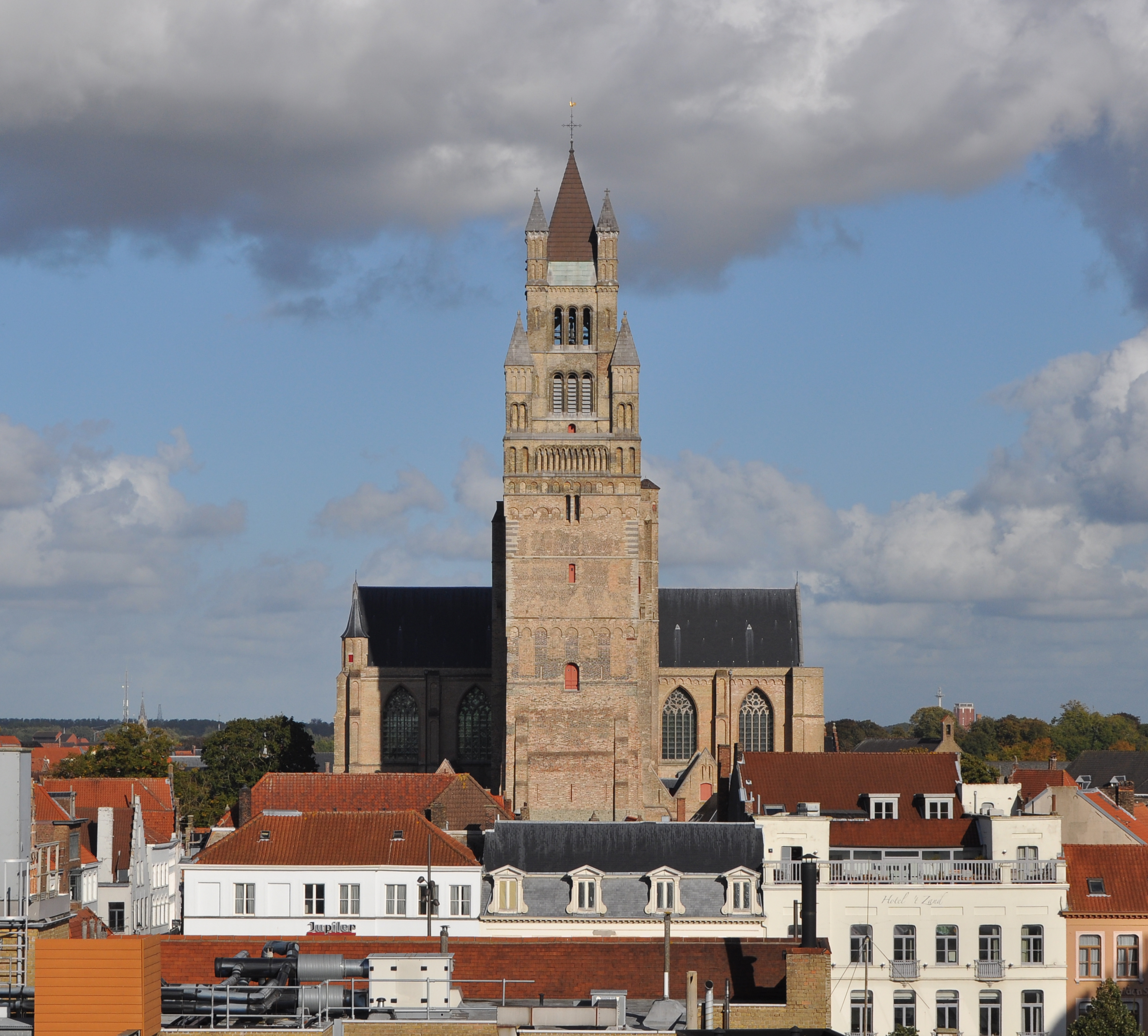
St. Salvator's Cathedral
There are two great church towers in Bruges, and Bruges has been arguing about which one is taller for nearly two hundred years. The Church of Our Lady raised its slim brick spire to 115 metres in the thirteenth century - one of the tallest brick structures in the world. St Salvator, three streets away, sat at a respectable but undeniably smaller 99 metres of squat Romanesque tower. In 1834, when St Salvator was unexpectedly promoted from parish church to cathedral, Bruges decided that something had to be done. The cathedral had to look like a cathedral. The story of how its tower grew - and what got built and rebuilt on top of it - is the story of a Belgian city working out who it wanted to be after independence, and of an English architect who had ideas of his own.
When St Salvator Was Not a Cathedral
For most of its existence, St Salvator's was simply the main parish church of Bruges - large, old and important, but never the seat of a bishop. That distinction belonged to St Donatian's Cathedral, which stood opposite the City Hall on the Burg, the city's old administrative square. Donatian's was the religious heart of Bruges from the tenth century onward. Salvator was the people's church, the brick-and-mortar Sunday parish for the working city. Documents place a church on the Salvator site from the tenth century. Fire took down its first major building in 1116. In 1127 a new Romanesque structure rose on the foundations - the oldest stonework still surviving in the present church belongs to that twelfth-century tower base. In 1250 the masons started over again, this time in the new Gothic style, and the present brick body of St Salvator was largely built over the following century. By the time of the fifteenth-century painters - the era when Van Eyck and Memling were working in the city - it was the long, solid, dependable parish church that everyone knew, and it stood in the literal and figurative shadow of grander neighbours.
The Revolution Comes
Then in 1794 the French Revolutionary armies took Bruges. The diocese of Bruges, founded only in 1559, was suppressed. The bishop was driven out. St Donatian's Cathedral - eight hundred years of accumulated stone, glass, books, plate, art and tombs - was confiscated by the new authorities, deconsecrated, and methodically demolished between 1799 and 1800 for building stone. Where it had stood, the new regime laid out a square. A great deal of Bruges's medieval inheritance went into rubble carts that summer. The city had lost its cathedral. Salvator, the modest parish church on the south side of the inner town, became the largest functioning church left standing inside the walls. In 1815 Belgium passed to the Netherlands. In 1830 Belgium revolted and won independence. In 1834 the diocese of Bruges was restored. There was a new bishop. There was no obvious cathedral. There was St Salvator.
An English Architect with a Romanesque Idea
St Salvator had a problem of presence. As a cathedral it looked too small - smaller, embarrassingly, than the neighbouring Church of Our Lady. Then in 1839, with the question of refit still open, a fire collapsed the roof. The disaster became an opportunity. The diocese commissioned Robert Chantrell, an English architect best known for his neo-Gothic restorations in Yorkshire, to put the building back together and to design a tower that would finally let St Salvator stand up beside its grand neighbour. Chantrell built up onto the twelfth-century stone of the old tower - the oldest surviving part of the church - and proposed something unexpected. Instead of capping his work in fashionable neo-Gothic, he stayed loyal to the Romanesque feel of the older fabric and designed a heavy, fortress-like brick tower, almost windowless near the top, terminating in a flat platform. The total height was 99 metres. Bruges did not love it. The Royal Commission for Monuments thought the flat top looked like an unfinished beer crate, and - without Chantrell's authorisation - had a small spire stuck on top of it. That awkward, slightly cobbled-together silhouette is what you see today.
Inside the 101 Metres
The interior of St Salvator is 101 metres long - longer than the building looks from outside. A great deal of what is in it does not really belong to it. When St Donatian's was demolished in 1799, the bishop's furniture, his paintings, his tapestries and his liturgical art were among the few things saved. They were eventually transferred to St Salvator after it became cathedral. The most striking are eight enormous wall tapestries made in Brussels by Jasper van der Borcht in 1731, commissioned for Donatian's, depicting scenes from the Life of Christ; the cathedral also holds the oil paintings that served as the cartoons for them. A walk down the nave today is, in a sense, also a walk through the surviving fragments of the building that should have been the cathedral. The organ at the west end has a long pedigree of its own. The original instrument was built by Jacobus van Eynde between 1717 and 1719, rebuilt and expanded three times in the twentieth century - by Hooghuys in 1902, by the renowned firm Klais of Bonn in 1935, and by Frans Loncke and zonen in 1988 - and now has 60 stops over three manuals and pedal. Since 1952 the Kathedraalconcerten concert series has filled the long nave with music. The current cathedral organist is Ignace Michiels.
Two Towers Across a Skyline
Stand on the Markt at sunset and the two big towers fight quietly for the sky: the Belfry above the merchant heart of the city, the slim brick spire of Our Lady to the south, and the heavy, fortress-like tower of St Salvator a little farther west, with its small awkward peak that nobody much loves and no one is going to take down. Bruges's medieval skyline is a postcard: the canals, the gables, the swans. The story underneath is more interesting. The cathedral that should be the centrepiece of any Flemish city sits where the parish church used to be, holding the rescued possessions of a vanished older cathedral, topped by a tower designed by an Englishman who refused to do neo-Gothic and finished off by a commission that refused to leave well enough alone. It is the most Belgian building in Bruges: improvised, layered, slightly inelegant, and built to last.
From the Air
Coordinates 51.21 N, 3.22 E - inner city of Bruges, West Flanders. Nearest airports: Ostend-Bruges (EBOS) 23 km west, Ghent (EBGT) 50 km south-east, Brussels (EBBR) 95 km south-east. From altitude Bruges is unmistakable: a near-circular medieval core ringed by the line of the old ramparts, three great towers - the Belfry (Markt), Our Lady's spire (south of centre) and St Salvator's heavier 99 m brick tower (west of centre) - and a tracery of canals. Best viewed in clear weather from 2,500-6,000 feet.