St. Salvator's Church, Utrecht
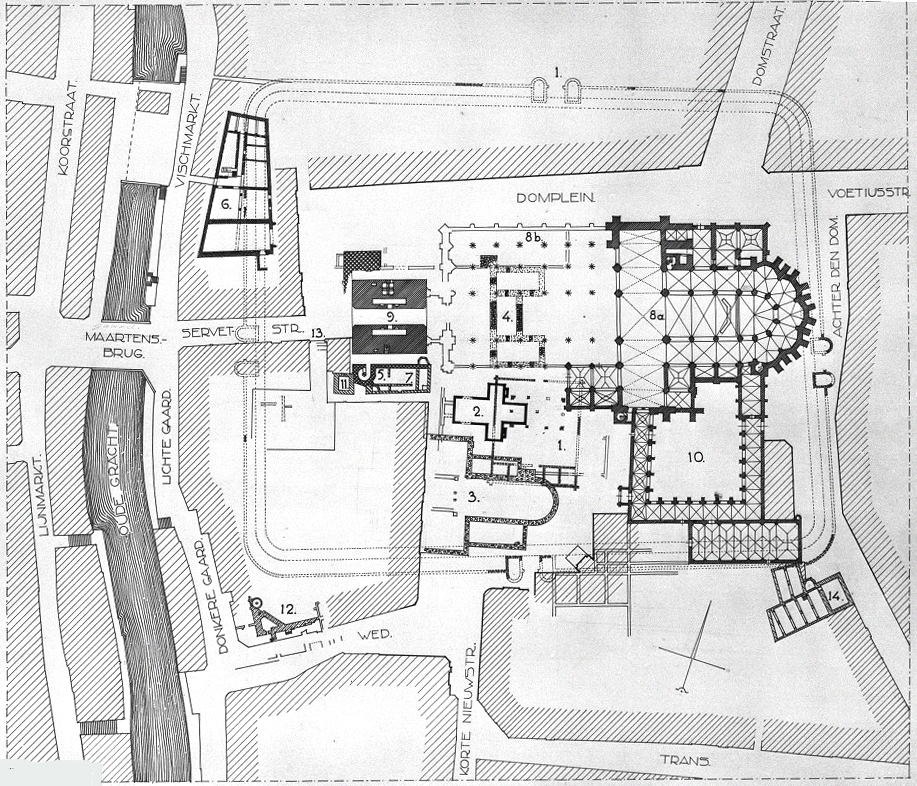
Walk the Domplein in Utrecht and you are walking on top of a church that no longer exists. The outlines in the paving are not decoration. They mark where the walls of the Sint-Salvator once stood, where a deep choir held the bones of bishops, where a tuff-stone basilica with two western towers shouldered into the medieval sky. The church was already a thousand years old when, in 1587, the Dutch Republic outlawed Catholicism. Within months, the wreckers came. By 1588, the church was gone. What remains is a ghost in pavement, a drawing made around 1615 by a Utrecht antiquarian who must have known what he was preserving, and the patient work of archaeologists still piecing the building back together from sarcophagi unearthed during the Second World War.
A Saint Sent From Rome
The church begins with a mission. Around the year 690, an English monk named Willibrord crossed the North Sea with the blessing of Pope Sergius I to evangelize the Frisians. He chose Utrecht as his base, and by 724 the presence of a church here dedicated to Salvator, the Savior, is firmly documented. The naming was deliberate: the mother church of all Catholic Christianity, the Basilica of St. John Lateran in Rome, had originally borne the same dedication. To call your church Salvator was to claim a direct line to Rome itself. For three centuries it served alongside a smaller building nearby, the Holy-Cross chapel, which was probably the original St. Martin's. Together, those two stones formed something rare in northern Europe: a double cathedral, two churches functioning almost as one, with the bishop's seat eventually settling in St. Martin's and leaving Salvator to its own quieter dignity.
Bones Beneath the Floor
By the eleventh century the church had been rebuilt in the grand manner. Bishop Ansfried added a western fortress-front in conscious imitation of Charlemagne's Palatine Chapel at Aachen. Bishop Bernold and his successor William carved away the old eastern annex and replaced it with a transept and a strikingly deep choir, and beneath that choir, a spacious crypt. The depth was the giveaway. This was not just architecture, it was reliquary. The first bishops of Utrecht were buried here, and tradition placed among them Saint Boniface, the Anglo-Saxon missionary martyred at Dokkum in 754. Before the crypt's altar of Saint Stephen lay Bishop Frederick of Utrecht, who was murdered inside this very church in 835. Legend blamed Empress Judith of Bavaria, angered by Frederick's criticisms. The bishop's tomb sat where the assassin had struck. To walk into the Sint-Salvator was to walk among the founders of Christian Utrecht, still present beneath your feet.
Fire, Fire, Reformation
Buildings of stone are not immune to fire. The roof timbers, the wooden fittings, the great rope-hoisted lamps - all of it burned in 1131, and again in 1253. Each time the church rose again, this time in Gothic taste layered over the older Romanesque bones. A school appeared at the south side of the tower, a library beside the choir. The complex grew into a small city of canons, books, and altars. Then came 1580, and the slow, irreversible turning of Utrecht toward the Reformation. Catholicism became illegal in 1587. The Sint-Salvator, the Old Munster of the city, was demolished in the months that followed. Most of its foundations were torn out and carted away. The bones beneath the choir, the centuries of accumulated memory, the stones quarried from German tuff and shaped by medieval masons - all of it scattered or buried.
The Drawing That Saved It
We know what the church looked like only because Aernout van Buchel, a Utrecht antiquarian and humanist, drew it. His map and elevations were made either just before the demolition or, more poignantly, just after, from memory and surviving stubs of wall. In 1592, Canon Jan Mersman wrote a description. Together these two men, working in the smoke of a religious revolution, preserved a building that no one else thought worth saving. Three centuries later, during the German occupation of the Netherlands in World War II, archaeologists dug at the Domplein and found exactly what Van Buchel had promised: limestone sarcophagi on the old church's axis, walls of the eastern annex, the geometry of a grave chapel. The dimensions matched. The drawing had been right.
What You Stand On Now
Today the Domplein is one of the most haunted squares in the Netherlands, in the literal sense that the things which made it the heart of the city are mostly invisible. The Dom Church - St. Martin's, the survivor - still stands on one side, its tower the tallest in the country. The Sint-Salvator is the absence opposite. The paving stones trace the outline of the choir and part of the transept; standing on them you can pace out the deep choir that once held bishops, walk the crossing, find the tower-line of the westwork. The square reads as a memorial to itself. A thousand years of one church, undone in a year, surviving now only as a footprint, a drawing, and the bones still resting beneath the cobblestones of a Dutch city square.
From the Air
St. Salvator's site lies at the heart of Utrecht's old city at 52.0903 N, 5.1217 E, just west of the Dom Tower at the Domplein. From cruising altitude, look for the dense red-roofed historic core of Utrecht, with the prominent Dom Tower as the navigational anchor. Nearest airfield is Amsterdam Schiphol (EHAM), roughly 35 km northwest. Approach pattern from Schiphol passes near the city; clear conditions reveal the medieval street grid.