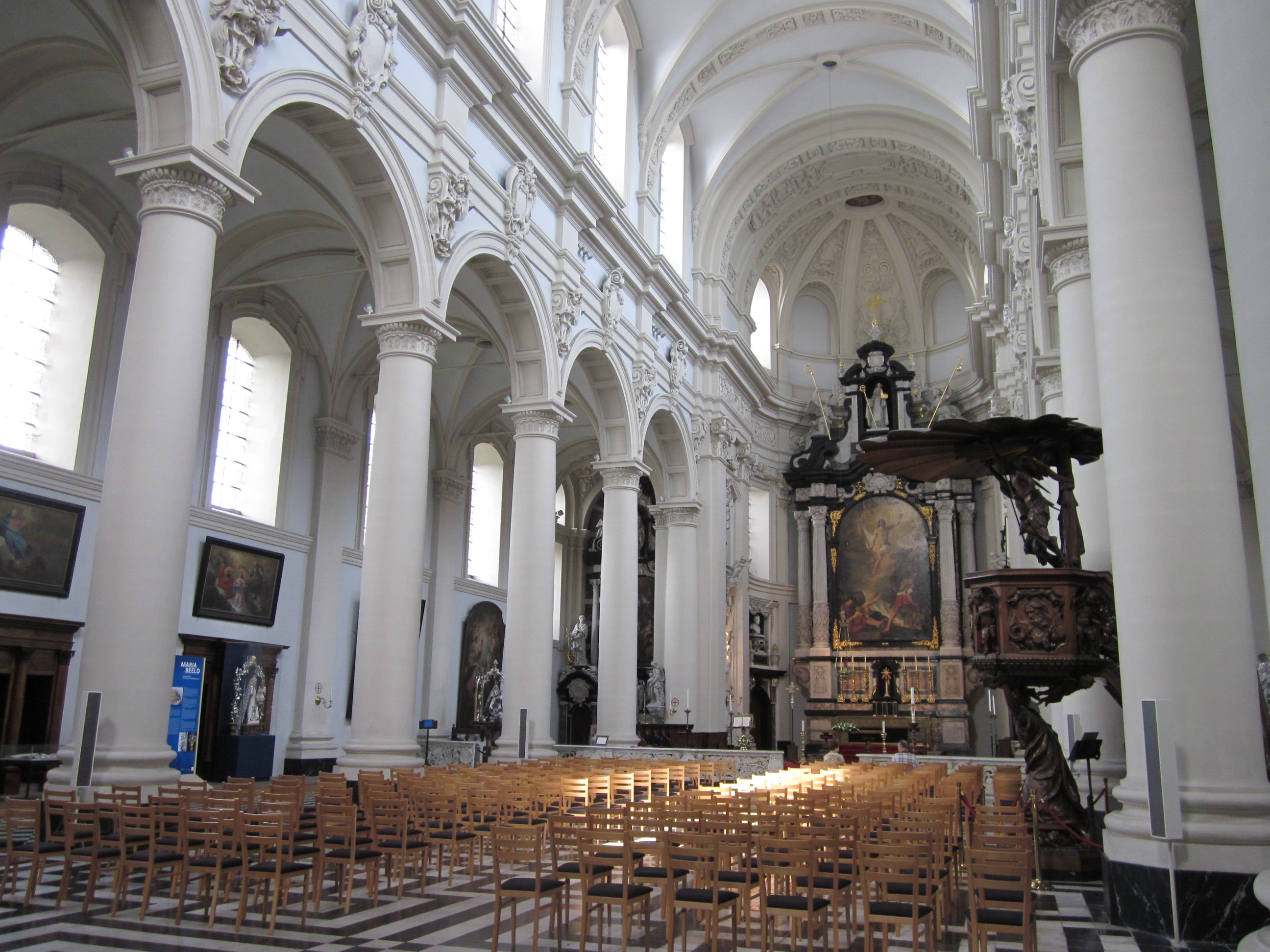
St. Walburga's Church, Bruges
Walk into St. Walburga's in Bruges and the building does something quietly aggressive. The columns lean in, the broken pediments lift the eye, marble curls into impossible volutes - all of it tuned to make a seventeenth-century Catholic parishioner feel that the floor was tipping toward heaven. This is Counter-Reformation theatre, built by the Jesuits to win back Flanders from the spreading Calvinism across the border, and modelled on the mother church of the whole order, the Gesu in Rome. What is strange is that the Jesuits did not get to keep it. They lost the church twice - once to a pope, once to a revolution - and the building has been quietly renaming itself ever since.
Building the Counter-Reformation
The Jesuits arrived in Bruges in 1596 and started small, with a chapel. By 1619 they were ready for a statement: a full Baroque church with attached college, convent, garden, and a separate chapel. The architect was Pieter Huyssens, a local Jesuit who knew exactly what his order wanted. Construction ran until 1641, hampered by money troubles and a sharp rivalry between the Bruges Jesuits and their richer cousins in Antwerp - Huyssens had to scale back the tower, the vault, and the nave windows from what he had originally drawn. He died in 1637, four years before the church was finished, and his fellow Jesuit J. Boule saw the work through. In 1642, Msgr Nicolas de Haudrion dedicated the new building to St. Francis Xavier, the order's great missionary saint.
The Gesu of the North
Huyssens copied the facade from the Church of the Gesu in Rome, the prototype Jesuit church that influenced Catholic building from Lima to Manila. The Bruges version trades Roman travertine for Belgian sandstone, brick rising behind it for the body of the nave. Inside, seven bays march toward a single-bay choir and an apse, and every flat surface curls into mouldings and broken pediments and pilasters - a system of light effects designed to dramatise the eucharist at the high altar. The monumental marble altar, dedicated in 1643, is the work of Jacob Cocx. Above the side portals stand busts of Francis Xavier and Francis Borgia, and statues of two young Jesuit saints, Aloysius Gonzaga and Stanislaus Kostka - a roster of order patrons that signals exactly whose church this was.
Pope Clement Closes the Doors
In 1773 Pope Clement XIV signed the brief Dominus ac Redemptor and dissolved the Society of Jesus throughout the Catholic world. It was the high point of an Enlightenment campaign by the Bourbon monarchies of France, Spain, and Portugal to break the order's political power. The Bruges Jesuits packed their books and left. Their church was sealed by imperial decree. Four years later, the local parish needed a new building - their own church was falling down - and in 1777 they took over the empty Jesuit church. The old parish church was demolished in 1781 and its furnishings sold to pay for restoration here. In 1779 the relics of St. Walburga, the eighth-century English missionary nun whose remains had become a pilgrimage focus in Flanders, were transferred in, and the church was rededicated.
Temple of the Law
When French Revolutionary forces occupied Bruges in 1796, they did what they had done everywhere - confiscated the church and repurposed it as a Temple of the Law, where civic ceremonies were performed under the cult of Reason. Catholic worship resumed in 1805 under Napoleon's Concordat, and the building was renamed again, this time as St. Donatian Church, when the relics of Bruges's patron saint Donatian were moved in from his own dilapidated old cathedral. The current name finally stuck unofficially in 1854. Then in 1918, near the end of the First World War, a bomb explosion damaged the northern aisle - a stray reminder that even Baroque drama is not exempt from twentieth-century violence.
What to Look For Inside
The floor of the choir carries strange geometric tilework that local lore claims spells out fragments of Kufic, an early Arabic script - probably wishful thinking, but the pattern is unmistakably Islamic-influenced, a memory of Flanders's trading reach. Look up to the rood screen for Pieter Claeissens the Younger's 1620 triptych of Our Lady of the Dry Tree. The Baroque pulpit, carved by Artus Quellinus II in 1670, is the visual centrepiece of the nave. The organ case was begun in 1735 by the French builder Cornil Cacheux and finished by Jean Baptiste Fremat in 1739, topped with statues of graceful women and a Jesus standing on the globe. The marble altar still holds an 1842 statue of St. Walburga by Houvenaegel, a Victorian addition that finally made the name match the saint.
From the Air
St. Walburga's stands at 51.21 degrees north, 3.23 degrees east, in the historic centre of Bruges along the Sint-Maartensplein. The church's pale sandstone facade and steep tile roof are landmarks within the densely packed medieval street grid; it lies a few blocks east of the Markt and Belfry. Ostend-Bruges International Airport (EBOS) is twelve nautical miles west. Bruges itself has no commercial airport but lies under the approach paths to Brussels (EBBR) thirty-five nautical miles south-southeast. Visibility in winter is often constrained by North Sea haze drifting inland over the canals.