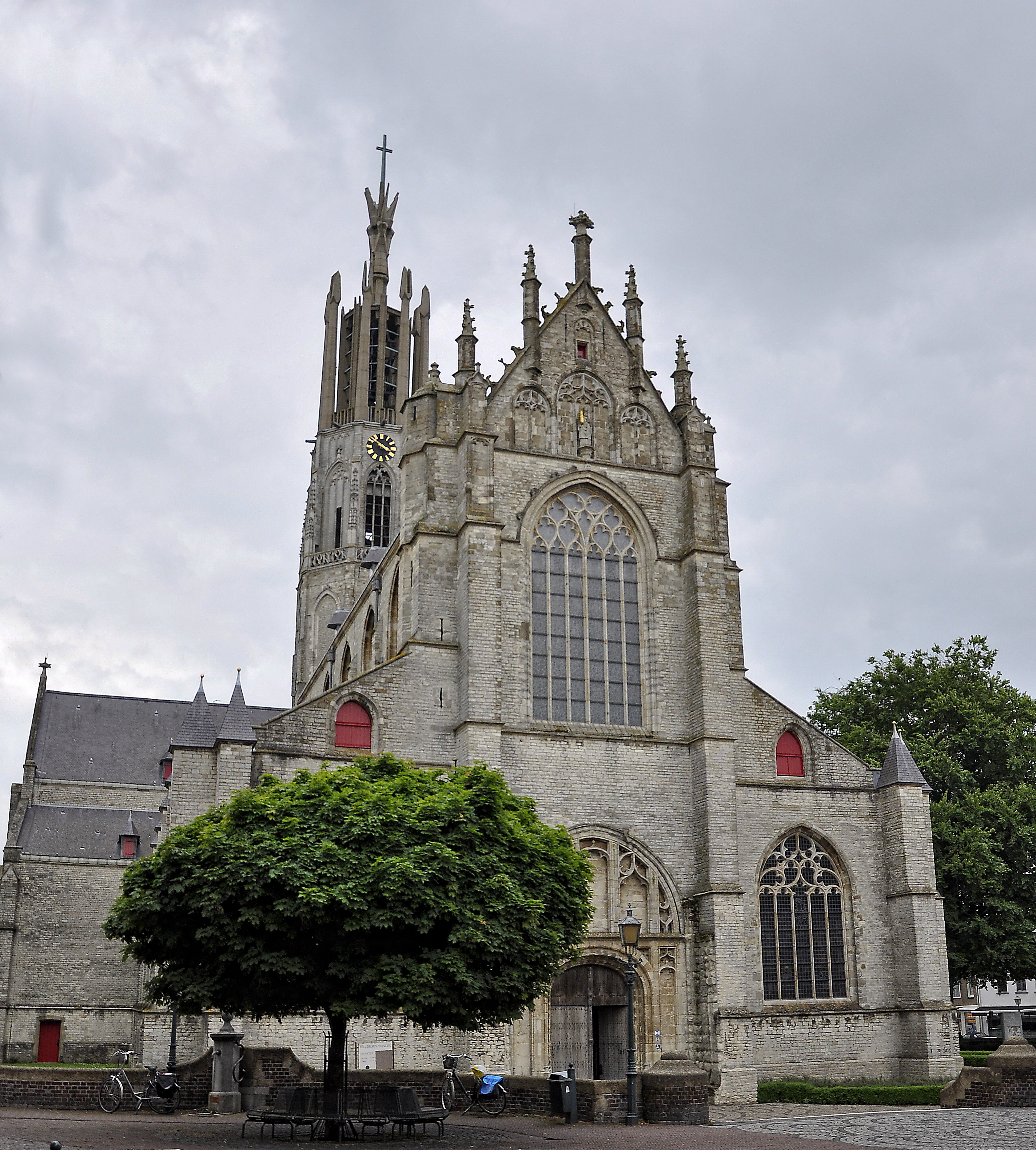
St Willibrordus Basilica, Hulst
On 18 September 1944, the first regiment of the Polish 1st Armoured Division shelled the tower of St Willibrordus Basilica in Hulst with about seventy tank rounds. They were not vandalizing it. They were trying to dislodge German lookouts who had spent four years inscribing their disrespects - '1940', 'Gott strafe England', a swastika - onto the bells. Most of the tower burned. Hulst was liberated the next morning. The current spire - the strange, beautiful, polarizing thing that crowns the basilica now - was built thirteen years later, in 1957, by a Dutch architect named Jan Brouwer, and it looks like nothing else on a Gothic church in Europe.
Six Centuries of Construction
There was a small Romanesque church here around 1200, at the foot of a motte. In the 15th century the people of Hulst replaced it with something far more ambitious - a Brabantine Gothic church in the shape of a Latin cross, with the central crossing tower that would become the basilica's signature. The master builder Everaert Spoorwater started rebuilding the structure in 1462. A fire reduced his work to ash before he could finish, and then he died, and the project sat dormant until 1481, when Herman de Waeghemazeker of Antwerp took over and brought in the Keldermans family - Matthijs II, then his great-nephew Laurens II - to complete the entrance and finally close the building in 1535. Seventy-three years from start to finish. By Gothic standards, almost brisk.
Catholic, Protestant, Both, Catholic Again
St Willibrordus was built Catholic, lost its Catholicism during the Eighty Years' War when Frederick Henry's victorious Dutch handed it to the Reformed Church, and stayed Protestant until Napoleon. Then it became something rare in Europe: a simultaneous church. The Catholics got the choir. The Protestants kept the nave. A wall was built down the middle, and for over a hundred years - from 1806 to 1929 - two separate congregations worshipped in the same building, separated by masonry and theology. In 1929 the Protestants sold their half to the Catholics and moved to a new church on the Houtmarkt. Six years later, on 24 November 1935, Pope Pius XI promoted St Willibrordus to basilica status. The tintinnabulum bells and the red-and-yellow conopeum parasol - the official insignia of a basilica - have hung beside the altar ever since.
The Tower That Would Not Stay Up
The spire of St Willibrordus has tried to stand four different times. The first was destroyed by lightning in 1668. The second, a classicist replacement from 1724, burned in 1876. The third, designed by Pierre Cuypers - the great Dutch architect of the Rijksmuseum and Amsterdam Centraal - was meant to serve double duty as a viewpoint over the Western Scheldt. It lasted until 1944, when the Polish gunners finished what lightning and fire had started. After the war, the parish held a competition for a new spire. Jan Brouwer won with a design he called 'De Prediker,' The Ecclesiastes. Built in 1957 of prestressed concrete, it stands on eight outer columns about fourteen meters high, with eight slightly shorter inner columns holding the bells of the carillon. Twelve steel wires run top to bottom. At the very crown, the sculptor Willem Reijers placed concrete angels eight meters tall, their bodies turned toward a bronze crucifix at the apex. The Dutch sometimes call it the most controversial church tower in the country. Other people just say it is the most honest, given how many times the old one had to be replaced.
Eight Chapels, Two Painters, an Organ from 1612
Inside, the basilica is laid out around the central crossing tower, with a choir aisle wrapping the east end. Eight rectangular side chapels and three polygonal radial chapels open from it - one for each of the medieval craft guilds of Hulst. The painting 'The Good Samaritan,' by Jan Baptist Maes (1794-1856) from Ghent, hangs in the choir. The fourteen Stations of the Cross were painted by Jan Jozef Deloose (1769-1849) from Sint-Niklaas, framed by the Ghent sculptor P. Pauwels. The organ above the nave is one of the most important Flemish instruments in the Netherlands - built between 1610 and 1612 by Loys Isore in Antwerp, repaired by Frederik Noblo in 1685, modified by Louis Delhaye in 1764, and faithfully reconstructed by Flentrop of Zaandam in 1970-71 to recover its southern-Flemish character. Eleven of its original fourteen registers still play.
The Carillon and the Tuning Forks
A Hemony chimes was installed in 1670 - Pieter Hemony, the Amsterdam bell-founder whose brothers cast the most famous carillon bells in the Low Countries. It burned with the tower in 1876. After the war, Petit and Fritsen of Aarle-Rixtel cast a new 36-bell carillon in 1958. The largest bell, the A1, weighs 470 kilograms. The bells hang on bronze bars between the inner columns of Brouwer's spire, ringed by the tuning forks that give the upper tower its strange, almost industrial silhouette. On a clear evening, a carilloneur in the tower plays across the rooftops of Hulst and the green star fort below. Six centuries of construction. Four lost spires. Two faiths. One basilica still working, still singing. It is hard to imagine a building more thoroughly Dutch.
From the Air
Coordinates 51.281°N, 4.054°E, at the center of Hulst within the star fort. The basilica's distinctive 1957 concrete spire with angel statues is visible from altitude. Best viewed at 1,500-3,000 ft. Nearest airports: Antwerp International (EBAW) 30 km southeast, Rotterdam-The Hague (EHRD) to the north.