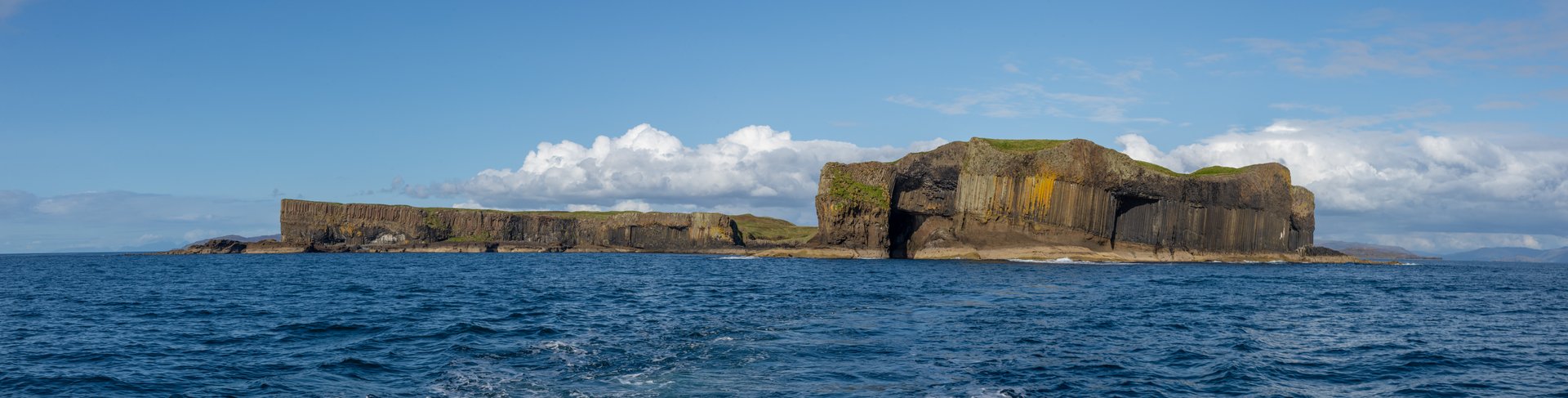
Staffa
Mendelssohn was seasick for the entire boat trip. He vomited his way across the heaving waters from Mull, staggered ashore on the basalt columns of Staffa, and composed one of the most celebrated pieces of orchestral music in the Western canon. His Hebrides Overture, inspired by the cathedral-like acoustics of Fingal's Cave, captured something that had been drawing visitors to this tiny uninhabited island since Sir Joseph Banks arrived in 1772 and left covered in lice but overwhelmed by what he had seen.
Fire and Fracture
Sixty million years ago, as a great rift sundered Europe from America and opened the North Atlantic, lava gushed from fissures across what would become the Scottish Hebrides, Northern Ireland, Iceland, and Greenland. The molten rock was so fluid it spread into vast fiery lakes rather than building into volcanoes. As this basalt cooled, it contracted and fractured into hexagonal columns -- the same geological process visible at Giant's Causeway in Antrim, but here exposed with particular drama along Staffa's southern coast. The island measures barely one kilometre north to south by 500 metres east to west, yet it contains some of the most spectacular geological formations in Europe. The Colonnade, or Great Face, is a wall of these basalt pillars capped by amorphous lava, the contrast between geometric perfection below and chaotic rock above suggesting a cathedral built by nature and then half-buried.
The Cave That Sings
Fingal's Cave is 75 metres deep, its walls formed entirely of those hexagonal basalt columns, its ceiling a canopy of fractured rock. The sea surges into the cave and the acoustics amplify the sound into a booming resonance that early visitors compared to pipe organ music. In Celtic legend, the cave connects to the Giant's Causeway across the sea in Ireland, both built by the giant Finn MacCool. The Vikings, more practically, named the island Staffa because the columns reminded them of the staves -- the support pillars -- of their buildings. Beyond Fingal's Cave, the island holds Clamshell Cave at the boat jetty, the 107-metre-long MacKinnon's Cave, and Boat Cave, each carved into the basalt by millennia of Atlantic waves. The pyramidal islet of Am Buachaille, 'the Herdsman,' guards the shore trail south.
From Lice to Royalty
Sir Joseph Banks, the naturalist who had sailed with Captain Cook, visited Staffa in 1772. The single family then scratching a living on the island shared more than their hospitality -- Banks left infested with lice. But his glowing reports launched a celebrity pilgrimage. Queen Victoria came. Mendelssohn came, despite the seasickness. By the late 20th century, visitor numbers soared as Mull became more accessible through roll-on, roll-off ferries from Oban. Staffa changed hands among private owners until it was gifted to the National Trust for Scotland in 1986 and declared a National Nature Reserve in 2001. The island is now rat-free -- too far from Mull for them to swim across -- which makes it a sanctuary for ground-nesting puffins, fulmars, shags, and great skuas. Grey seals haul out on the rocks, and minke whales, basking sharks, and dolphins pass through the surrounding waters.
Walking the Columns
Landing at the southeast jetty, visitors face a choice: follow the narrow trail along the cliff base into Fingal's Cave, or climb steep uneven steps to the island's plateau. Both routes demand respect. The basalt is slippery when wet, which it usually is, and the trails can be dangerously crowded in summer. The plateau reveals a different Staffa: the ruins of farm buildings, the grooves of old runrig cultivation, and the island's highest point, Meall nan Gamhna, at just 42 metres. From there, you can look straight down into Fingal's Cave from above. There is no shop, no water supply, no mobile signal, and no camping allowed. Staffa offers nothing but geology, wildlife, and one of the finest natural acoustic chambers on Earth. That has always been more than enough.
From the Air
Staffa lies at 56.436N, 6.340W in the Inner Hebrides, west of the Isle of Mull. The island is tiny -- about 1 km by 500 m -- but its basalt column formations, particularly the Colonnade on the south end, are distinctive from the air. Nearest airfield is Oban Airport (EGEO), approximately 30 nm southeast on the mainland. Approach from the east for views of the columnar cliff face and Fingal's Cave. The island of Iona lies approximately 6 nm to the south.