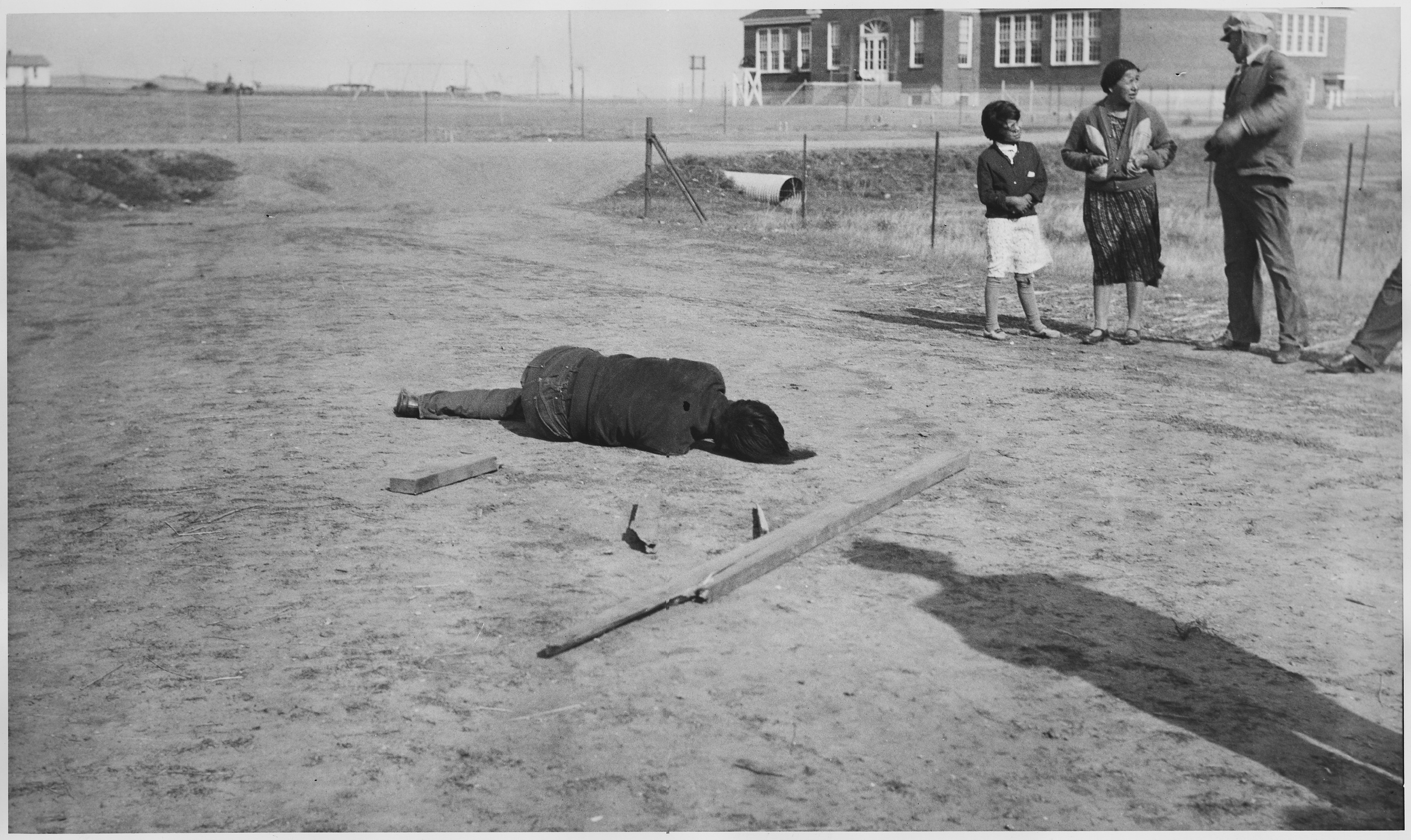
Standing Rock Sioux Reservation
Former Indian agent Valentine McGillycuddy watched the panic spreading through government offices in 1890 and offered a pointed comparison: "If the Seventh-Day Adventists prepare the ascension robes for the Second Coming of the Savior, the United States Army is not put in motion to prevent them. Why should not the Indians have the same privilege?" He was talking about the Ghost Dance, a spiritual movement that terrified federal authorities on the Standing Rock Reservation. The troops came anyway. Sitting Bull died. Three hundred Lakota were killed at Wounded Knee. More than a century later, Standing Rock would again draw the eyes of the nation -- this time over a pipeline, a river, and the question of whose water matters.
The Shattering of a Homeland
The Standing Rock Reservation exists because the Great Sioux Reservation was destroyed. In 1890, the United States government broke up that enormous territory -- which had encompassed the majority of what is now South Dakota -- into five smaller parcels. The stated intent was blunt: to "break up tribal relationships" and "conform the tribes to the white man's ways, peaceably if they will, or forcibly if they must." The Hunkpapa, Sihasapa, and Upper Yanktonai bands of the Lakota and Dakota Oyate were confined to Standing Rock, which straddles the border between North and South Dakota. Families received individual land allotments. A nomadic people whose culture was built on the buffalo and the horse were told to farm semi-arid prairie. By the end of the 1890 growing season -- a year of intense heat and scarce rain -- it was clear the land could barely sustain crops. With the bison herds already destroyed, starvation loomed.
Dawn on the Grand River
Sitting Bull, the Hunkpapa Lakota leader who had helped defeat Custer at Little Bighorn, lived along the Grand River on the Standing Rock Reservation. Indian Agent James McLaughlin considered him the driving force behind the Ghost Dance and ordered his arrest. On December 15, 1890, agency police arrived at the chief's cabin before dawn. During the arrest, one of Sitting Bull's followers, Catch the Bear, fired at Lieutenant Bull Head, striking him in the right side. Bull Head turned and shot Sitting Bull in the left side. Both men died. So did Sitting Bull's son, and more than a dozen others. The Hunkpapa who had lived in Sitting Bull's camp fled south, joining the Big Foot Band at Cherry Creek before heading to Pine Ridge to meet Chief Red Cloud. The 7th Cavalry caught them at Wounded Knee on December 29. The soldiers killed 300 people, including women and children.
Drowned by Progress
In the 1960s, the Army Corps of Engineers and the Bureau of Reclamation built five large dams on the Missouri River under the Pick-Sloan Missouri Basin Program. The dams provided flood control and hydroelectric power for the region. They also flooded vast tracts of Standing Rock and neighboring Cheyenne River Reservation land. The Oahe Dam alone submerged thousands of acres of the most fertile bottomland on the reservation -- river terraces where cottonwoods grew, where communities had gathered for generations. As of 2015, poverty remains entrenched among the displaced populations. Residents have sought compensation for their towns now lying beneath Lake Oahe, but the loss extends beyond property. It is the erasure of places that anchored memory and ceremony, replaced by a reservoir that generates electricity for cities hundreds of miles away.
Sacred Stone and the Water Protectors
On April 1, 2016, LaDonna Brave Bull Allard, an elder of the Standing Rock Sioux Tribe, established the Sacred Stone Camp on her private land near the Missouri River. The Dakota Access Pipeline, rerouted away from Bismarck after being deemed too risky for that city's water supply, was now slated to cross under Lake Oahe near the reservation. What began as a small protest by Allard and her grandchildren became the largest gathering of Native American tribes in a century. By late September, over 300 federally recognized tribes had sent representatives. Thousands of supporters -- including approximately 2,000 military veterans who arrived in December 2016 -- camped in solidarity. Young activists ran from North Dakota to Washington, D.C., under the banner ReZpect our Water. Over 700 arrests were made. The pipeline was completed by April 2017 and delivered its first oil on May 14, 2017. But in March 2020, a federal judge ordered a full environmental impact statement, ruling that the Corps' analysis was "severely lacking."
The Council Fire Still Burns
Standing Rock is governed by an elected 17-member Tribal Council, including representatives from eight regional districts stretching from Fort Yates and Cannonball in the north to Kenel and Wakpala in the south. The tribal college, Sitting Bull College, operates from Fort Yates. The reservation's notable citizens span centuries -- from Sitting Bull himself to Eagle Woman, a 19th-century peace activist and diplomat, to Vine Deloria Jr., the writer and activist whose 1969 book Custer Died for Your Sins reshaped how America understood indigenous politics. Basketball star Kyrie Irving, enrolled as a member of the Standing Rock Sioux Tribe, carries the connection into a different arena entirely. In June 2014, President Barack Obama visited during the annual Cannon Ball Flag Day Celebration -- one of the rare visits by a sitting president to any Native American reservation.
From the Air
Located at 45.75°N, 101.20°W, straddling the North Dakota-South Dakota border. The reservation is bordered on the east by the Missouri River and Lake Oahe, clearly visible from altitude as a long, narrow reservoir cutting through the prairie. Fort Yates, the tribal headquarters, sits on the western bank of Lake Oahe. The nearest significant airports are Bismarck Municipal Airport (KBIS) approximately 60 miles north and Pierre Regional Airport (KPIR) approximately 90 miles south. The Cannonball River drainage is visible crossing the northern portion. At 10,000-15,000 feet, the state border is invisible but the contrast between reservation grassland and surrounding agricultural patterns may be discernible. The Dakota Access Pipeline corridor crosses near the northern end of the reservation.