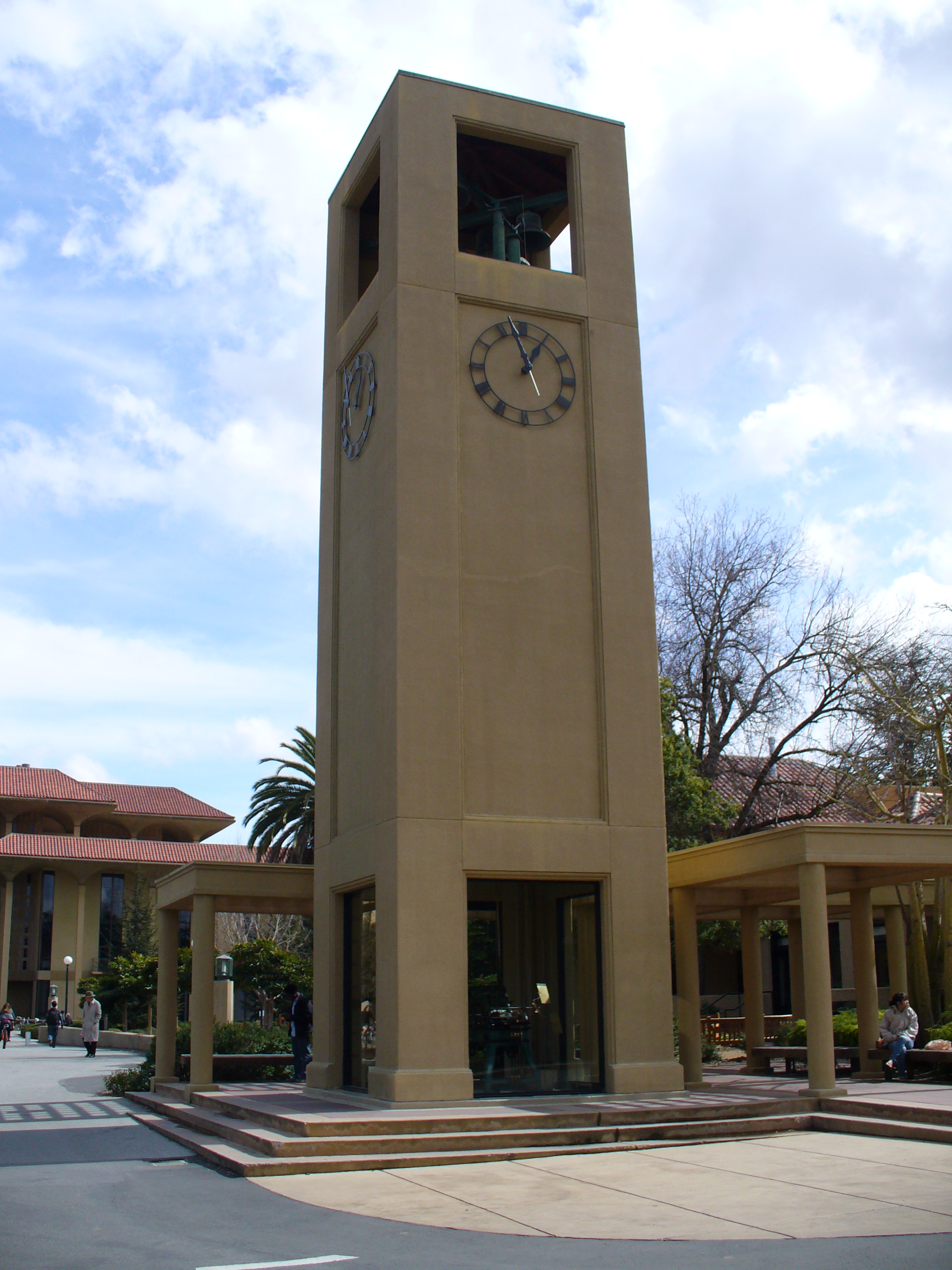
Stanford Clock Tower
When Stanford's president Donald Kennedy unveiled the new clock tower on May 10, 1983, he burst out laughing. Someone had replaced the west face of the clock with Mickey Mouse's face and hands. The prankster was never identified, but the joke perfectly captured the spirit of a timepiece that has survived earthquakes, decades of improvised housing, and a mysterious tendency to strike thirteen at noon.
A Clock Older Than Its Tower
The mechanical clock itself predates the tower by more than eighty years. Built in 1901 by the Seth Thomas Clock Company, it was originally installed in the large belfry of Stanford Memorial Church. The clock dutifully chimed the hours until April 18, 1906, when the great San Francisco earthquake toppled the belfry. Rather than abandon the mechanism, the university rescued the chimes and installed them in temporary structures near the church, where they continued marking time through makeshift arrangements that lasted the better part of a century. Not until 1983, funded by a donation from trustee William Kimball, did the clock finally receive a permanent home in the colonnaded tower that stands today at the corner of Escondido and Lasuen Malls.
The Circle of Death
The tower's location has its own notoriety. Stanford students know the intersection of Escondido and Lasuen Malls as the "Circle of Death" -- not for any sinister reason, but because the converging bicycle traffic makes it one of the most accident-prone spots on campus. Thousands of students cross this junction daily on bikes, and the near-misses are a rite of passage. The clock tower presides over this chaos with the patient indifference of something that has already survived much worse. Its colonnaded pergola provides a gathering point and visual anchor in a campus that can feel sprawling, a landmark that students navigate by whether or not they ever think about the mechanism ticking inside.
Thirteen Strikes and a Temperature Fix
During the 1950s and 1960s, the chimes developed a peculiar habit: they would strike thirteen times at noon. University lore attributes this to a student prank, though the exact mechanism was never publicly confirmed. The clock's mechanical heart requires human attention to this day. Twice a week, someone must hand-crank the mechanism to keep it running -- a ritual that connects the present campus to the era of analog timekeeping. In 1997, engineering students addressed a more mundane problem, designing and installing a temperature-compensating pendulum that eliminated the timekeeping errors caused by thermal expansion and contraction. It was a characteristic Stanford solution: students applying cutting-edge engineering to preserve a piece of 19th-century craftsmanship.
Keeping Time at Stanford
From the air, the Stanford Clock Tower is a minor element in the vast campus layout -- easy to miss amid the red-tiled roofs and the quadrangles that radiate from Memorial Church. But for anyone who has spent time on the ground at Stanford, the tower is a touchstone. The chimes still mark the hours, as they have since 1901, connecting students typing on laptops in Green Library to the era when this was a young university on a horse ranch, and a clockmaker in Connecticut built a mechanism sturdy enough to outlast its first three homes. The tower stands at the heart of student life, and every hour, it reminds the campus that some things still run on human hands and gravity.
From the Air
Stanford Clock Tower is at 37.426°N, 122.169°W on the Stanford University campus. The tower is a small structure not easily distinguished from altitude; look for it near the center of campus at the intersection of major pedestrian malls. Nearest airports: Palo Alto (KPAO) 2 nm northeast, San Jose International (KSJC) 10 nm southeast. Class B airspace for SFO overhead.