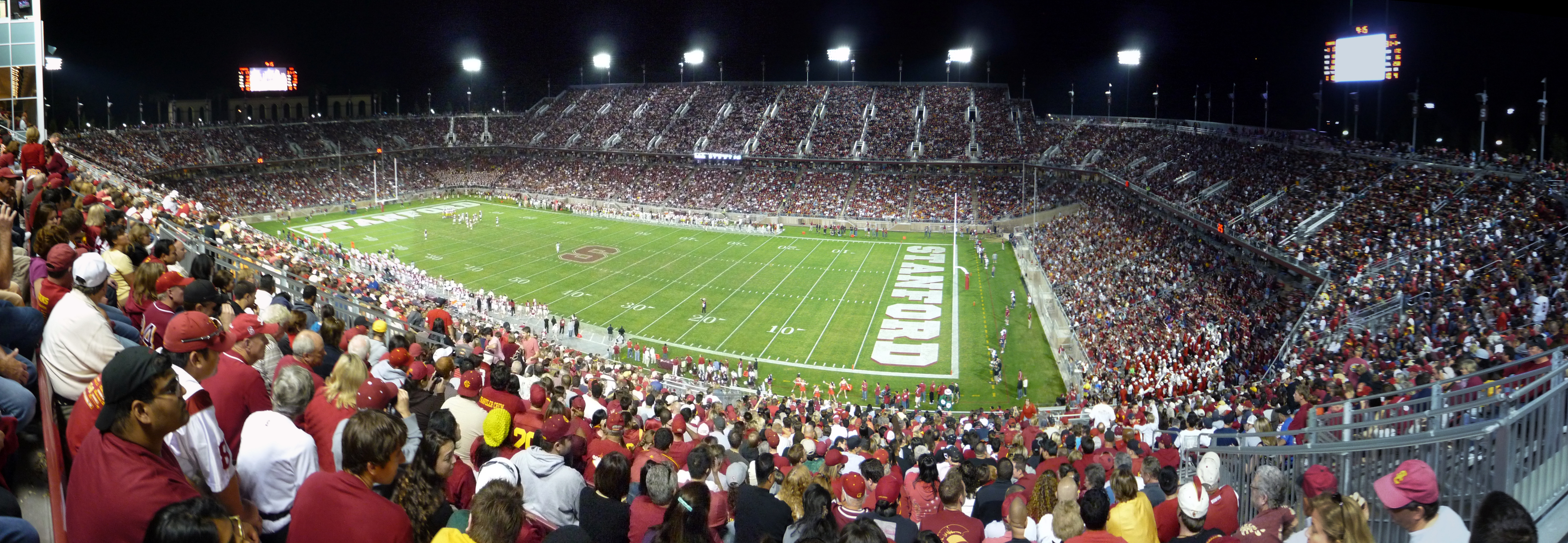
Stanford Stadium
Construction began minutes after the final whistle. On November 26, 2005, while fans were still filing out of Stanford's 38-31 loss to Notre Dame, bulldozers rolled onto the field and began tearing up the turf. The 84-year-old stadium, which had once held 94,000 spectators and hosted a Super Bowl, was being demolished to make room for a smaller, better version of itself. It was a very Stanford solution to a very Stanford problem: the old stadium was too big, the sightlines were terrible, and the restrooms were inadequate.
Five Months from Dirt to Kickoff
Stanford Stadium was built in just five months in 1921, opening on November 19 with a 42-7 loss to rival California in the Big Game. The original earthen horseshoe seated 60,000 on wooden bleachers over a steel frame, second in size only to the Yale Bowl. By 1925, 10,200 seats had been added; by 1927, fourteen additional rows nearly enclosed the bowl. In 1935, the stadium set a single-game attendance record of 94,000 for a 13-0 victory over Cal. The growth reflected Stanford's ambitions, but it also created a facility that was difficult to maintain and, eventually, impossible to justify at its original scale.
Super Bowls, World Cups, and Earthquakes
Stanford Stadium hosted Super Bowl XIX in January 1985, the first Super Bowl in the Bay Area. The San Francisco 49ers defeated the Miami Dolphins 38-16 in front of a capacity crowd. The game required $2 million in renovations and a portable lighting system, since kickoff was at 3 p.m. local time. The stadium also hosted soccer matches for the 1984 Summer Olympics, the 1994 FIFA World Cup, and the 1999 FIFA Women's World Cup. When the Loma Prieta earthquake damaged Candlestick Park in October 1989, the 49ers played a home game at Stanford against the New England Patriots. Herbert Hoover accepted the 1928 Republican presidential nomination here, and Coldplay performed back-to-back shows in 2025.
The Rebuild
The new stadium, completed in September 2006, seats 50,424 -- nearly 40,000 fewer than the old bowl at its peak. The reduction was deliberate: Stanford's athletics program wanted an intimate atmosphere that could actually be filled, rather than a cavernous bowl that advertised empty seats on television. The dual-deck concrete structure eliminated the track that had pushed spectators far from the field and sank the playing surface 29 feet below ground level. The Stanford Band was notably absent from the opening game -- a 37-9 loss to Navy -- having been banned from September events due to accusations of vandalizing a temporary trailer. Instead, the Navy band played.
Still Surprising
In April 2025, Stanford moved its home softball games to the football stadium while its regular softball park underwent renovation, and 13,207 fans showed up for a rivalry game against Cal -- a new NCAA single-game softball attendance record. It was the kind of unexpected moment that captures what makes Stanford Stadium interesting beyond its architecture: a venue built for football, expanded for a Super Bowl, rebuilt for intimacy, and then briefly converted into the loudest softball park in the country.
From the Air
Stanford Stadium is at 37.434°N, 122.161°W on the Stanford campus. The rectangular stadium is visible from altitude, surrounded by parking areas and campus buildings. Look for it east of the main quad. Nearest airports: Palo Alto (KPAO) 2 nm northeast, San Jose International (KSJC) 10 nm southeast.