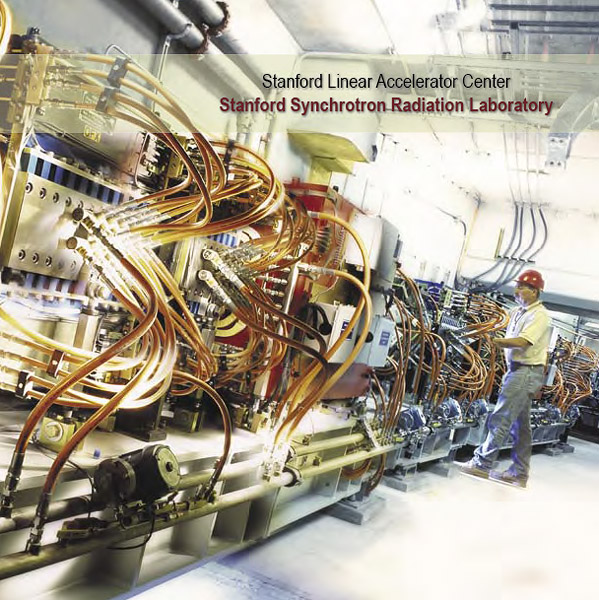
Stanford Synchrotron Radiation Lightsource
In 1972, physicists Ingolf Lindau and Piero Pianetta punched a literal hole in the wall of the SPEAR storage ring at Stanford and pointed instruments at the radiation leaking out. The physicists who had built SPEAR were interested in smashing particles together to find antimatter; Lindau and Pianetta wanted the X-rays that the circling electrons produced as a byproduct. From that improvised beginning -- a single beamline extending through a hole in concrete -- grew the Stanford Synchrotron Radiation Lightsource, now one of the most productive scientific facilities in the world.
Light Brighter Than the Sun
SSRL operates as a division of SLAC National Accelerator Laboratory, funded by the Department of Energy and operated by Stanford University. The facility produces synchrotron radiation -- electromagnetic energy ranging from X-rays to infrared light -- by sending electrons around the SPEAR storage ring at nearly the speed of light. The resulting light is millions of times brighter than what a conventional X-ray machine produces, allowing scientists to study matter at the atomic and molecular scale with extraordinary precision. Today, SSRL runs 24 hours a day, seven days a week, for about nine months each year. The remaining time is devoted to maintenance and upgrades that require direct access to the storage ring.
From Five Hutches to Seventeen Beamlines
The early Stanford Synchrotron Radiation Project had five experimental stations using radiation from a single bending magnet. Scientists brought their samples from around the world. By 1991, SPEAR had its own dedicated three-section linear accelerator and booster ring, freeing it from dependence on the two-mile-long SLAC accelerator. Today, the facility operates 17 beamlines and over 30 unique experimental stations, serving some 2,000 academic and industrial scientists annually. Their work spans an extraordinary range: drug design, environmental cleanup, electronics development, and X-ray imaging of biological structures. Macromolecular crystallography stations have helped determine the three-dimensional structures of proteins crucial to medical research.
The Accidental Light Source
SSRL's origin as a parasite on a particle physics experiment is central to its identity. Synchrotron radiation was initially considered a nuisance -- energy lost by electrons as they curved through magnetic fields, reducing the beam intensity for the collision experiments that were SPEAR's primary purpose. That someone saw this waste product as a scientific resource, and punched a hole in a wall to get at it, captures something essential about research: breakthroughs often come not from asking new questions but from recognizing that the answers to different questions are already leaking through the walls.
From the Air
SSRL is at 37.418°N, 122.201°W at the SLAC National Accelerator Laboratory, Menlo Park. The long linear accelerator is visible from altitude as a straight line running through the hills west of Stanford campus. Nearest airports: Palo Alto (KPAO) 3 nm east, Half Moon Bay (KHAF) 10 nm northwest.