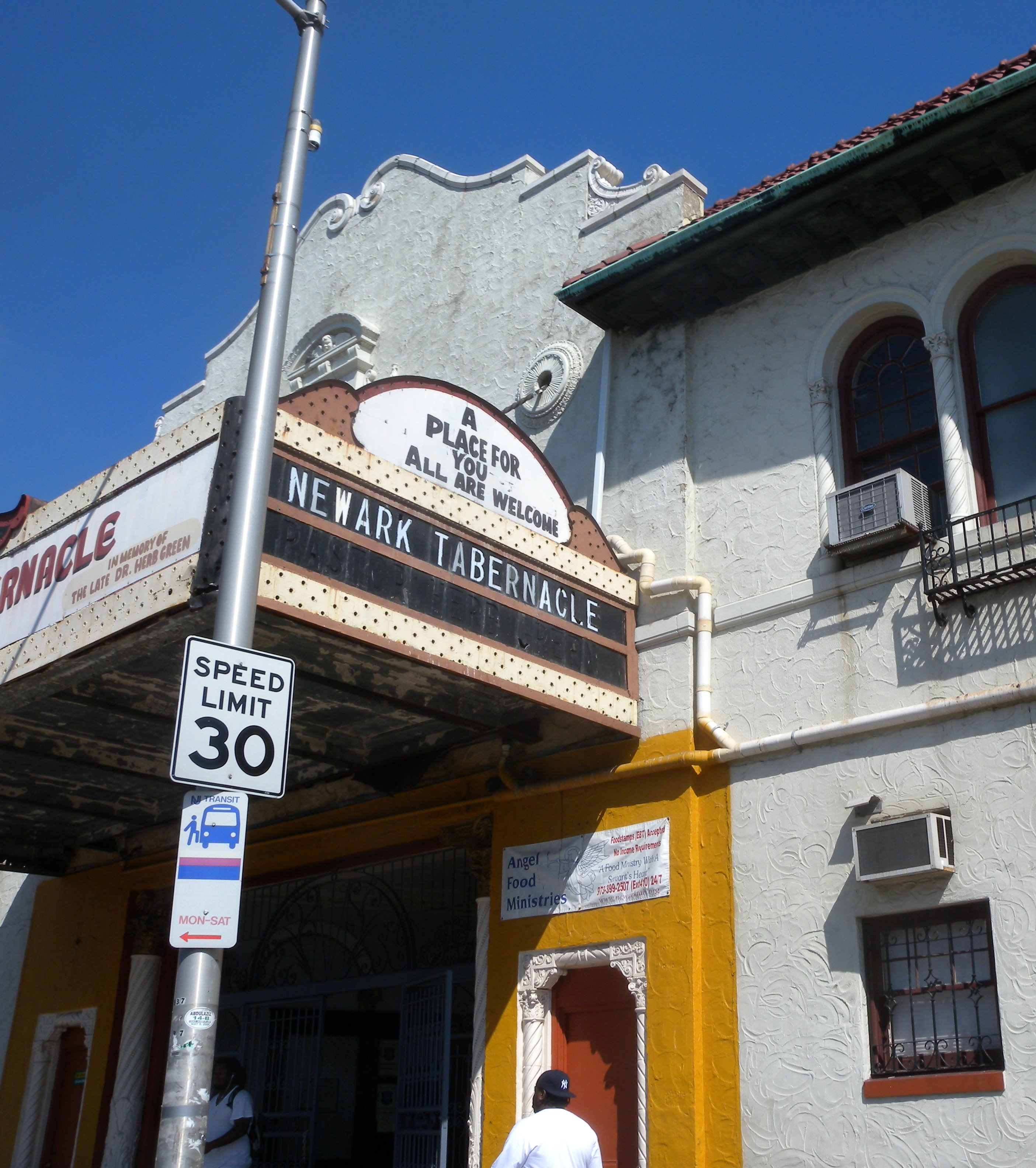
Stanley Theater (Newark, New Jersey)
Cloud machines. That is not a metaphor. When the Stanley Theater opened on May 26, 1927, in Newark's Vailsburg neighborhood, its designers had installed actual cloud-making equipment on hidden platforms behind three-dimensional Spanish facades, capable of projecting drifting clouds across the auditorium's vaulted ceiling. Below, two thousand moviegoers sat beneath a simulated moonlit sky studded with tiny electric stars, surrounded by the ornate plasterwork of a Spanish courtyard that existed entirely indoors. It was the kind of extravagance that seemed perfectly reasonable in the golden age of movie palaces.
An Atmosphere Factory
The Stanley was what theater historians call an atmospheric -- a cinema designed to make the audience feel they were sitting outdoors in some exotic locale rather than inside a building in northern New Jersey. Stanley-Fabian executive Louis R. Golding conceived the Spanish theme, then hired local architect Frank Grad and builder Warren MacEvoy to realize it. Reflectors, specialized lighting units, and small perforations in the ceiling produced the star effects. Weather equipment generated clouds that drifted overhead during the show. The result was an amphitheater canopied by a glorious simulated sky, a place where the boundary between the film on screen and the world around the viewer deliberately blurred. In an era before television, before home entertainment of any kind, this was what it took to get people through the door.
The Warner Empire
The Stanley Theater was part of the Stanley Company of America, a theater chain that controlled a significant slice of the American movie exhibition business. In 1928, Warner Bros. Pictures acquired Stanley in a deal worth roughly $100 million -- a staggering sum at the time -- unifying the assets of Warner, Vitaphone, and Stanley under one roof. Stanley also controlled First National Pictures and what is now the Warner Bros. Studios lot in Burbank. Warner operated the theaters until antitrust action in the late 1940s forced the separation of movie production from exhibition. The theater portfolio was spun off as Stanley-Warner, and in 1953 Warner board member S. H. Fabian and associates took control of a circuit stretching from New York to Virginia.
From Silver Screen to Sacred Space
By the 1970s, the Stanley had stopped showing films. The building was converted into a social hall, and from 1980 onward it served as the Newark Tabernacle, a church. Where cloud machines had once simulated weather, congregants gathered beneath the same star-studded ceiling for worship. In 1986, the theater was added to the National Register of Historic Places, a recognition of its architectural significance even as its physical condition declined. Eventually, the building was abandoned altogether, joining the long roster of American movie palaces lost to changing habits and suburban flight.
A Second Act
The story may not end there. In late 2024, Newark's Landmarks Commission approved a proposal to restore the Stanley's lobby and historic marquee. The plan envisions the restored lobby becoming the entrance to a new five-story mixed-use building with 16 residential units on the upper floors. It is a hybrid approach -- preservation meeting practical economics -- that has become the template for saving endangered historic theaters across the country. Whether the Spanish patio atmosphere can be recaptured, whether the cloud machines will ever drift again, remains to be seen. But after nearly a century, the Stanley still has its ceiling of stars, waiting.
From the Air
Located at 40.747N, 74.229W in Newark's Vailsburg neighborhood. Not individually visible from flight altitude but located within the dense urban grid of western Newark. Nearest airports: Newark Liberty International (KEWR, 4nm SE), Essex County Airport (KCDW, 7nm NW), Teterboro (KTEB, 12nm NE). Under New York Class B airspace.