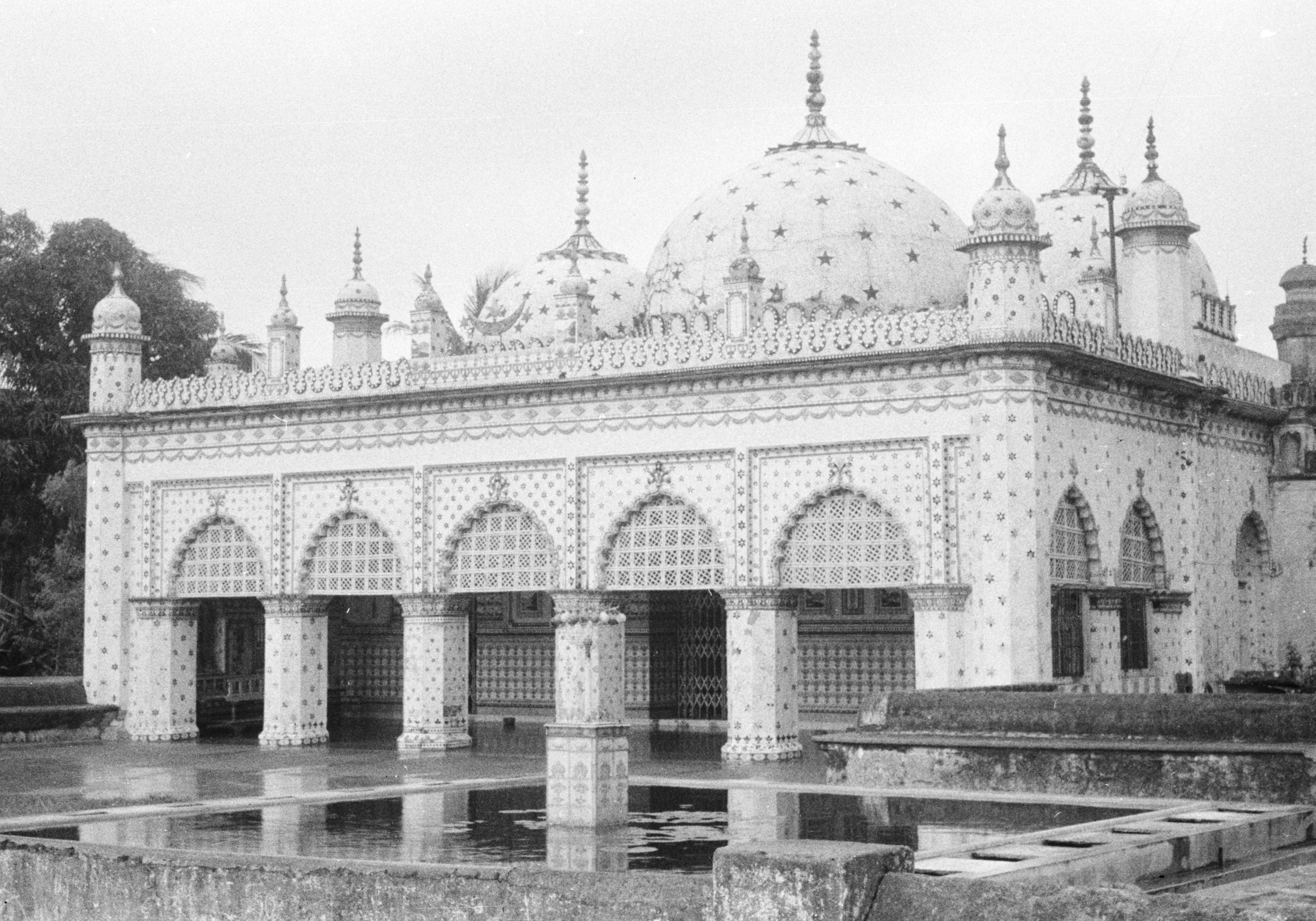
Star Mosque
Pull a five-taka note from your pocket in Bangladesh and you will find it there -- a small mosque glittering with blue and white stars under five delicate domes. The Star Mosque, or Tara Masjid, sits in the Armanitola neighborhood of Old Dhaka, and its fame vastly exceeds its size. Originally a plain rectangular prayer hall built in the Mughal style, it was reborn in the early twentieth century when a local businessman paid to sheathe its surfaces in chinitikri -- mosaics made from broken pieces of Chinese porcelain. That renovation turned an unremarkable neighborhood mosque into one of the most photographed buildings in Bangladesh.
From Nobleman's Gift to National Icon
A local nobleman named Mirza Ghulam Pir built the original mosque, which for decades bore his name. When he died around 1860, the building he left behind was modest by any standard: a rectangular structure measuring roughly 33 by 11 feet, three domes across the roof, three arched doorways on the east facade, and simple plastered panels for decoration. It was functional, pious, and forgettable. The transformation came in the early twentieth century, when Ali Jan Bepari, a local businessman, financed a major renovation. He added an eastern verandah and commissioned artisans to cover the mosque's surfaces in chinitikri work -- a decorative technique using fragments of broken china porcelain set into plaster, popular in the 1930s. The stars that give the mosque its name emerged from this process: blue and white star-shaped motifs pressed into the domes and exterior walls, catching sunlight and scattering it across the narrow lanes of Old Dhaka.
Porcelain Constellations
The chinitikri technique is itself worth understanding. Artisans took Japanese and English china clay tiles -- some solid-colored, some patterned -- and cut them into shapes, then pressed the fragments into wet white plaster to form intricate designs. The result is something between mosaic and collage, where the slightly irregular surfaces of broken china create a texture that flat tile never achieves. On the Star Mosque's exterior, the technique produces fields of colored stars against white backgrounds, with crescent motifs adorning the upper eastern facade. Inside, the approach shifts. The artisans used assorted pieces of different glazed tile designs, creating a warmer, more varied texture on the interior walls. The three mihrabs and doorways carry mosaic floral patterns, while a repeating plant-and-vase motif decorates the pendentives and verandah walls. Between the doors, you can find the Japanese Fujiyama motif -- Mount Fuji rendered in broken china on a mosque wall in Dhaka, a quiet testament to how widely Asian trade goods traveled.
Five Domes and Growing
The mosque has grown over the centuries, each addition layered atop the last like the porcelain fragments on its walls. The original three domes were joined by two more in 1987, when the Ministry of Religious Affairs commissioned architects Giasul Huque and Zahiruddin to extend the prayer hall. The newer domes received the same chinitikri treatment, decorated with imported china clay tiles to match -- though not precisely replicate -- the earlier work. This kind of gradual accretion is common in South Asian religious architecture, where buildings are living things, expanded and embellished by successive generations of patrons. The Star Mosque's coherence is remarkable given its piecemeal construction; the chinitikri serves as a unifying skin, binding old and new sections into a single shimmering surface.
Stars in the Old City
Old Dhaka is one of the densest urban environments on Earth, a labyrinth of narrow lanes, rickshaw traffic, and buildings pressed shoulder to shoulder. The Star Mosque sits within this crush, smaller than you expect and more luminous. Dhaka has earned its nickname as the City of Mosques, and among them the Tara Masjid holds a special place -- not for its size or age, but for the sheer improbability of its beauty. A building that began as an ordinary neighborhood prayer house became, through the vision of a single patron and the skill of anonymous artisans, something that belongs on currency. The stars on its domes look upward; the faithful inside look toward Mecca. And the broken pieces of china, salvaged and rearranged, became more beautiful than they ever were whole.
From the Air
Located at 23.716N, 90.402E in the Armanitola area of Old Dhaka. The mosque is small and difficult to spot from altitude, but Old Dhaka's dense historic district along the Buriganga River is a distinctive visual landmark. Best viewed at 1,500-2,500 feet. Nearby airport: Hazrat Shahjalal International Airport (VGHS), approximately 12 km north. The Buriganga River to the south helps orient navigation.