State Archives (Belgium)
Three hundred and twenty-five kilometres. Stack the shelves of the Belgian State Archives end to end and you could lay paper from Brussels nearly to the German border. Add another twenty-five kilometres of books and you have an institution whose physical scale is its own argument: this is what it takes to remember a country. The head office sits on the rue de Ruysbroeck in central Brussels, in the buildings that were once the Hotel de Croy, but the Archives are everywhere - eighteen provincial repositories scattered from Bruges to Eupen, each with reading rooms open to anyone who wants to look up an ancestor's baptism, a notary's deed, or a 1917 cabinet meeting whose participants are all long dead.
Born Under Austrian Rule
The institution's origins are older than Belgium itself. In 1773, while the Austrian Habsburgs still governed what is now Belgium as the Austrian Netherlands, an Archives Office was set up in Brussels - a centralised repository for the main records of the Austrian administration. Count Jean-Baptiste Goswin de Wynants, a Brussels jurist, became its first director general. When the French Revolution swept into the Low Countries in 1795, it brought a startling new idea with it: the law of 7 Messidor of Year II established that the archives of the nation belonged to its citizens. Anyone could consult them. The Decree of 5 Brumaire of Year V (October 1796) followed up by ordering an archive repository in every department. When Belgium became independent in 1830, those repositories were already in place. The new country simply inherited a working national memory.
Louis Prosper Gachard's Fifty-Four Years
When Belgium gained independence, the head office in Brussels needed a director. Louis Prosper Gachard, who had served as deputy since 1826, took the role in 1831 and held it until his death on the eve of Christmas 1885 - fifty-four years, the longest tenure any national archivist anywhere is known to have served. Gachard was an obsessive document hunter. He travelled to Simancas in Spain to copy the correspondence of Philip II, and to Vienna to comb through the Habsburg archives for anything touching Belgian history. His published editions of state papers ran to dozens of volumes. By the time he died, the Belgian State Archives had grown from a modest Brussels office into a national network with established branches in Bruges (1834), Namur (1849), Arlon (1851), Hasselt (1869), and Antwerp (eventually 1896). Every later director worked in his shadow.
Acid-Free Boxes and Climate Control
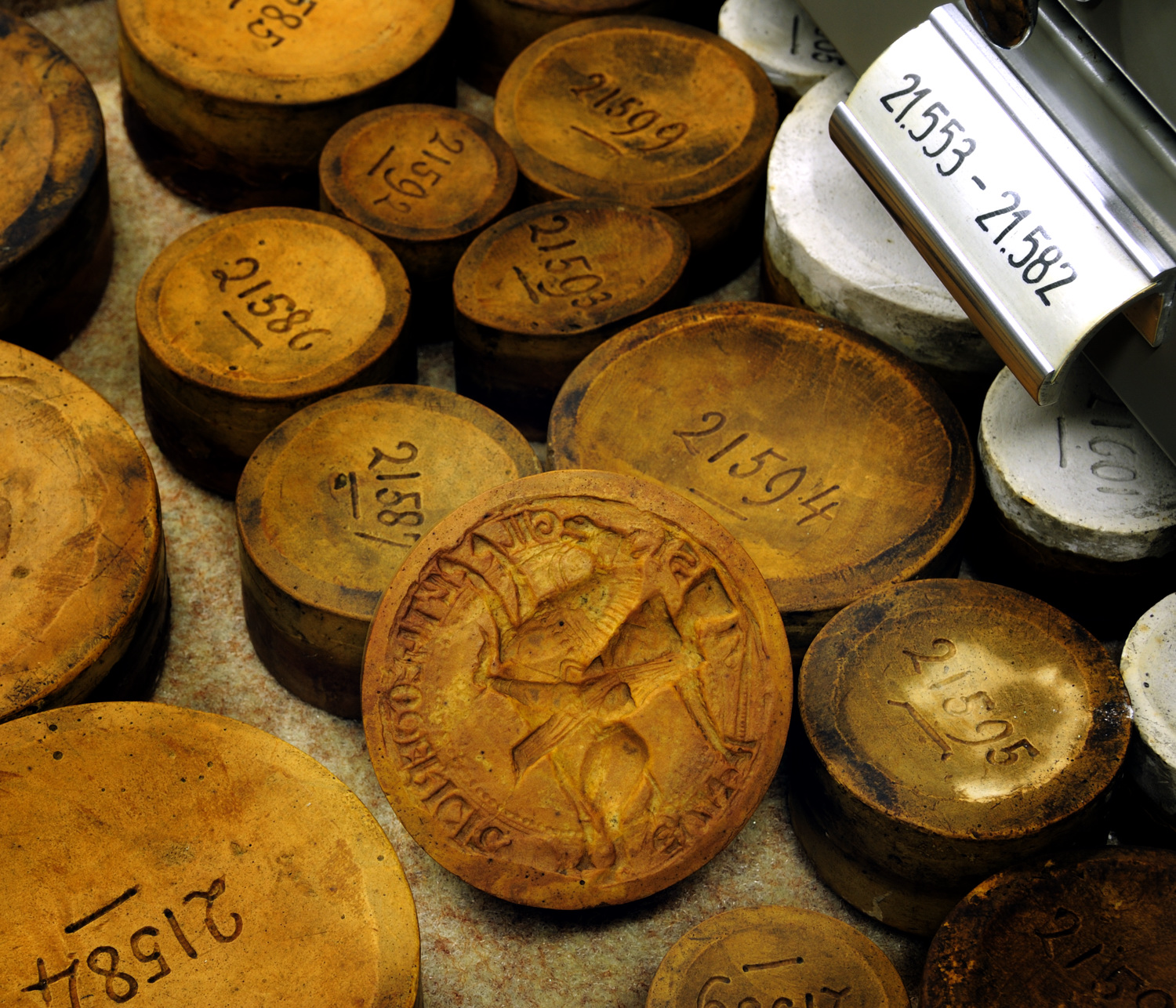
The unglamorous heart of the State Archives' work is preservation - the slow chemistry of keeping paper alive. Documents are stored in specially equipped stacks held to strict temperature and humidity tolerances, with redundant fire and flood protection. Each piece is folded into an acid-free archive box, identified with codes that tie it back to its origin. Anything that has deteriorated gets restored and rebound. Anything heavily consulted - parish registers, civil status registers, hand-drawn maps, parchment charters - gets microfilmed first, and increasingly digitised, so that the original can rest. The State Archives also sells acid-free boxes at cost to private institutions that want to do the same. The collection includes more than 38,000 seal moulds - wax and lead impressions used to authenticate medieval and early modern documents - making it the second-largest seal collection of its kind in the world.
Genealogists, Historians, and the Internet
Walk into any of the nineteen reading rooms on a weekday and you will find the same mix: PhD students working on Burgundian land contracts, retired engineers tracing great-grandparents from a village near Tournai, journalists chasing a story about a 1950s industrial closure, lawyers verifying a chain of inheritance. In 2009 the retention period was lowered from one hundred years to thirty - a reform aimed at giving citizens faster access to recent history without compromising privacy law. Since August 2009, the digitised church and civil status registers have been gradually rolled out across all nineteen reading rooms. By January 2013, roughly 27,000 church registers were also available free of charge on the State Archives website, along with the proceedings of every Council of Ministers meeting between 1918 and 1979 and the full Belgian statistical yearbooks - including those from the Belgian Congo - going back to 1870.
Traces of a Colonial Past
That last collection raises a question the Archives have spent the last decade addressing directly. The records of Belgian rule in the Congo, in Ruanda-Urundi, and in other colonial enterprises now sit in the State Archives alongside the records of the Belgian state itself. The Archives I Presume? exhibition, mounted as part of a wider reckoning with colonial memory in Belgium, made the colonial files visible in a way they had not been before. The institution does not own that history; it preserves it. The distinction matters. The CEGESOMA centre - the Centre for the Study of War and Contemporary Society, now part of the State Archives as Department IV - holds the parallel records of occupation, resistance, and collaboration during the World Wars. The Joseph Cuvelier repository, named for the national archivist who served from 1912 to 1935, opened in Anderlecht as Belgium ran out of space to store the past. The country keeps generating documents faster than it can absorb them. The Archives keep building shelves.
From the Air
The State Archives head office sits at 50.842 N, 4.356 E in central Brussels, near the Mont des Arts. The Royal Palace lies 400 m east; Brussels Central station is 500 m north-east. Eighteen additional repositories are scattered nationally; the Joseph Cuvelier repository is 5 km south-west in Anderlecht. Brussels Airport (EBBR) is 12 km north-east; Charleroi (EBCI) is 47 km south. Brussels Class C TMA covers central Brussels from the surface to FL095; expect frequent EBBR arrivals overhead and Brussels-City heliport traffic in the immediate area.