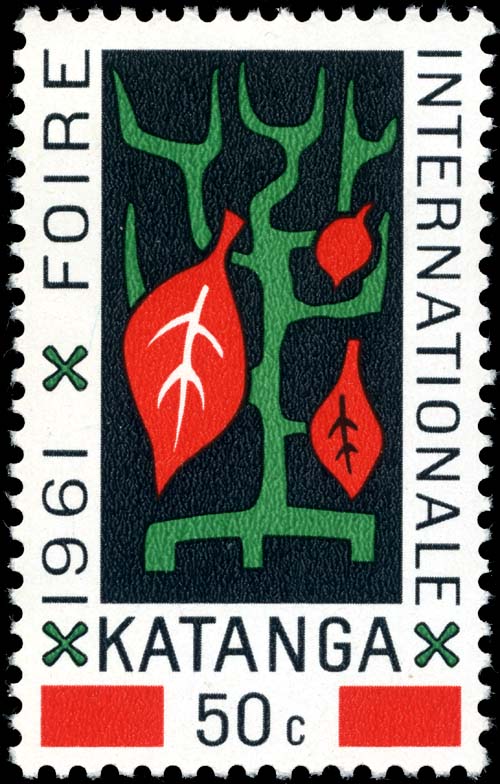
State of Katanga
Eleven days after the Belgian Congo became an independent nation, its richest province tried to leave. On 11 July 1960, Moise Tshombe stood before microphones in Elisabethville and declared that Katanga -- the source of a third of the entire country's revenue -- was a sovereign state. Behind him stood the mining executives of Union Miniere du Haut-Katanga, who had bankrolled the secession with an advance of 1.25 billion Belgian francs. Ahead lay three years of war, the assassination of a prime minister, the death of a UN Secretary-General, and one of the Cold War's ugliest proxy conflicts, all fought over the copper and uranium beneath this red African soil.
Copper Kingdom
Katanga's story begins underground. Since 1906, Union Miniere du Haut-Katanga had held exclusive rights to the province's copper, and as the decades passed, tin and uranium joined the haul. By the 1950s, 33.7 percent of the entire Congo's revenue flowed from Katanga's mines, and the wealth had drawn some 32,000 Belgian settlers -- more than any other province. When Belgium announced in January 1959 that independence would come by June 1960, the mining company began hedging its bets. Starting in March 1960, UMHK funneled money to Tshombe's CONAKAT party, buying policies favorable to continued extraction. The company was not alone in its calculations. Katanga's white settlers were already in contact with their counterparts in the Central African Federation, discussing plans for the province to break away from the Congo and join the British-dominated bloc to the south. Mineral wealth was not merely an economic asset here; it was the engine of geopolitics.
A Nation Unravels
Independence on 30 June 1960 did not bring peace. The new nation was already fractured by ethnic rivalries and political distrust, and CONAKAT feared that Prime Minister Patrice Lumumba would replace Katangese officials with his own loyalists. When Tshombe proclaimed secession, he accused the central government of communist sympathies and dictatorial ambitions. Belgian soldiers and mercenaries from Northern Rhodesia helped organize the Katangese Gendarmerie, giving the breakaway state its own army and even a small air force. The United Nations sent peacekeeping troops under Operation ONUC, but their mandate was ambiguous -- were they there to restore order or to end the secession? While diplomats debated, the conflict escalated. Lumumba, frustrated by the UN's refusal to act decisively, turned to the Soviet Union for military support, a move that alarmed the West and sealed his fate. In January 1961, Lumumba was kidnapped and transported to Katanga, where he was murdered -- a crime in which Belgian officers and Katangese officials were complicit.
The Death of Hammarskjold
The Katanga crisis claimed lives far beyond the Congo's borders. UN Secretary-General Dag Hammarskjold flew to the region in September 1961 to negotiate a ceasefire. His plane crashed near Ndola in Northern Rhodesia on the night of 17-18 September, killing all aboard. The official investigation concluded it was an accident, but suspicions of sabotage persisted for decades. Evidence later emerged suggesting the aircraft may have been shot down by a mercenary pilot -- a theory supported by witness accounts and diplomatic cables that surfaced in the 2010s. Hammarskjold's death shocked the world and complicated the UN's already difficult mission. Meanwhile, Katanga's internal politics were no less turbulent. The northern part of the province, home to the Luba people, never supported the secession and was wracked by ethnic violence. Tshombe's government, propped up by foreign mercenaries and mining money, controlled the south but could never claim legitimacy across the whole territory.
Operation Grandslam
By late 1962, patience had run out. The UN authorized a more aggressive approach, and in December 1962, ONUC forces launched Operation Grandslam against Katangese positions around Elisabethville. Indian, Ethiopian, and Irish troops fought their way through roadblocks and sniper fire, engaging mercenaries and Gendarmes who had fortified the city. The Siege of Jadotville earlier in 1961 had already demonstrated the danger -- an entire company of Irish troops had been forced to surrender after holding out for days against overwhelming numbers. This time the UN had the numbers and the mandate. By January 1963, Tshombe's forces either surrendered or scattered. The State of Katanga was dissolved and reintegrated into the Congo. Tshombe himself went into exile, though he would later return briefly as prime minister of the entire Congo -- a twist that would have seemed impossible during the secession.
The Ground Remembers
The site of Katanga's former capital, now Lubumbashi, remains the heart of the Congo's mining belt. The copper that drove the secession still flows from the earth, though the cast of corporate players has changed. The broader legacy is harder to quantify. Katanga's breakaway emboldened other secessionist movements across post-colonial Africa and demonstrated how easily mineral wealth could be weaponized against fragile new states. The murder of Lumumba, carried out on Katangese soil, deprived the Congo of its most prominent independence leader and set the stage for decades of authoritarian rule under Mobutu. For the Congolese, the State of Katanga is not a distant chapter -- it is the opening act of a story that continues to unfold, one in which the relationship between underground riches and political power has never been fully resolved.
From the Air
Centered on Elisabethville (modern Lubumbashi) at approximately 11.13S, 27.10E. The former Katanga territory stretches across southeastern DRC. From altitude, the copper belt's open-pit mines and tailings are visible south and west of the city. Lubumbashi International Airport (ICAO: FZQA) serves the region. Recommended viewing altitude: 15,000-25,000 ft for the mining landscape; 35,000+ ft to appreciate the scale of the former breakaway state. Nearby airports include Kolwezi (FZQM) and Likasi.