State Railway of Thailand
On 26 March 1897, King Chulalongkorn boarded a train at Bangkok and rode 71 kilometers north to Ayutthaya, the ruined capital his ancestors had abandoned 130 years earlier. The journey that once took days by river now took hours by rail. That inaugural ride on the Bangkok-Ayutthaya line was the beginning of what would become the State Railway of Thailand -- a 4,044-kilometer network of meter-gauge track that connects 47 provinces, carried over 35 million passengers annually at its peak, and has not turned a profit in living memory.
A King's Ambition on Iron Rails
Chulalongkorn, Rama V, saw railways as the instrument that would bind a kingdom of rivers and monsoons into a modern state. He ordered the Department of Railways established in 1890 under the name Royal State Railways of Siam, and construction of the Northern Line began the same year. The Bangkok-Ayutthaya section was the first completed, but the ambition ran far beyond it. Lines would eventually reach Chiang Mai in the north, Nong Khai on the Laotian border in the northeast, and all the way down the Malay Peninsula to Padang Besar on the Malaysian frontier. Before the railway, a trip from Bangkok to Nakhon Ratchasima took five days overland. By train, it shrank to six hours. That compression of distance changed everything -- trade routes, migration patterns, the very idea of what Thailand was.
Four Lines to Every Corner
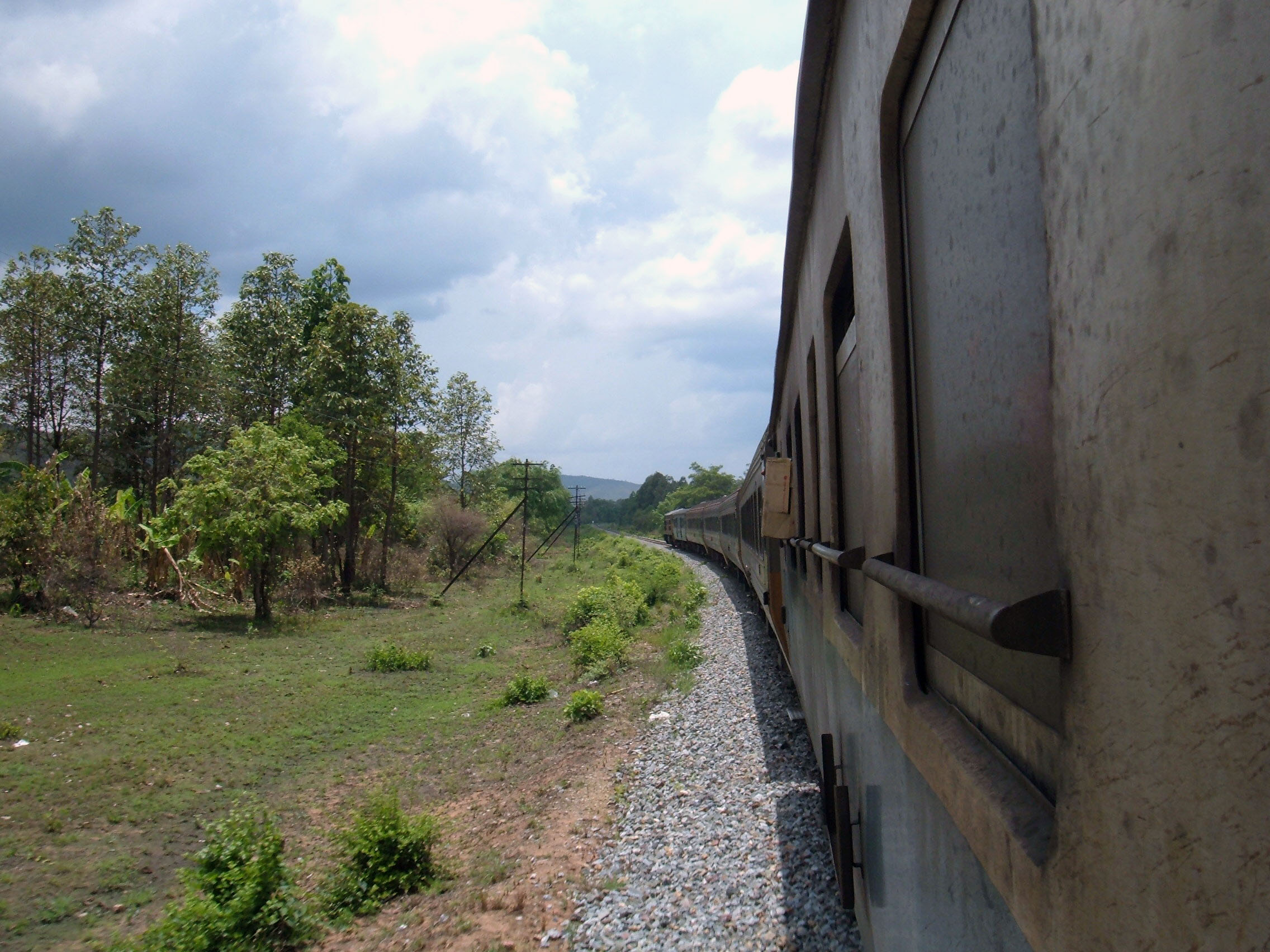
The network radiates from Bangkok along four main corridors. The Northern Line runs through Ayutthaya, Phitsanulok, and Lampang before terminating at Chiang Mai. The Northeastern Line splits at Ban Phachi Junction: one branch reaches Nong Khai and connects to Laos across the Mekong, the other crosses the Isan plateau to Ubon Ratchathani. The Southern Line drops through Hua Hin and Surat Thani to Hat Yai, where it forks toward the Malaysian border at Padang Besar and the deep south at Su-ngai Kolok. The Eastern Line heads to Aranyaprathet near the Cambodian border, with branches to Chonburi, Pattaya, and the deep-sea ports at Laem Chabang and Map Ta Phut. A separate, disconnected Maeklong Railway runs two short segments between Bangkok and Samut Songkhram, linked by a ferry across the Tha Chin River. As of 2023, long-distance services depart from the new Krung Thep Aphiwat Central Terminal, while the historic Hua Lamphong station handles eastern and commuter routes.
Elegant Decline
The SRT is one of Thailand's largest landholders, owning an estimated 39,840 hectares of property. It receives large government subsidies. It has not been permitted to raise fares since 1985. And it consistently loses money -- 7.58 billion baht in preliminary losses in 2010 alone, with accumulated debts approaching 190 billion baht. Passenger numbers tell the story of a system losing ground: 88 million riders in 1994 fell to 44 million by 2014 and 26 million by 2020. Nearly 91 percent of the track remains single-gauge, bottlenecking a network that was designed for an era of fewer trains. A transport expert at Thammasat University compared the SRT to a patient in intensive care being told he is the future. The analogy stings because it is not wrong.
Ghosts and Gateways
Some of the network's most evocative stretches are its abandoned or diminished connections. The rail link to Cambodia through Aranyaprathet was built in 1941, closed in 1961 over Cold War tensions, repaired and briefly reopened in April 2019, then suspended again by COVID-19. The connection to Myanmar -- the infamous Death Railway through Kanchanaburi -- is defunct, though the scenic Namtok branch still carries tourists along its surviving section. International service to Malaysia once ran all the way to Butterworth in Penang; now direct trains from Bangkok stop at Padang Besar. In 2024, overnight sleeper trains between Bangkok and Vientiane began running, a quiet milestone connecting two capitals that share a river and a border but not much recent rail history.
The Patient Stirs
For all its troubles, the SRT endures. The overnight sleeper from Bangkok to Chiang Mai remains one of Southeast Asia's great rail journeys -- thirteen hours through rice paddies, limestone karsts, and the mountain tunnels north of Lampang. Weekend excursion trains to Nam Tok and the Bridge over the River Kwai draw tourists who want a slower encounter with the Thai landscape. The Red Line commuter rail project has begun replacing congested at-grade crossings in Bangkok, and plans for standard-gauge high-speed lines to Nakhon Ratchasima and beyond promise to transform the network's spine. Whether those plans materialize faster than the SRT's debts accumulate remains an open question. The railway that King Chulalongkorn inaugurated with a ride to Ayutthaya is still running -- late, often, but running.
From the Air
Located at 13.807N, 100.517E (Krung Thep Aphiwat Central Terminal, formerly Bang Sue Grand Station). The rail network's main Bangkok hub is visible from altitude as a large modern terminal north of the city center. Rail lines radiate visibly in four directions. Historic Hua Lamphong station is at 13.738N, 100.517E near the Chao Phraya River. Best viewed at 3,000-5,000 feet to trace the rail corridors. Nearest airports: Don Mueang (VTBD) approximately 8 nm north, Suvarnabhumi (VTBS) approximately 17 nm east-southeast.