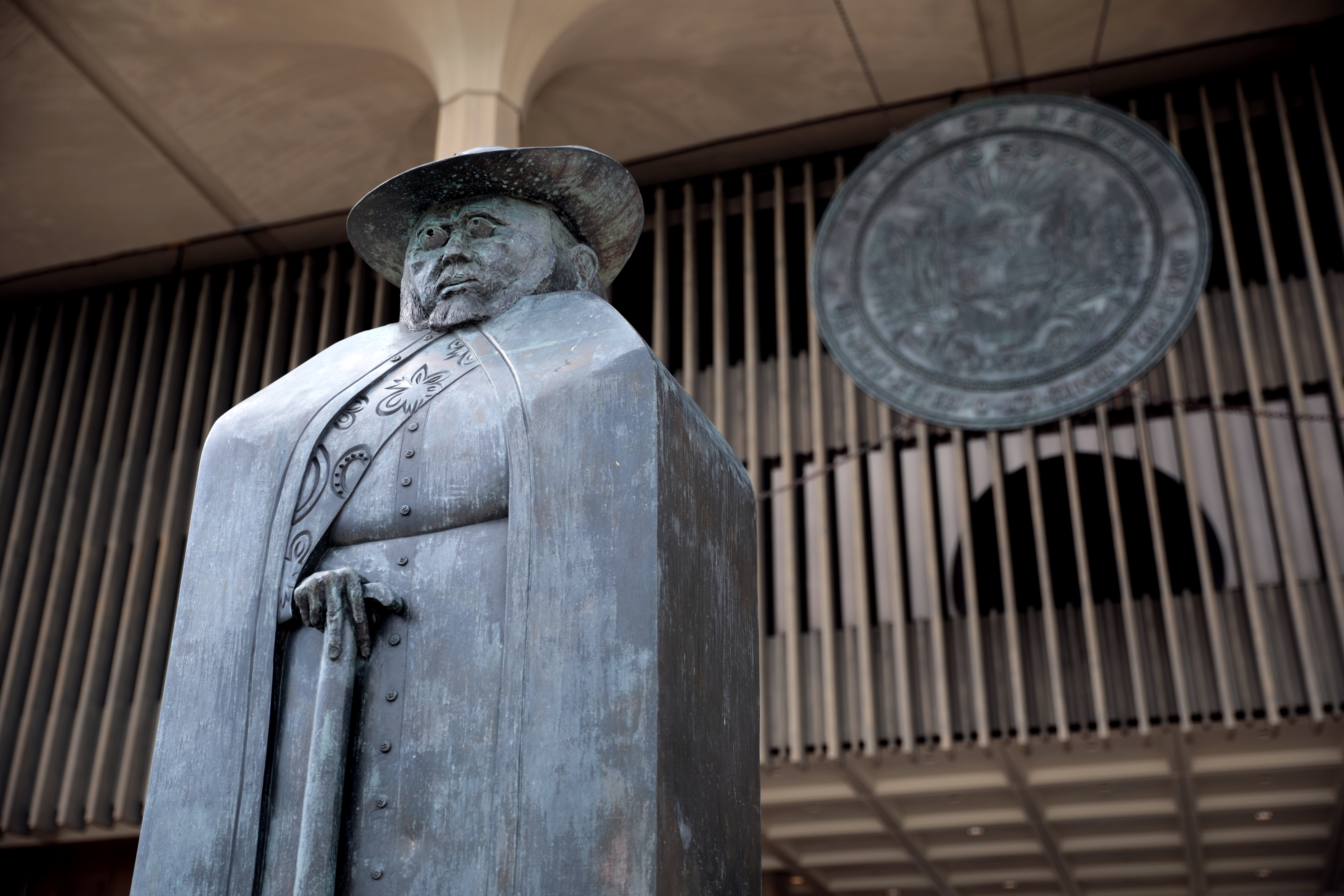
Statue of Father Damien
Most statues of heroes depict them at their best. This one shows a man at his worst — and that is precisely the point. The bronze figure of Father Damien that stands at the entrance to the Hawaiʻi State Capitol wears glasses, carries one arm in a sling, and bears the disfiguring scars of Hansen's disease across his face. The sculptor, Marisol Escobar, based her work on a photograph taken near the end of the Belgian priest's life, after leprosy had claimed his body but not his purpose. It is an intentionally uncomfortable statue, and Hawaiʻi placed it at the front door of its government.
The Priest of Kalaupapa
Father Damien — born Jozef De Veuster in Tremelo, Belgium — arrived in Hawaiʻi in 1864 as a young Catholic missionary. In 1873, he volunteered to serve at the leprosy settlement on the isolated Kalaupapa Peninsula of Molokaʻi, where the Hawaiian government had been forcibly relocating people diagnosed with Hansen's disease since 1866. The conditions were desperate: the settlement had been described as a place where the law of the land did not reach and the basic needs of the sick went unmet. Damien built houses, a church, and a water system. He dressed wounds, dug graves, and provided the kind of sustained human contact that the rest of the world had denied these patients. In 1884, he discovered that he had contracted the disease himself. He continued working until his death on April 15, 1889, at the age of 49. Pope Benedict XVI canonized him as a saint on October 11, 2009.
Sixty-Six Artists and a Broken Mold
In the late 1960s, the Hawaiʻi State Statuary Hall Commission solicited bids from sixty-six artists to create a statue of Father Damien for the National Statuary Hall Collection in Washington, D.C. Seven finalists submitted models. Marisol Escobar, a Venezuelan-American sculptor based in New York City, won the commission. Her design was deliberately unconventional: where other artists submitted idealized, classical representations of Damien in his vigorous youth, Escobar chose to depict him in his final years, marked by illness, his carpenter's hands folded beneath a damaged arm. The commission favored the contemporary honesty of her approach. Because Damien had also been a carpenter, Escobar carved her initial model from wood before creating a plaster version for the bronze foundry in Viareggio, Italy. The plaster model broke during shipping. A second plaster model was lost in transit. Escobar finally sent a wax mold that survived the journey.
Two Statues, Two Lost Shipments
The cursed shipping history echoed a much older Hawaiian story. The Kamehameha Statue, commissioned by King David Kalākaua in the 1870s, had also been lost at sea when the ship carrying it sank near the Falkland Islands. That statue was eventually recovered, but not before a replacement had been cast and erected. Hawaiʻi's two most sacred statues — one of its greatest king, the other of its most selfless adopted son — both nearly vanished in transit before they could reach the islands. The Father Damien Statue was officially unveiled in the United States Capitol Rotunda on April 15, 1969, Father Damien Day, displayed alongside a reproduction of the Kamehameha Statue. A second cast was placed at the entrance to the Hawaiʻi State Capitol in Honolulu, where it stands today.
Honesty Cast in Bronze
What makes the statue remarkable is its refusal to sanitize. Father Damien could have been portrayed as the handsome young priest who first arrived at Kalaupapa, full of purpose and physical strength. Instead, Hawaiʻi chose the version of Damien that most fully embodied his sacrifice: a man who looked like the people he served because he had literally become one of them. The statue stands at the threshold of the State Capitol and the Hawaiʻi State Legislature, a daily reminder to every lawmaker who enters the building. Additional statues of Father Damien stand in Brussels, Leuven, and Tremelo in Belgium. But the Honolulu cast, positioned where government meets the public, carries a particular weight. It says something specific about what Hawaiʻi values: not power or beauty, but the willingness to stay when everyone else has left.
From the Air
The Statue of Father Damien is located at 21.308°N, 157.857°W at the entrance to the Hawaiʻi State Capitol in downtown Honolulu on Oʻahu. The Capitol's distinctive open-air design and volcanic-cone-shaped legislative chambers are identifiable from the air; the statue stands at the building's front entrance facing Beretania Street. Best viewed at 1,500–2,000 ft AGL. Nearest airport: Daniel K. Inouye International (PHNL), approximately 5 nm northwest. ʻIolani Palace is immediately adjacent to the southwest.