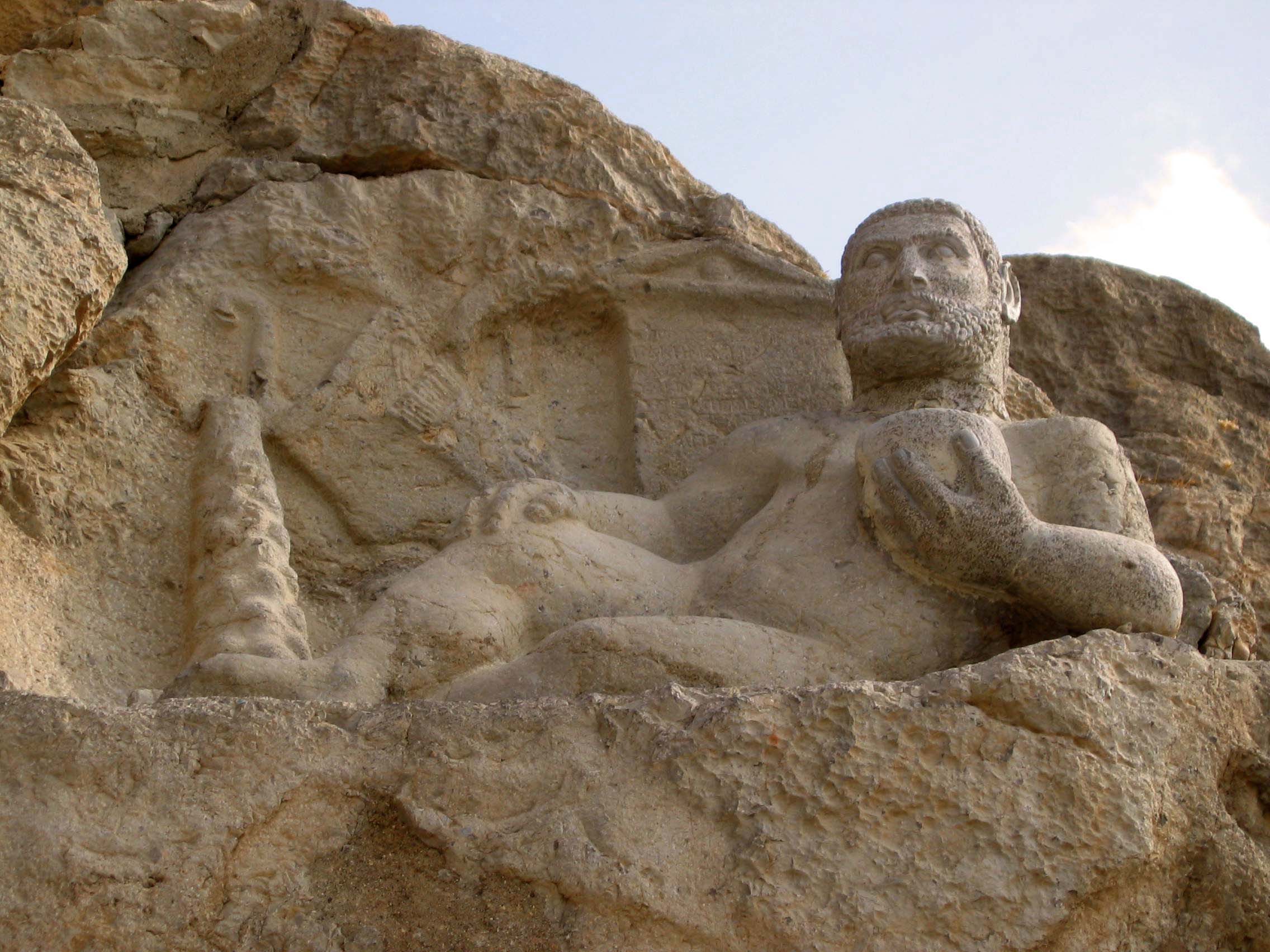
Statue of Hercules in Behistun
He lies on his back with a bowl in his left hand, carved into a mountainside in western Iran. This is not where you expect to find Hercules. Yet here on Mount Behistun, far from any Greek temple, the hero reclines in stone as he has since 148 BC, the only surviving rock sculpture from the entire Seleucid period on the Iranian Plateau. Discovered in 1958, the figure is at once Greek and not Greek at all. His club is propped behind him in the classical manner, but the bow he carries belongs to a Persian tradition. He is two gods occupying the same body, a monument to what happens when empires overlap.
Glorious in Victory
The inscription behind the statue dedicates it to "Herakles Kallinikos," Hercules glorious in victory. A Seleucid governor commissioned the work in honor of a satrap, the provincial ruler who administered this region for the empire that Alexander the Great's successors built across the ancient Near East. The dedication follows the conventions of Seleucid imperial epigraphy. The stele's form echoes other official monuments in the area, most notably one from Laodicia-in-Media at Nahavand, where a local official recorded a copy of the dynastic cult inscription that Antiochus III the Great created for his wife Queen Laodice III during his reign from 222 to 187 BC. Behind the Greek text, a fainter Aramaic version was also carved, though only the word for "in the year" remains legible. The governor wanted his message understood across languages and cultures.
Two Gods in One
Look closely and the sculpture tells a story of cultural fusion. According to historian Rolf Strootman, the design is more Iranian than Greek. In Hellenistic art, Heracles is rarely depicted with a bow. But this Hercules holds one, and it resembles the bows carved into the Behistun Inscription, the nearby monument that Darius the Great commissioned nearly four centuries earlier. The epithet "Kallinikos" was common in Greek religion, but it also suited the Iranian god Wahram, the Avestan deity Verethragna, a god of victory with whom the Greeks identified Hercules. The sculptor, who was not formally trained in Greek sculptural traditions, created something that belongs to neither culture entirely. The statue most likely represents the merging of Hercules and Wahram during the Seleucid period, though scholars note the evidence stops short of certainty.
A Shrine at the Crossroads
Near the statue stands the remnant of a small Ionic column, the same height as those at the Temple of Athena Nike in Athens. This fragment suggests the relief was part of a naiskos, a small shrine, bringing a piece of Greek sacred architecture to the Zagros Mountains. Mount Behistun sat along one of the ancient world's great east-west corridors, the route that connected Mesopotamia to the Iranian Plateau and beyond. Empires left their marks here in layers. Darius the Great carved his trilingual inscription into the cliff around 520 BC. The Seleucids added their Hercules six centuries later. Each successive power found this mountain irresistible as a place to declare presence and authority. The Ionic column beside a reclining Hercules holding a Persian bow captures the Seleucid project in miniature: govern an Iranian land through Greek forms, but bend those forms to local expectations.
Stolen and Recovered
The statue has not survived intact. Its head was stolen twice. After the second theft, authorities recovered it in 1996, but the damage was done. Today, a replica head sits on the original body. The genuine head is held by Iran's Cultural Heritage, Handcrafts and Tourism Organization. The theft underscores both the statue's vulnerability and its value. Carved directly into the mountain, the body cannot be moved or looted. But the head, protruding from the rock, proved too tempting. The replica maintains the figure's appearance for visitors, though it introduces a modern element into a scene that has otherwise changed little in over two thousand years. Hercules still reclines with his bowl and his club, still gazes across the valley where Silk Road caravans once passed, still embodies the moment when Greek mythology and Iranian religion briefly became the same thing.
From the Air
Located at 34.39N, 47.44E on the slopes of Mount Behistun in Kermanshah Province, western Iran. The statue is carved into the mountain near the larger Behistun Inscription complex. Best viewed from low altitude (2,000-4,000 feet AGL) approaching from the west along the valley. Nearest airport is Kermanshah (OICC/KSH), approximately 30 km to the southwest. The Zagros Mountain range creates significant terrain and weather considerations. Morning approaches offer the best light on the east-facing cliff.