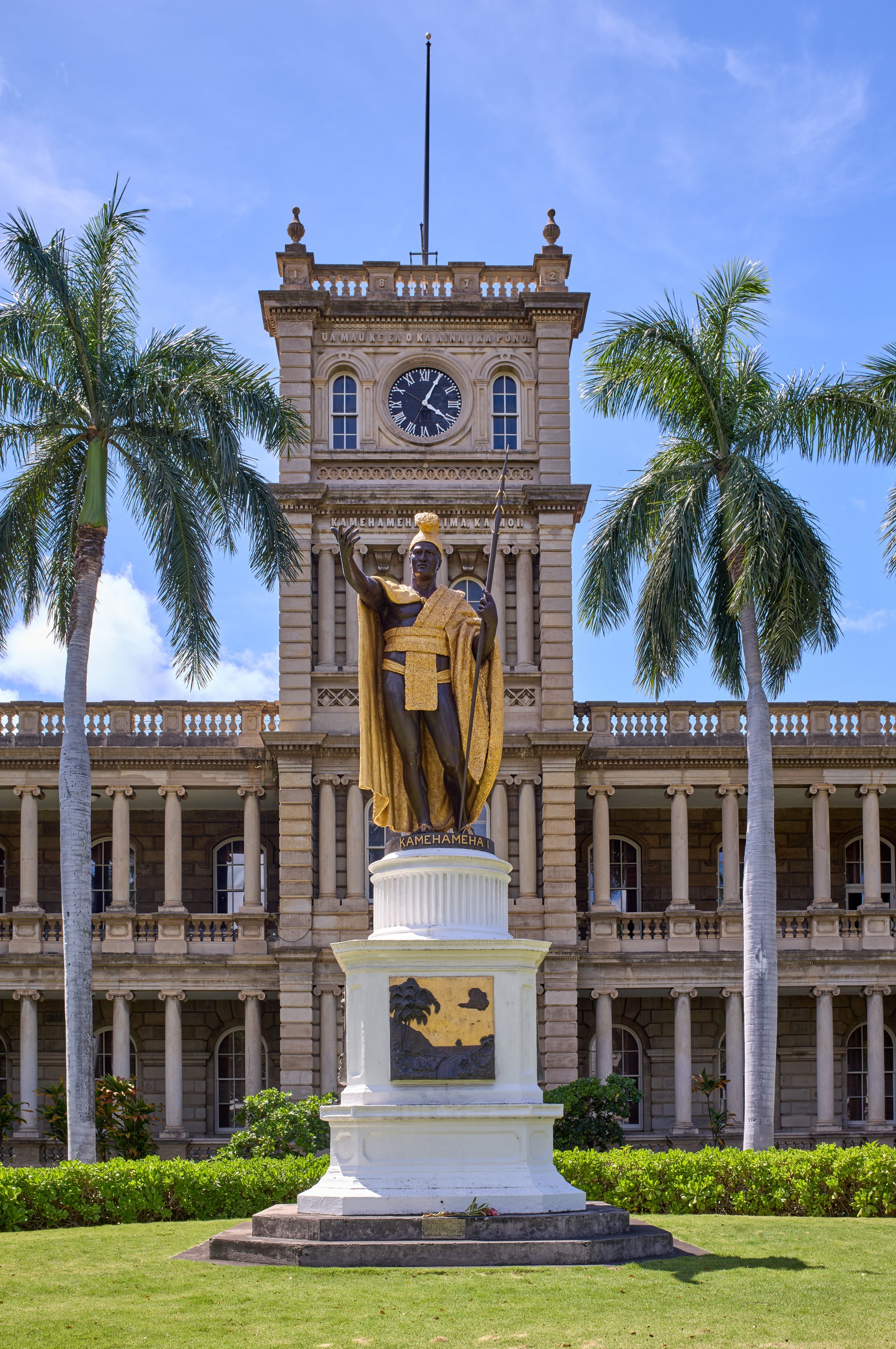
Statue of Kamehameha I (Honolulu)
The most famous statue in Hawaiʻi was never supposed to exist. It is a replacement — a backup cast, commissioned with insurance money after the original sank to the bottom of the South Atlantic. The ship carrying the first Kamehameha I statue went down in a storm near the Falkland Islands in the early 1880s, and by the time that original was fished out of the sea and delivered to Hawaiʻi, the second cast had already arrived in better condition. Officials chose the replacement. It was unveiled during King David Kalākaua's coronation ceremonies in February 1883 and has stood in front of Aliʻiōlani Hale ever since, becoming the most photographed, most lei-draped, and most iconic image of the Hawaiian Islands.
A Centennial Commission Gone Wrong
The idea originated in 1878 with Walter M. Gibson, a member of the Hawaiian legislature who wanted to mark the centennial of Captain James Cook's arrival to the Hawaiian Islands with a grand commemorative sculpture. Government funds were allocated, and Gibson selected American artist Thomas Ridgeway Gould, then working from a studio in Florence, Italy, to create the piece. Gould completed a full-size plaster model in 1880 and sent it to the Barbedienne Foundry in Paris to be cast in brass. The finished statue was shipped to Hawaiʻi in August of that year. It never arrived. The ship encountered a storm and sank near the Falkland Islands, taking the statue to the ocean floor. Hawaiʻi collected approximately $12,000 in insurance and immediately commissioned a second cast.
The Original Surfaces Too Late
What happened next is the kind of coincidence that makes history feel scripted. The original cast was recovered from the wreck and completed its journey to Hawaiʻi in March 1882. But the replacement had already been ordered and was on its way. When the second cast arrived in Honolulu in January 1883, officials compared the two and found the replacement in superior condition. The second cast was installed in front of Aliʻiōlani Hale in Honolulu, the location that had been intended for the original all along. The rescued first cast was sent to Kapaʻau in North Kohala on the island of Hawaiʻi, near Kamehameha I's birthplace, where it stands to this day. Having missed its moment as a centennial tribute, the Honolulu statue was instead unveiled during Kalākaua's coronation — a grander occasion, as it turned out.
The Sculptor Who Died Before Finishing
After the shipwreck, Gibson and Gould collaborated on an additional feature for the replacement: four partially gilded bas-relief panels for the statue's plinth, funded by an extra $4,000 from the insurance settlement. Each panel was to depict a scene from Kamehameha I's life, though Gibson intended them as political propaganda as much as historical record — modeled on the narrative tradition of Trajan's Column and other classical monuments. Whether Kamehameha was actually present at all the events depicted remains debated. Gould returned to his Florence studio to begin the reliefs but suffered a fatal heart attack on November 26, 1881, after completing only the maquette for the first panel. His son, Marshall S. Gould, finished the remaining three. The panels show Kamehameha meeting Captain Cook aboard the HMS Resolution off Lahaina in 1778, Kamehameha as a warrior deflecting spears, the king reviewing his war fleet off the Kohala coast, and travelers resting along a road — an illustration of his Kānāwai Māmalahoe, the law guaranteeing safe passage on Hawaiian roadways.
Golden King of Kamehameha Day
The statue is an oversized brass figure with a two-toned finish: a dark brown chemical patina on the body and gilded garments that catch the Hawaiian sunlight. It has become inseparable from Hawaiʻi's identity. The image appears on the official state seal and the logo of the Kamehameha Schools. In 1959, a third cast was made from the Honolulu statue's molds and placed in National Statuary Hall inside the U.S. Capitol to mark Hawaiʻi's admission as the fiftieth state. Every June 11, Kamehameha Day, the statue is ceremonially draped in lei that cascade from its outstretched arms to the ground — an annual tribute to the warrior who unified the Hawaiian Islands into a single kingdom in 1810. Tourist shops sell miniature reproductions, postcards feature its silhouette against tropical sunsets, and visitors line up for photographs. But beneath the gilding and the souvenirs, the statue represents something the insurance adjusters and foundry workers could never have intended: a symbol that endured precisely because the first version was lost.
From the Air
The Statue of Kamehameha I is located at 21.306°N, 157.860°W in front of Aliʻiōlani Hale in downtown Honolulu on Oʻahu. The gold-leaf figure is distinctive from low altitude, standing in the building's courtyard facing King Street with ʻIolani Palace directly across. Best viewed at 1,000–2,000 ft AGL. Nearest airport: Daniel K. Inouye International (PHNL), approximately 5 nm northwest. The downtown Honolulu civic center provides a dense cluster of visual landmarks including the State Capitol, Kawaiahaʻo Church, and Honolulu Harbor to the south.