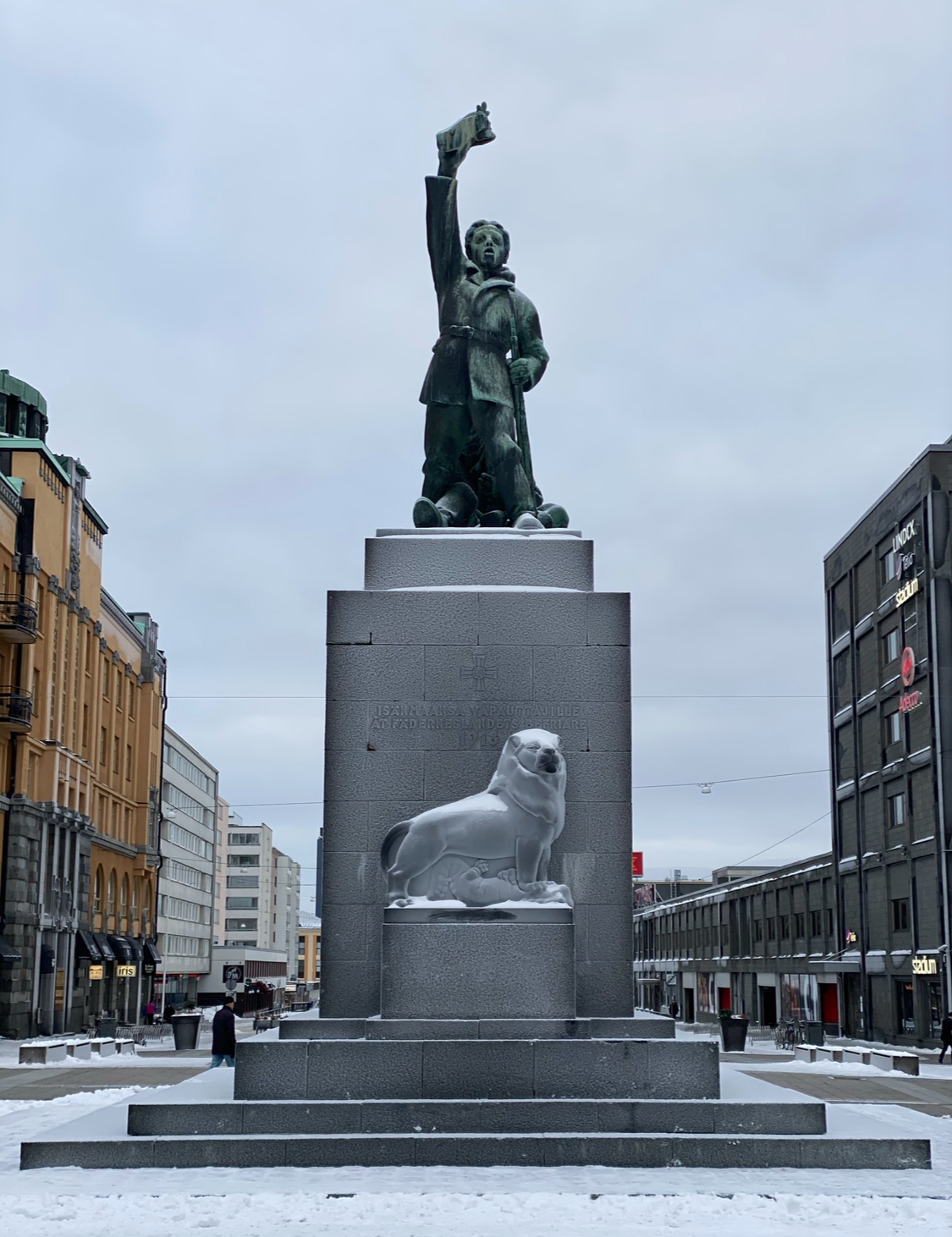
Statue of Liberty (Finland)
Not every Statue of Liberty celebrates the same kind of freedom. In the Market Square of Vaasa, a 14-meter bronze monument rises above the cobblestones, crowned not with a torch but with the imagery of a young nation tearing itself apart. Finland's Statue of Liberty -- Vapaudenpatsas -- commemorates the White victory in the Finnish Civil War of 1918, a conflict that split the country along class lines barely a year after independence from Russia. The statue took twenty years of disagreements, fundraising struggles, and political maneuvering before its unveiling in 1938. Its existence says as much about the difficulty of memorializing civil wars as it does about the war itself.
A War Between Neighbors
The Finnish Civil War erupted in January 1918, just weeks after Finland declared independence from Russia on 6 December 1917. The conflict pitted the conservative White Guard, backed by the Senate and supported by Imperial Germany, against the socialist Red Guard, which drew its strength from the industrial working class and landless rural laborers. Vaasa served as the White capital during the war, making it the natural home for a monument to the White cause. The fighting lasted only a few months -- from late January to mid-May 1918 -- but it left deep wounds. Approximately 37,000 Finns died, many of them in the brutal aftermath, when thousands of Red prisoners perished in internment camps from disease and starvation. The victors remembered liberation; the defeated remembered something very different.
Twenty Years of Argument
A committee to plan the statue was assembled in the summer of 1918, while the war's echoes were still fresh. The group included prominent Vaasa businessmen: Commercial Counselor E. J. Ollonqvist, Consul Erik Hartman, and Gosta Serlachius, the industrialist from Mantta. Fundraising drew contributions from across Finland, though the bulk of the money came from Ostrobothnia and Vaasa itself. The total cost reached 1,352,000 Finnish marks, with the city of Vaasa covering the pedestal and the unveiling ceremony. But the project dragged on for two decades. Disagreements over the monument's purpose -- should it celebrate military victory, mourn the dead, or symbolize national unity? -- stalled progress repeatedly. The question of how to memorialize a civil war is never simple, and Finland wrestled with it longer than most.
Bronze and Allegory
The monument that finally emerged is rich with symbolic detail. Four allegorical reliefs adorn the pedestal, each facing a different direction. Tyo -- "Work" -- shows a man holding a grain sheaf and sickle. Tulevaisuus -- "Future" -- depicts a mother with two children. Laki -- "Law" -- presents a man bearing sword and shield. Uskonto -- "Religion" -- portrays a woman turning her face toward a church. Together they sketch the values the White victors wished to project: industriousness, family, order, faith. On the pedestal's back, a relief of Marshal C. G. E. Mannerheim surveys the scene in his military jacket, binoculars in hand, with soldiers marching behind him and a cannon wheel visible in the background. Mannerheim led the White forces to victory and would later serve as Finland's president during World War II -- a figure whose stature only grew with time.
An Unveiling and Its Silences
On 9 July 1938, the Statue of Liberty was finally unveiled in Vaasa's Market Square. The city paid for the celebration. Twenty years had passed since the war, long enough for the physical scars to heal but not the political ones. The monument stands in a country where the civil war remained a sensitive subject for generations. Red families did not see their experience reflected in the bronze allegories of Work and Law and Religion. The statue celebrates one side's version of liberty -- a version inseparable from military victory over fellow citizens. Finland has since grappled openly with the civil war's legacy, but the Vapaudenpatsas remains fixed in its original framing: a White monument in a White wartime capital. It endures as both a work of art and a reminder that freedom, like history, looks different depending on where you stand.
From the Air
Located at 63.10N, 21.62E in the center of Vaasa, Finland, in the Market Square (Kauppatori). The monument stands 14 meters tall including pedestal. Vaasa Airport (EFVA) is approximately 9 km to the southeast. From the air, the Market Square is identifiable as an open area in Vaasa's grid-pattern city center, near the waterfront along the Gulf of Bothnia.