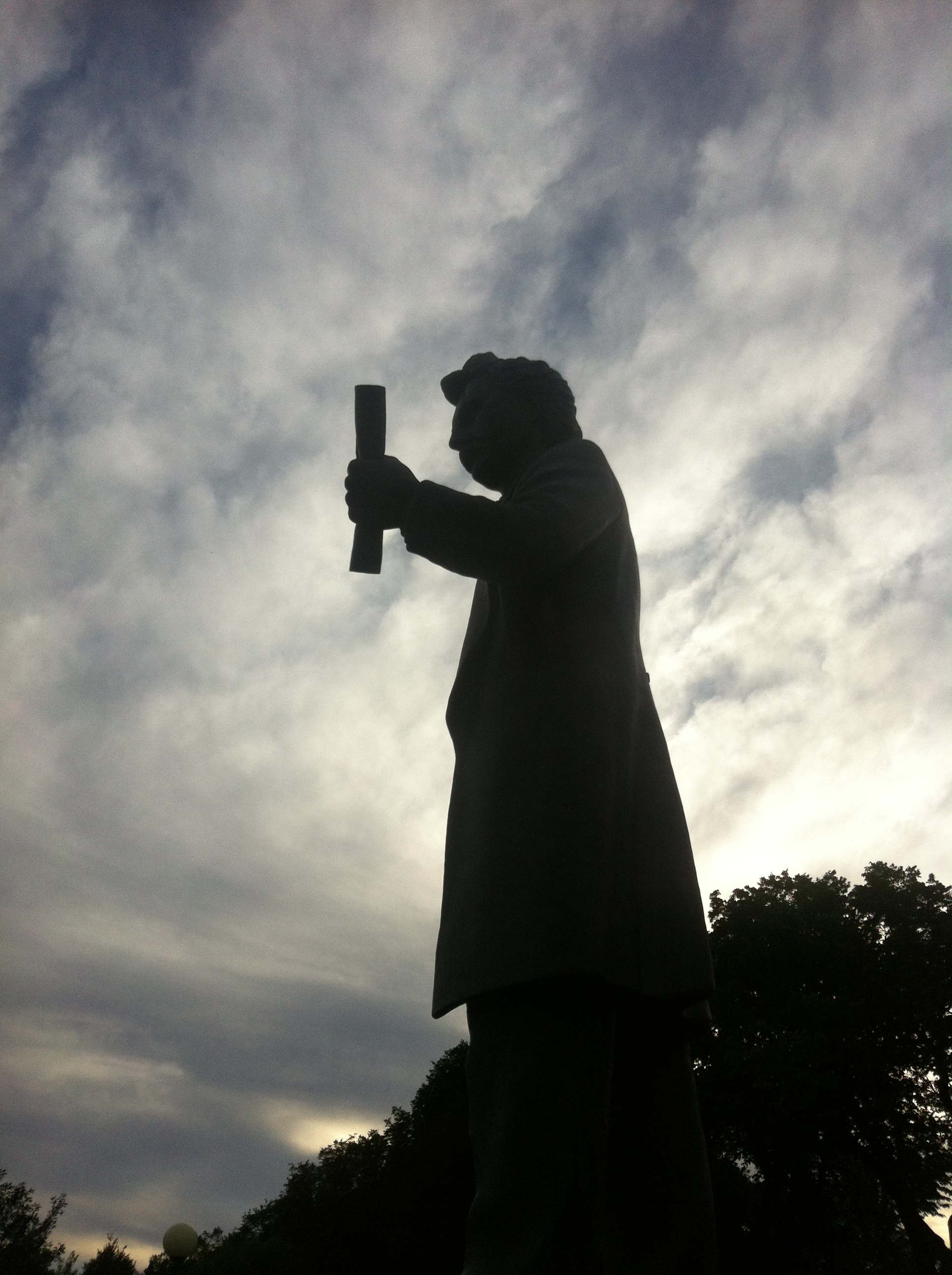
Statue of Louis Riel
His fists are clenched. His left hand grips a rolled parchment -- the Manitoba Act, the document he fought to create and was ultimately hanged for defending. Standing over sixteen feet tall on a base of Tyndall Stone, the bronze figure of Louis Riel faces the Assiniboine River from the south grounds of the Manitoba Legislative Building, occupying one of the most politically charged pieces of real estate in Canada. This is the second statue of Riel to stand in Winnipeg. The first, a tortured nude figure by Marcien Lemay and Etienne Gaboury, was so controversial that it was removed in 1995 after two decades of public outcry. Sculptor Miguel Joyal's replacement, commissioned by the Manitoba Metis Federation, chose a different path: Riel dressed in period clothing, wearing moccasins and a sash, depicted not as a victim but as a leader.
The Father of Manitoba
Understanding the statue requires understanding the man. Louis Riel led the Red River Resistance of 1869-1870, organizing the Metis people of the Red River Settlement against the Canadian government's attempt to absorb their lands into the new Dominion without consultation. That resistance produced the Manitoba Act of 1870, which created the province of Manitoba and guaranteed Metis land rights and French language protections. Riel was elected to the Canadian Parliament three times but was never permitted to take his seat. After years of exile in the United States, he returned to lead the North-West Resistance of 1885 in what is now Saskatchewan. Captured after the Battle of Batoche, he was tried for high treason and hanged on November 16, 1885. His execution divided the country along linguistic and cultural lines, a wound that has never fully healed. In 1992, the Canadian Parliament and the Manitoba legislature formally recognized Riel as a founder of Manitoba.
From Foam to Bronze
Miguel Joyal conceived the maquette in just two weeks during April 1995, and his model was officially selected on May 3. The bronze construction took place at the MST Bronze Limited Art Foundry in Toronto. Workers began by welding a steel armature -- legs, arms, head -- and fastening it to a wheeled base. Two eight-foot blocks of extruded polystyrene foam were glued to the leg framework, then carved using various saws while Joyal divided both the maquette and the foam frame into five equal parts so that one inch of the model represented one foot of the final sculpture. At sixteen feet eight and a half inches, the statue was too large for traditional lost-wax casting. Instead, Joyal divided it into ten sections and used sand casting -- sand mixed with epoxy, formed around each section, dusted with graphite to prevent adhesion. Plasticine layers created the voids for molten bronze. After casting, the ten sections were welded together, sandblasted to a uniform texture, and coated with patina to protect the metal from Winnipeg's brutal climate.
Symbols in Bronze
Every detail of the statue carries meaning. Joyal dressed Riel in a 19th-century shirt, overcoat, and trousers drawn directly from historical photographs, grounding the figure in documented reality rather than artistic interpretation. The moccasins and Metis sash speak to Riel's Indigenous heritage, the mixed-ancestry culture that defined his political mission. The Manitoba Act clutched in his left hand is the statue's central symbol -- not a weapon, not a cross, but a legal document, a reminder that Riel's most lasting achievement was the creation of a province through negotiation and political skill. His clenched fists and forward stance were deliberately composed to convey power and leadership, a conscious counter-narrative to the earlier nude statue that had depicted him as anguished and vulnerable.
A Contested Monument
The statue's $200,000 cost was to be split between the Manitoba Metis Federation and the Province of Manitoba. When the MMF struggled to raise its share in 1994, the federal government contributed $15,000 to close the gap. The finished sculpture was transported from Toronto to Winnipeg in a large wooden crate and fastened to a cement base plated with Tyndall Stone -- a locally quarried dolomitic limestone shot through with fossils, the same material used to build the Legislative Building itself. The statue now stands on the building's south grounds, facing the river that defined the Metis homeland. It is simultaneously a work of public art, a political statement, and a memorial to a man whose legacy still sparks debate across Canada. Riel's body rests at the cemetery of St. Boniface Cathedral, just across the river, within sight of the bronze figure that stands on the grounds of the province he created.
From the Air
Located at 49.8828N, 97.1459W on the south grounds of the Manitoba Legislative Building in Winnipeg. The Legislative Building's distinctive dome and grounds are clearly visible from the air, situated between the Assiniboine River to the south and Broadway to the north. Nearest major airport is Winnipeg James Armstrong Richardson International (CYWG), approximately 7 km west. Best viewed from 1,000-2,000 ft AGL. The statue faces south toward the Assiniboine River. St. Boniface Cathedral, where Riel is buried, is visible across the Red River to the east.