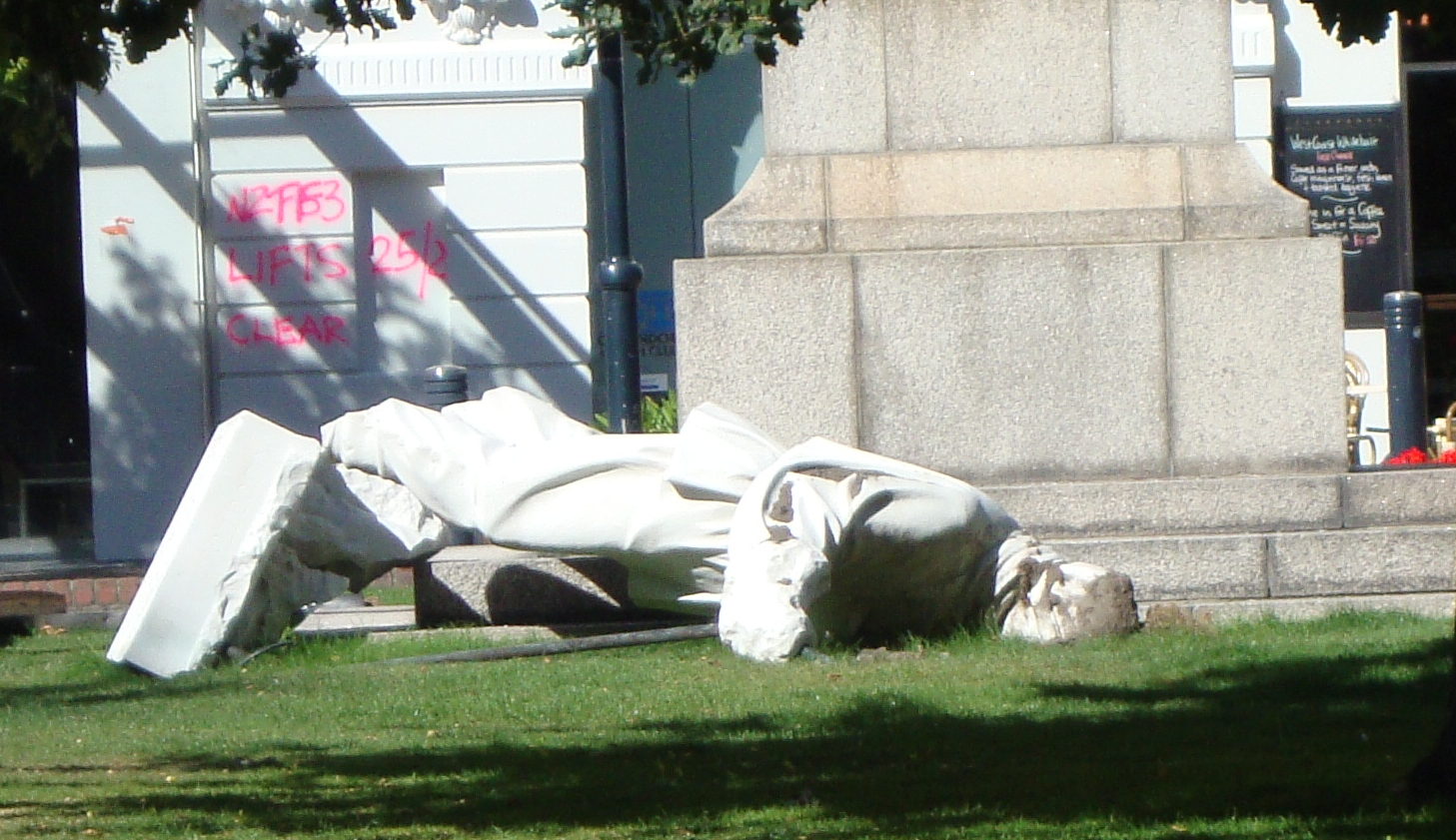
Statue of Robert Falcon Scott, Christchurch
Kathleen Scott had already lost her husband to Antarctica. Now, in March 1916, she stood in a marble quarry in Carrara, Italy, chiseling his likeness from stone while Europe tore itself apart around her. The statue she carved - Captain Robert Falcon Scott in polar dress, bronze alpenstock in hand - would travel by ship to Christchurch, the city that had been Scott's last point of civilization before the ice. Unveiled on 9 February 1917, it stood beside the Avon River for ninety-four years. Then, on 22 February 2011, the earthquake that devastated Christchurch threw the marble figure from its granite plinth and broke it in two. The statue's story mirrors the city's own: loss, endurance, and the stubborn refusal to let either stay fallen.
Christchurch's Antarctic Connection
Scott chose Christchurch and its port at Lyttelton as his New Zealand base twice - for the Discovery Expedition of 1901-1904 and the Terra Nova Expedition of 1910-1913. Between those voyages, Ernest Shackleton's Nimrod Expedition of 1907-1909 also used Lyttelton as a staging point, cementing Canterbury's role as the gateway to Antarctic exploration. When the Terra Nova arrived at Lyttelton Harbour on 28 October 1910, locals welcomed Scott and his companions warmly. The explorers conducted research at the Canterbury Museum and tested meteorological equipment in the Christchurch Botanic Gardens. On 28 November, crowds gathered at the harbor to bid farewell as the expedition departed for Port Chalmers and then the ice. Scott and four companions reached the South Pole on 17 January 1912 - only to find that Roald Amundsen's Norwegian team had beaten them by thirty-four days.
The Long March Home
The return journey destroyed them. Exhausted, frostbitten, and running low on supplies, the five-man polar party dwindled. Edgar Evans died first, then Lawrence Oates walked out of the tent into a blizzard with the famous words 'I am just going outside and may be some time.' Scott, Henry Robertson Bowers, and Edward Wilson pitched their tent for the last time on 19 March 1912, just eleven miles from a supply depot that could have saved them. A blizzard pinned them down. Scott, unable to walk, likely died on 29 March - the last of the three. When the Terra Nova reached Oamaru on 10 February 1913, two crew members rowed ashore and sent a coded message carrying the news. Two days later, the ship entered Lyttelton Harbour. The crew were startled to see the city already draped in mourning, flags at half-mast. Throughout the British Empire, the dead explorers were received as heroes.
A Widow's Chisel
Within a week of the news reaching Christchurch, Mayor Henry Holland convened a public meeting to organize a memorial fund. Over a thousand pounds flowed in from schools and local organizations. The Scott Memorial Committee wrote to Kathleen Scott, who was already sculpting a bronze of her husband for Waterloo Place in London, erected in 1915. The committee commissioned a replica, but World War I had driven bronze prices beyond reach. Marble became the practical alternative, and Kathleen traveled to Carrara to carve it herself. She completed the 2.6-meter figure in May 1916. Shipped to New Zealand, it was unveiled on 9 February 1917 at Worcester Street and Oxford Terrace, beside the Avon River. The Governor-General, the Earl of Liverpool, spoke of how Scott 'represented everything best in the traditions of the British Navy.' A large crowd watched the white marble figure take its place overlooking the city that had been his last home port.
Toppled, Mended, Toppled Again
For nearly a century the statue stood undisturbed. Then the February 2011 earthquake flung it from its plinth, snapping the marble in two. The broken pieces were carefully recovered and placed on display at the Canterbury Museum while restoration work began. The repair was meticulous: four carbon fibre rods were inserted from foot to waist through each leg, and the base was fitted with a spring mechanism designed to absorb future seismic shocks. The restoration cost was estimated at 560,000 dollars. On 6 October 2017, descendants of Scott and former Mayor Lianne Dalziel unveiled the statue a second time in its original location. Weeks later, someone snapped off the bronze alpenstock from Scott's right hand. A council staff member found it in a nearby garden. It was reattached. The statue, like the explorer it depicts and the city that erected it, has proven difficult to keep down. Heritage New Zealand recognized it as a Category II historic place in 1981 - one of the few monuments anywhere dedicated to early twentieth-century Antarctic exploration.
From the Air
The Scott Statue stands at the corner of Worcester Street and Oxford Terrace in Christchurch Central City (43.5312S, 172.6336E), beside the Avon River in the small Scott Statue Reserve. Not individually visible from altitude, but the park is part of the Avon River corridor that traces a clear green line through the city grid. Christchurch Airport (NZCH) is approximately 10 km to the northwest. The Canterbury Museum, where the statue was housed during restoration, is nearby on Rolleston Avenue. From the air, look for the distinctive bend of the Avon near Worcester Street. Banks Peninsula and the Port Hills are visible to the southeast. Recommended altitude: 2,000-4,000 ft for the central city layout.