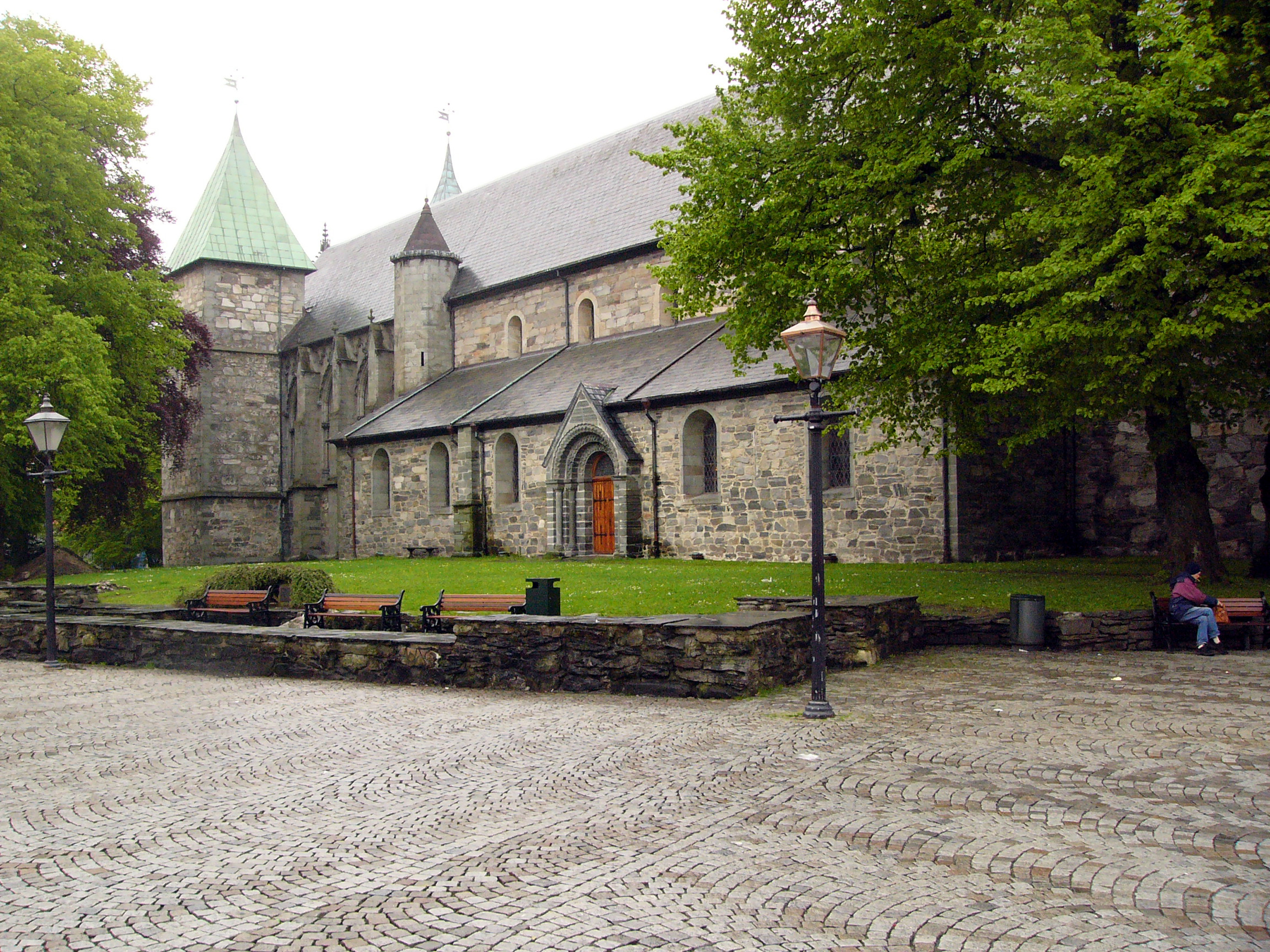
Stavanger Cathedral
An English bishop brought his patron saint across the North Sea around 1100, and the gray stone church he raised in Stavanger still stands. Dedicated to Saint Swithun of Winchester, the cathedral is the oldest in Norway -- a place where Romanesque round arches give way to pointed Gothic vaults, where pillar capitals carved with scenes of Ragnarok sit beneath a Christian altar, and where the medieval and the modern occupy the same worn flagstones. Stavanger counts 1125 as the year of its founding, tied not to a king's decree or a battle, but to the completion of this building.
An English Saint in a Norse City
Bishop Reinald, who may have come from Winchester in England, began construction around 1100. The cathedral he built was modest by continental standards: a wooden rectangular nave, a narrower chancel, and a tall western tower, all dressed in the pale gray stone that gives Stavanger's old quarter its distinctive character. By 1150, the building was complete and consecrated to Saint Swithun, an early Bishop of Winchester and patron saint of Winchester Cathedral. The dedication was not arbitrary -- it bound this remote Norwegian diocese to one of England's most powerful ecclesiastical seats, a connection carried in stone and liturgy for centuries. The church served as the seat of the Catholic Diocese of Stavanger until the Protestant Reformation reshaped Norway's religious landscape.
Fire, Rebirth, and the Gothic Turn
In 1272, fire ravaged Stavanger and left the cathedral badly damaged. Bishop Arne, who served from 1276 to 1303, oversaw the rebuilding, and what rose from the ashes was a different building in spirit. The original Romanesque structure was enlarged in the Gothic style: the west tower gave way to a vestibule with a broader base, and the choir was rebuilt and extended with an east facade crowned by two corner towers and a great window. Crypts that had lain beneath the Romanesque choir survived the transformation. The result was a hybrid -- Romanesque bones dressed in Gothic ambition -- that gives the interior its unusual rhythm. Round pillars march down the central nave in arched procession, their capitals alive with figures that depict not biblical scenes but Ragnarok, the Norse apocalypse. Palmettes and arcatures decorate the cornices, weaving Christian architectural grammar with older mythological threads.
A Diocese Lost and Found
In 1682, King Christian V stripped Stavanger of its episcopal seat, transferring it to Kristiansand. For nearly 250 years, the cathedral stood without a bishop -- still a parish church, still in use, but diminished. The 1860s brought well-meaning renovation that plastered over the stone walls and erased much of the building's medieval character. It took architect Gerhard Fischer, working from 1939 to 1964, to peel back those layers and restore what could be recovered. Then, on Stavanger's 800th anniversary in 1925, King Haakon VII re-established the Diocese of Stavanger, appointing Jacob Christian Petersen as the city's first bishop since the late 17th century. The cathedral was whole again -- not just as a building, but as the spiritual center its builders had intended.
Where Democracy Found Its Voice
In 1814, while Europe convulsed in the aftermath of the Napoleonic Wars, Norway seized the chance to write its own constitution. Stavanger Cathedral became an election church -- one of more than 300 parish churches across the country that served as polling stations for Norway's first national elections. Each parish elected representatives who would travel to Eidsvoll to draft the Constitution of Norway, a document that remains among the oldest codified constitutions in continuous use. The cathedral's role was brief but significant: it placed this ancient building at the intersection of religious tradition and democratic aspiration, adding another layer to a structure already rich with accumulated meaning.
Stone Witnesses
At the entrance to the sacristy, sculpted busts of three medieval Norwegian kings -- Magnus VI, Eric II, and Haakon V -- gaze out at visitors. The baptismal font dates to approximately 1300, its stone basin shaped by hands that lived seven centuries ago. The Bishop's chair, by contrast, dates only to 1925, marking the year the diocese was restored. Scottish craftsman Andrew Lawrenceson Smith, working in the mid-to-late 1600s, left his mark in woodwork that has outlasted the empire he served. These objects anchor the cathedral in specific moments, but the building itself transcends any single era. It seats about 800 people today, much as it has for centuries -- a working church where weddings follow funerals, where ordinary Sundays accumulate into something extraordinary simply through persistence.
From the Air
Stavanger Cathedral is located at 58.97N, 5.73E in central Stavanger, Norway. The gray stone structure is nestled between the Breiavatnet lake and the harbor Vagen. Best viewed at altitudes below 3,000 feet for detail. Stavanger Airport Sola (ENZV) is located approximately 14 km southwest. The cathedral sits in the old city center and is identifiable by its tower among the low-rise historic buildings.