Steamboat Jenny Lind
Dinner had just been called aboard the steamboat Jenny Lind on the evening of April 11, 1853. The ferry was making its regular run from Alviso to San Francisco across the Bay, carrying residents of Alviso and San Jose. As the vessel passed the Redwood City inlet, the boiler exploded. The worst casualties fell among the women and children, who had been seated first at the dinner table, closest to the blast. At least 31 people died.
A Name from the Stage
Built in San Francisco in 1850, the Jenny Lind was named for the Swedish opera singer Jenny Lind, whom P.T. Barnum had made famous across the United States through a spectacular promotional tour. The name was fashionable. Hotels, theaters, and ships across the country borrowed the singer's celebrity, and the Bay Area ferry was no exception. For residents of Alviso and San Jose, the Jenny Lind was a vital transportation link. The South Bay had no railroad, and the ferry was the fastest way to reach San Francisco. The explosion did not just take lives; it severed a community's primary connection to the commercial center of the region.
The People Lost
Among the dead were some of the most prominent citizens of early California. Jacob David Hoppe, a contributing founder of The Daily Alta California and a signatory of the Constitution of California, had served as the first postmaster of San Jose. Thomas W. White was the second mayor of the Pueblo of San Jose. Thomas Godden was a landowner in Santa Clara County. Christopher A. Shelton was a botanist credited with bringing the first beehive to San Jose. Noah Ripley was a prominent San Francisco resident. These were not anonymous passengers. They were the civic builders of a young state, people whose absence was felt in the institutions they had been creating.
The Railroad That Grief Built
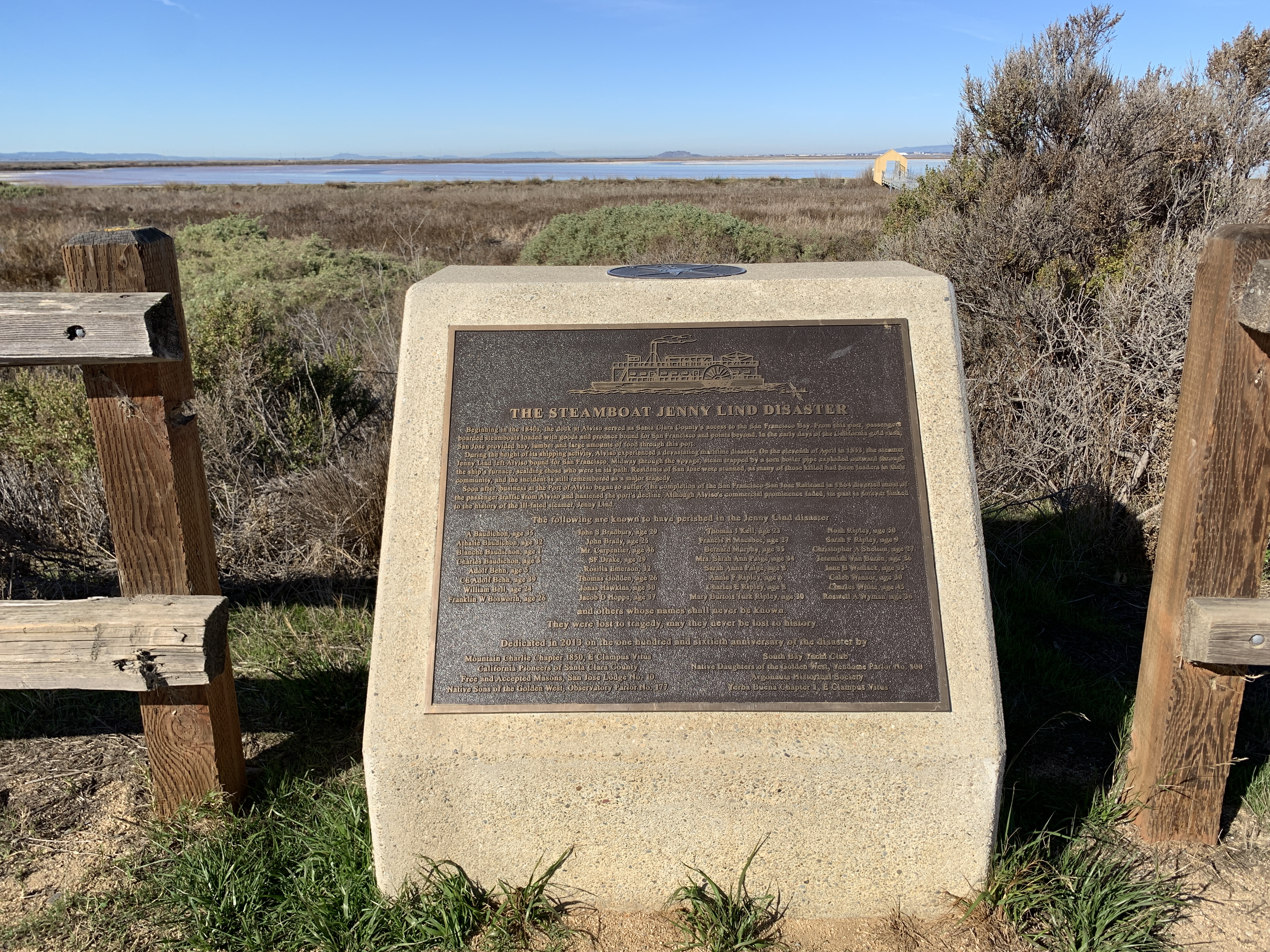
The destruction of the Jenny Lind did more than mourn a tragedy; it accelerated a transportation revolution. The disaster became a major argument for building the San Francisco and San Jose Railroad, eliminating the dangerous dependence on steamboat travel across the Bay. The railroad, when it came, transformed the Peninsula, connecting the communities between San Francisco and San Jose by land for the first time and setting the template for the commuter corridor that Caltrain follows today. A memorial to the Jenny Lind disaster stands at Alviso Marina County Park, marking the spot where the ferry's passengers began their final voyage. It is a quiet monument in a quiet park, easy to miss unless you know the story of the dinner bell that rang just before the boiler blew.
From the Air
Located at 37.54°N, 122.18°W in San Francisco Bay near the Redwood City inlet. The explosion occurred in open water during a ferry crossing from Alviso to San Francisco. A memorial exists at Alviso Marina County Park at the south end of the Bay. San Carlos Airport (KSQL) is approximately 4 miles west. The Redwood City inlet and salt ponds provide visual reference from altitude.