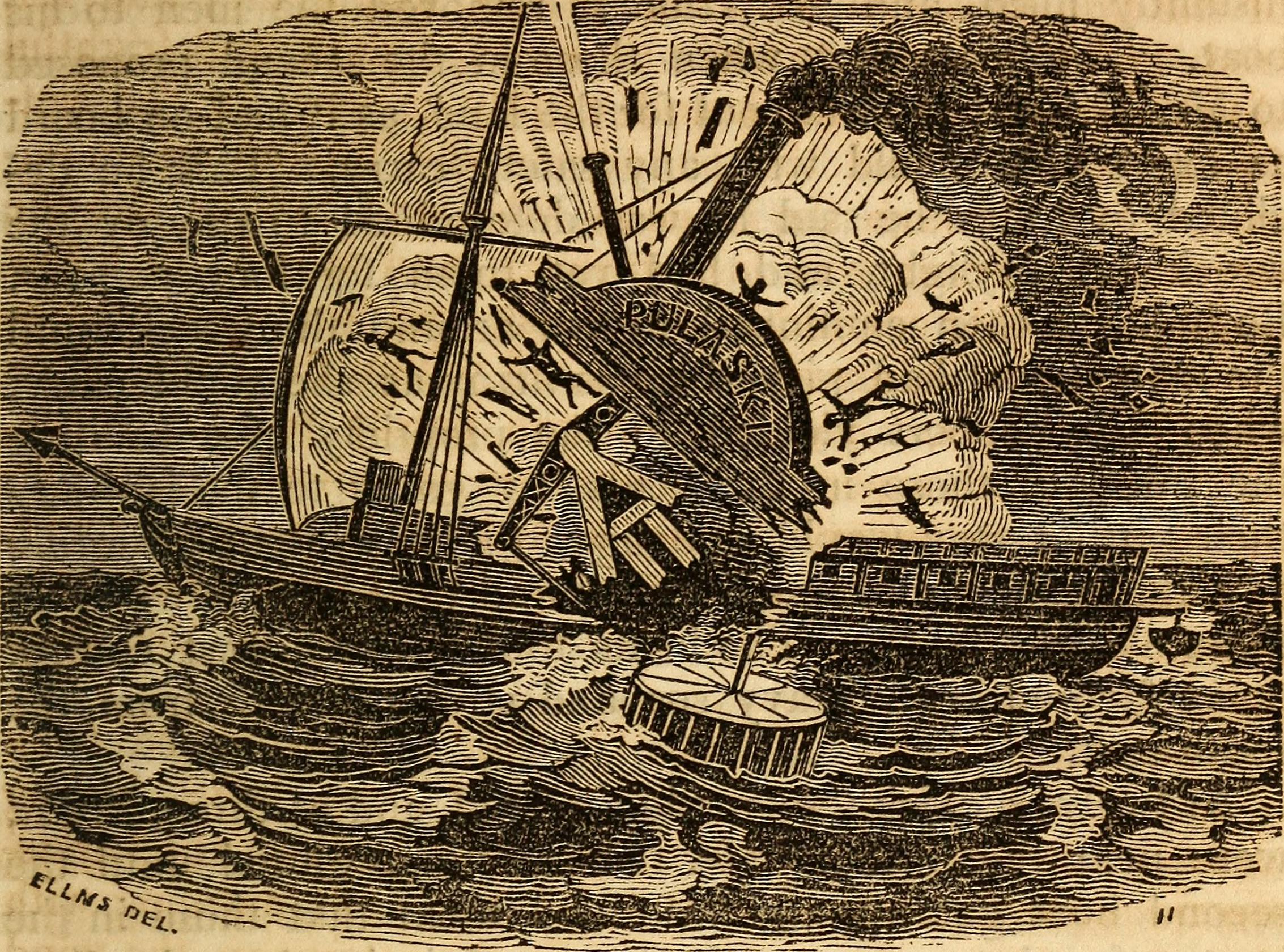
Steamship Pulaski Disaster
Forty-five minutes. That is all the time the passengers of the Pulaski had between the thunderclap of a starboard boiler explosion and the black Atlantic swallowing their ship whole. It was June 14, 1838, a warm Thursday night on the coastal run from Savannah to Baltimore, and most of the 168 souls aboard were asleep when the blast ripped through the middle of the vessel at eleven o'clock. The concussion killed some instantly. Others staggered onto a deck that was already splitting apart beneath their feet. Within three-quarters of an hour, the Pulaski was gone, and the survivors -- barely a third of those who had boarded -- were left clinging to wreckage in the open ocean, miles from the Carolina shore.
A Voyage of Prominence
The Pulaski was no ordinary coastal steamer. She carried the Southern elite -- planters, bankers, politicians, and their families -- on the popular summer route between Savannah and the mid-Atlantic ports. On her final voyage, the passenger manifest read like a social register. William B. Rochester, a former United States congressman from New York, was aboard. So was Jane Lamar, wife of the powerful Savannah banker and shipper Gazaway Bugg Lamar, traveling with five of their six children and a niece. The ship departed Charleston under Captain DuBois with a crew of 37 and 131 passengers, threading northward along the familiar coastline. No one had reason to fear. Steam packets had transformed coastal travel into something approaching luxury, and the Pulaski was considered a fine vessel.
Eleven O'Clock Thunder
The explosion announced itself with a violence that left no room for comprehension. The starboard boiler detonated, tearing through the midsection of the ship and opening a wound that no crew could close. Passengers who survived the initial blast emerged into chaos -- scalding steam, shattered timber, the screams of the injured and the terrible sound of water rushing in. First Mate Hibbard, knocked unconscious by the concussion, came to and assessed the lifeboats. The ship carried three small boats, but two had been so damaged by prolonged sun exposure that they were barely seaworthy. One sank almost immediately after being lowered. Ten survivors crammed into one boat, eleven into the other, and they began rowing desperately away from the doomed vessel. Those left behind clung to whatever wreckage they could find as the Pulaski slipped beneath the surface, roughly thirty miles off the North Carolina coast.
The Weight of Loss
Of the 168 passengers and crew aboard, only about 59 survived. The Lamar family was devastated: Jane Lamar, five of her children, and a niece all perished. Her husband Gazaway and their eldest son Charles Augustus Lafayette Lamar were among the few family members to escape. The confusion in the aftermath was so thorough that neither father nor son appeared on the initial survivor lists published two weeks later in the North-Carolina Standard. It took months -- and the work of salvage divers recovering personal effects from the wreck -- to confirm who had lived and who had died. The disaster sent shockwaves through the planter aristocracy of the antebellum South, where the names on the casualty list were recognized in every drawing room from Savannah to Richmond.
Echoes Across Centuries
The Pulaski's story refused to stay buried. Newspapers in 1838 devoted columns to what they called a "heart-rending catastrophe," and the disaster entered the literary imagination almost immediately. Eugenia Price wove the tragedy into her 1985 novel To See Your Face Again, the second book in her Savannah Quartet. Patti Callahan's 2021 novel Surviving Savannah brought the Pulaski back to popular attention. And in 2018, nearly 180 years after the sinking, divers located wreckage off the North Carolina coast that they identified as the Pulaski, prompting the Charlotte Observer to dub it "the Titanic of its time." The wreck site, resting in the waters where the Outer Banks give way to the open Atlantic, holds not just the remains of a ship but the possessions and the stories of the people who sailed on her -- silver, porcelain, and personal artifacts still being recovered from the seafloor.
A Graveyard in Open Water
From the air, there is nothing to mark where the Pulaski went down. The ocean off Cape Hatteras looks the same as it has for centuries -- gray-green swells rolling toward the barrier islands, the pale line of the Outer Banks curving away to the south. But the waters here are among the most storied shipwreck grounds on the Atlantic seaboard, and the Pulaski is one of their earliest and most tragic losses. The wreck sits roughly thirty miles offshore, in waters deep enough that it remained undiscovered for 180 years. For the passengers who clung to debris through the long night of June 14, 1838, rescue came from passing ships and from their own desperate rowing toward a coast they could not see. The survivors carried the memory of those forty-five minutes for the rest of their lives.
From the Air
Located at approximately 35.73N, 74.76W, roughly 30 nautical miles off the North Carolina coast near Cape Hatteras. The wreck site lies in open Atlantic water east of the Outer Banks. Best viewed from 5,000-10,000 feet, where the transition from shallow coastal waters to deep ocean is visible. Nearby airports include Billy Mitchell Airport (KHSE) on Hatteras Island and Dare County Regional Airport (KMQI) in Manteo. The Outer Banks barrier islands provide a dramatic visual reference line along the coast.