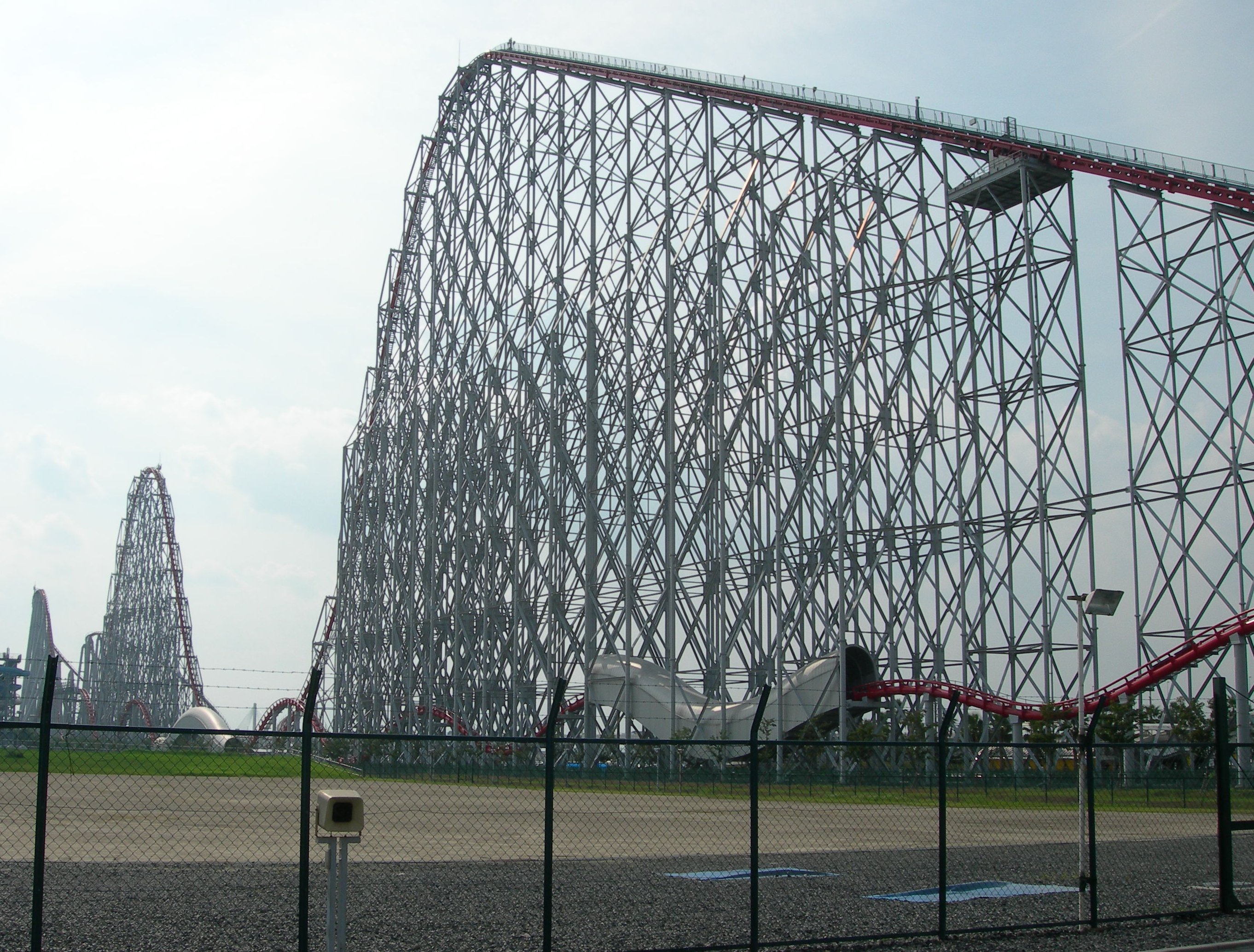
Steel Dragon 2000
The year 2000 was the Year of the Dragon in the Chinese zodiac, and in Mie Prefecture, Japan, an amusement park decided to honor that symbolism in the most literal way possible: by building a steel beast that would devour world records. Steel Dragon 2000, opening on August 1, 2000, at Nagashima Spa Land, arrived as the tallest, fastest, and longest complete-circuit roller coaster on the planet. Only three months earlier, Cedar Point's Millennium Force in Ohio had claimed the title of the world's first giga coaster. Steel Dragon 2000 became the second, and in several measurements, it surpassed its American rival immediately.
Built to Survive the Earth Itself
Japan sits on the Pacific Ring of Fire, where earthquakes are not possibilities but certainties. The engineers at D. H. Morgan Manufacturing faced a challenge unique among roller coaster designers: the structure had to flex and endure seismic forces that would twist lesser frameworks into wreckage. The solution was steel -- far more of it than any comparable coaster required. The resulting framework is visibly heavier and denser than its international peers, a lattice of reinforced supports that gives Steel Dragon 2000 the appearance of an industrial bridge stretched across the Ise Bay coastline. That earthquake-resistant engineering came at a price: over 7 billion yen, making it one of the most expensive roller coasters ever constructed. The investment proved prescient. The coaster has weathered decades of seismic activity without structural compromise.
A Dragon's Anatomy
The ride begins with a right-hand turn onto a lift hill so long it requires two separate chain systems driven by independent motors to haul trains to the summit. From the crest, riders plunge down a 93-meter drop, the ground rushing upward as the train accelerates to 153 kilometers per hour. A series of airtime hills follows, each one momentarily lifting passengers from their seats before gravity reclaims them. The outbound run threads through a pair of helixes -- one clockwise, one counterclockwise -- that press riders sideways as the track corkscrews through the support structure of its own hills. Midcourse brakes mark the turnaround, and the return trip runs parallel to the outbound track, delivering a sequence of airtime hills before the final brake run deposits riders back at the base of the lift. The full circuit covers 2,479 meters of track, a distance that held the world record for longest roller coaster for twenty-five years.
Records Lost and Kept
Steel Dragon 2000 debuted holding three world records simultaneously: tallest, fastest, and longest complete-circuit coaster. The height and speed titles fell relatively quickly as the coaster wars of the early 2000s escalated -- Top Thrill Dragster, Fury 325, and Red Force each claimed pieces of the crown. But the length record proved stubborn. At 2,479 meters, no designer saw fit to build longer until 2025, when Falcons Flight in Saudi Arabia finally exceeded it. Today, Steel Dragon 2000 still ranks as the fourth tallest steel roller coaster in the world at 97 meters, and it ties with Fury 325 for the fastest coaster using a traditional lift hill. For a ride that opened at the turn of the millennium, that staying power in the record books is remarkable.
The Wheel That Changed Everything
On August 23, 2003, a sheared axle caused one of Steel Dragon's trains to lose a wheel mid-ride. A passenger aboard the coaster suffered a serious back injury. Below, a 28-year-old man swimming in the adjacent water park pool was struck in the hip by the detached wheel. The incident shut Steel Dragon 2000 down for more than three years. When the coaster reopened on September 3, 2006, it carried enhanced safety protocols. In 2013, the original D. H. Morgan trains were replaced entirely with new rolling stock from Bolliger & Mabillard, the Swiss firm widely regarded as the gold standard of coaster manufacturing. The B&M trains brought a smoother, more refined ride experience to a layout that had always been ambitious in scale.
A Dragon on the Bay
Nagashima Spa Land sits along the coast where the Kiso, Nagara, and Ibi rivers empty into Ise Bay, a flat expanse of reclaimed industrial land that gives Steel Dragon 2000's massive profile an unobstructed canvas. From a distance, the coaster's silhouette dominates the park's skyline, its lift hill rising like a steel cliff above the surrounding water slides, gardens, and hot spring baths that make up one of Japan's largest amusement complexes. The park draws visitors from Nagoya, just 30 minutes away, and from across the Kansai and Chubu regions. For many, the dragon is the reason they come -- a quarter-century-old monument to the moment Japan decided a roller coaster should be built not just for thrills, but to outlast the earth shaking beneath it.
From the Air
Located at 35.03°N, 136.73°E on the Ise Bay coast in Mie Prefecture, Japan. The coaster's massive steel structure is visible from moderate altitude along the coastline. Nagashima Spa Land sits at the river delta where the Kiso, Nagara, and Ibi rivers meet Ise Bay. Nearest major airport is Chubu Centrair International Airport (RJGG), approximately 35 km to the southeast. Nagoya Airfield (RJNA) lies about 40 km to the north. Best viewed at 3,000-5,000 ft AGL on clear days when the lift hill profile stands out against the flat coastal terrain.