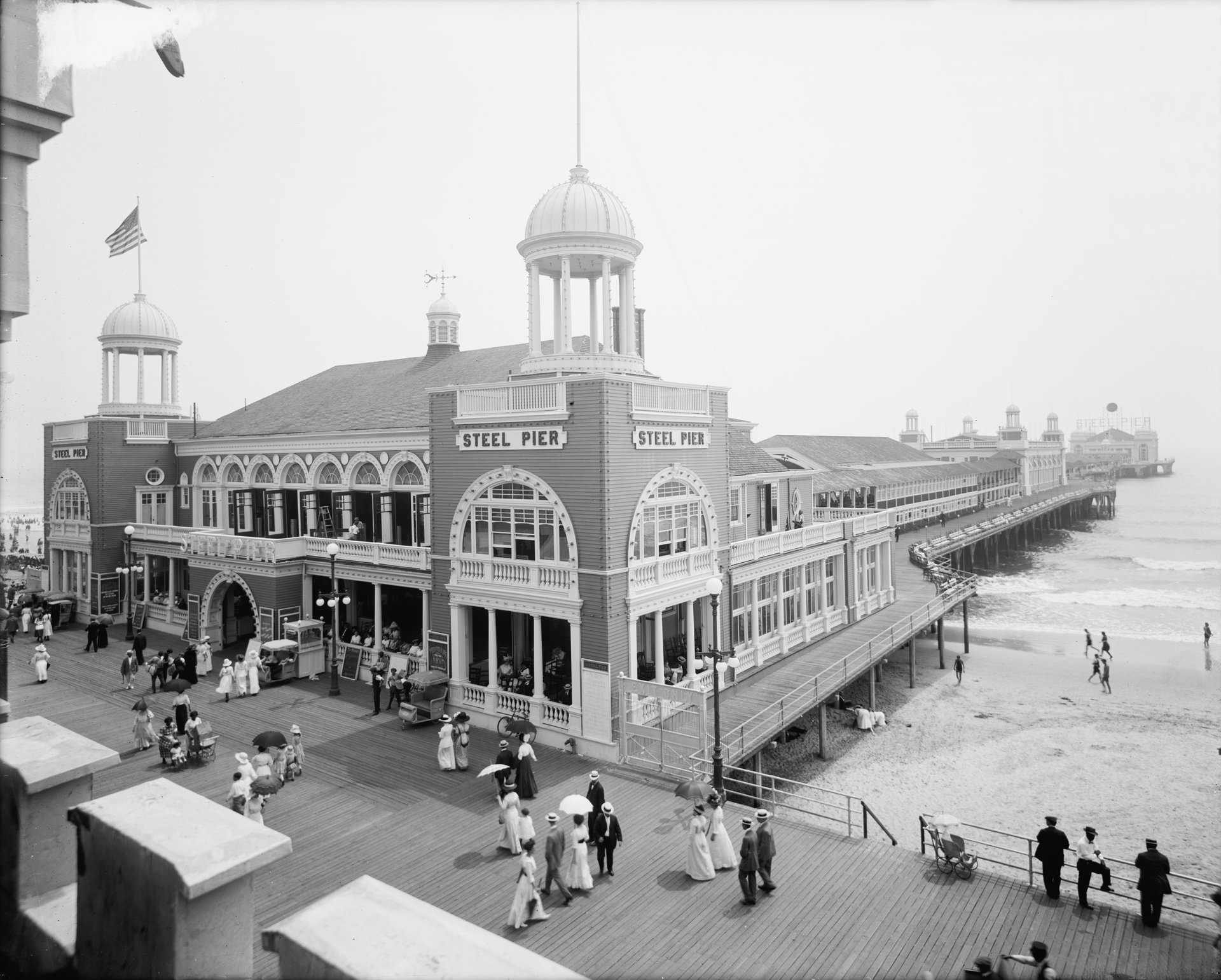
Steel Pier
They called it the Showplace of the Nation, and the boast was not empty. On June 18, 1898, a 1,000-foot pier of iron pilings and steel girders opened on the Atlantic City Boardwalk and proceeded to become the most famous amusement pier in America. Over the next seven decades, Steel Pier hosted John Philip Sousa, Frank Sinatra, Al Jolson, Diana Ross and The Supremes, and the Beatles -- or tried to host the Beatles, before overwhelming ticket demand forced the Fab Four to move to the larger Boardwalk Hall. It crowned Miss America. It shot a woman from a cannon. It sent horses diving from a forty-foot platform into a pool of water while crowds gasped and cheered. None of these acts were the strangest thing about Steel Pier. The strangest thing is that the pier is still there.
The Salt Water Barnum
The pier's golden age began in 1925, when a promoter named Frank Gravatt purchased the fire-damaged structure and rebuilt it into something between a carnival and a cultural institution. The local newspaper dubbed him the "salt water Barnum," and Gravatt earned the title. He installed three movie theaters, a water circus, an opera stage, children's shows, dance bands, and a catalogue of stunts that defied good sense. The High Diving Horse became the pier's signature spectacle: a horse climbing a ramp and plunging into a tank of water, ridden by a young woman who had answered a classified ad. Rex the Wonder Dog performed tricks. A human cannonball arced over the crowd. General Motors opened an exhibit in 1926 that ran for seven years before Ford replaced it. From 1935 through 1938, the Miss America pageant crowned its winners on the Steel Pier stage. The tagline captured the philosophy perfectly: "Rain or Shine... There's Always a Good Show on Steel Pier."
Rock and Roll on Iron Pilings
In 1945, George Hamid purchased Steel Pier from Gravatt, and the pier's soundtrack shifted. Hamid brought rock and roll to the boards, starting with Bill Haley and the Comets in 1955. The pier's Music Hall Theater and Marine Ballroom became essential stops on the touring circuit. Diana Ross and The Supremes played week-long sold-out engagements in the summers of 1965, 1966, and 1967. The Beatles were booked for 1964, but demand for tickets was so enormous that the concert had to relocate to Boardwalk Hall, the massive convention center down the boardwalk. Even the near-disasters added to the legend. The Ash Wednesday Storm of 1962 ripped away sections of the pier. A fire in December 1969 shortened it by a third, six months before the 1970 season was set to open. The pier kept coming back. It always kept coming back.
The Long Decline
By the late 1960s, Atlantic City itself was fading. The resort town that had drawn millions was losing out to cheaper air travel and newer vacation destinations. Steel Pier felt every tremor of the decline. The pier changed hands in 1973, sold to a group of local businessmen who struggled to fill it. When New Jersey legalized casino gambling, a developer proposed converting the pier into a hotel-casino, but the permits never came through. Resorts International bought it in 1978 and used it mostly for storage. Then fire finished what neglect had started: in 1982, the original wooden pier with its steel underpinnings burned to the waterline. What stands today is not Gravatt's pier, or Hamid's pier, but a concrete structure built in 1993, reduced from its peak length to roughly 1,000 feet. Trump Entertainment connected it to the Taj Mahal casino via an overhead walking bridge. The name survived. The music and the diving horses did not.
Reinvention at the Waterline
The Catanoso family, who had leased the pier to run the amusement park, purchased it outright and rebranded it as a family-oriented attraction. Twenty-four rides now line the concrete deck, along with a helicopter station, an arcade, and food stands. In 2017, a new giant Ferris wheel went up, studded with LEDs that glow from 4:30 PM to midnight every day, visible from up and down the boardwalk. In 2012, a proposal to revive the diving horse act surfaced as part of a Tourism Master Plan, but public outcry killed it within days. Some traditions, Atlantic City decided, belong in the past. The pier's cultural afterlife, meanwhile, keeps expanding. Walt Disney Pictures told the story of the diving horse riders in Wild Hearts Can't Be Broken. The Three Stooges filmed on the pier in 1938. Burt Lancaster and Susan Sarandon shot scenes near it for Atlantic City in 1980. Bobby Rydell sang about it. The Beach Boys name-checked it.
Three Centuries on the Boards
Steel Pier has now existed in three centuries. It opened in the Gilded Age, peaked in the mid-twentieth century, burned and was rebuilt, and continues to operate as an amusement park on the Atlantic City Boardwalk. It has survived at least three major fires, the Ash Wednesday Storm, the collapse of Atlantic City's tourism economy, the casino era, and the bankruptcy of the casino era. The Hard Rock Hotel and Casino, formerly the Trump Taj Mahal, rises behind it. The Ferris wheel turns above it. The Atlantic Ocean stretches out beneath it. For 128 years, something has stood on this spot at the edge of the boardwalk, promising a good show, rain or shine. The materials have changed. The acts have changed. The pier itself has been entirely replaced. But the impulse remains the same: build something spectacular at the end of a boardwalk, point it at the ocean, and see who comes.
From the Air
Located at 39.3575N, 74.419W on the Atlantic City Boardwalk, extending into the Atlantic Ocean. Steel Pier is visible from altitude as a prominent structure jutting east from the boardwalk, identifiable by its large Ferris wheel illuminated with LEDs. The pier sits directly across from the Hard Rock Hotel & Casino (the tallest building in the area). The nearest airport is Atlantic City International (KACY), approximately 9nm to the west-northwest. The former Bader Field (KAIY) is roughly 2nm to the southwest. For the best view, approach from the ocean side at 500-1,000 feet AGL along the coastline. The boardwalk and casino towers provide unmistakable orientation landmarks.