Steep Rock Lake
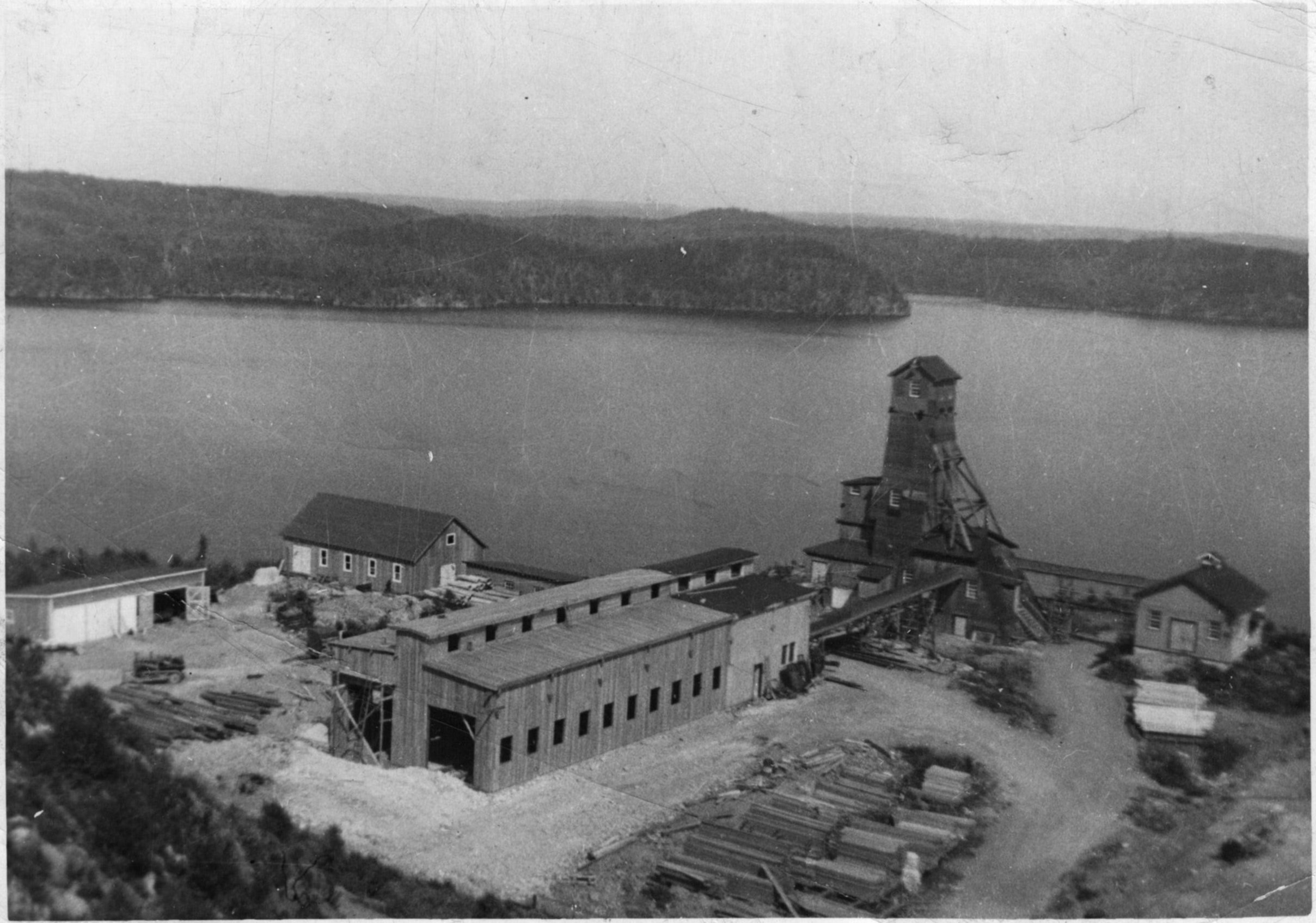
In 1891, a Harvard professor named Henry L. Smyth walked the south shore of a sprawling M-shaped lake in northern Ontario and found boulders laced with iron ore. He mapped the north shore and found none. His conclusion was simple and audacious: the iron was under the lake. Nearly half a century would pass before anyone proved him right. In March 1938, Julian Cross drilled six test holes through the bed of Steep Rock Lake and struck a massive body of iron ore. The discovery was confirmed, but the engineering challenge was almost absurd -- to mine the ore, someone would have to drain the lake. What followed was one of the most extraordinary mining operations in Canadian history, a wartime effort that rerouted a river, pumped billions of gallons of water, and turned a pristine lake bottom into an open-pit mine.
A River Forced to Change Course
The Seine River fed Steep Rock Lake. To isolate the lake for mining, the river had to go somewhere else. In March 1943, after years of negotiation involving Steep Rock Iron Mines Limited, Ontario Hydro, and the Ontario-Minnesota Pulp and Paper Company, engineers began the diversion. A special act of Ontario legislation in 1942 authorized the damming. Charlie Pitts and his construction company built roadways to Finlayson Lake. Patrick Harrison's crew dug a tunnel to lower Finlayson's water level. On July 23, 1943, a plug was blown at Finlayson's bottom, connecting it via tunnel to the Seine River. Three dams went up through the fall. Raft Lake, between Finlayson and Marmion Lake, was lowered to join the two. More than a million cubic yards of rock were blasted and excavated to create a canal six hundred yards long, a hundred feet wide, and ninety feet deep. On January 28, 1944, the diversion cuts were blown and the Seine River abandoned its ancient course. Steep Rock Lake became an isolated body of water, ready to be pumped dry.
Mining the Lake Bottom
By the spring of 1944, pumps were draining the middle arm of Steep Rock Lake. A pumping barge fitted with a suction dredge cleared silt from the lake bed to expose the ore body beneath. In September 1944, enough had been removed to begin mining. The first trainload of iron ore left on October 3, 1944, traveling via Canadian National Railway to Fort Frances, then by ship to Duluth, Minnesota. It was the first time iron ore mined in northwestern Ontario had crossed the international border, creating a new trade economy. The mine was named the Errington Mine after Joseph Errington, the company's founding president, who had died of a heart attack in early 1942 while traveling to New York for a financing presentation. The open pit operated until 1953, when it reached its economic depth. An underground extension ran until 1973. Altogether, the Errington Mine yielded over 12.8 million tons of iron ore.
Operation Up and Over
The most improbable chapter came in March 1954. Two massive dredges -- the Steep Rock and the Marmion -- needed to be moved from the completed Hogarth Mine pit to the next ore zone. Rather than disassemble them, engineers fitted the dredges with continuous tracks, attached them to bulldozers by long metal cables, and dragged them overland. The route covered two miles with a vertical lift of 240 feet, negotiating 8-percent grades and one sharp corner that demanded careful planning. The operation, dubbed Operation Up and Over, took two weeks. Both dredges arrived at the G ore zone without incident. The G zone, later renamed the Roberts Mine, would become one of the deepest open-pit mines in Canada at the time, reaching 1,100 feet before closing in 1972 after yielding more than 18 million tons of ore.
Ninety-One Million Tons and a UFO Hoax
Across all its mines -- Errington, Hogarth, Roberts, and the Caland operation -- Steep Rock Lake produced over 91 million tons of iron ore between 1944 and 1980. The Hogarth Mine alone shipped 25.6 million tons. Caland topped them all at 34.6 million. A pelletizing plant built in 1965 at a cost of $17.5 million processed the ore into uniform pellets for more efficient blast furnace operation. The end came not from exhaustion of the resource but from economics: declining iron ore prices and a surplus of pellets in the Great Lakes region made continued operation unviable. By April 1980, the last plant shut down. The lake also earned a footnote in popular culture: in 1950, it became the site of an elaborate UFO hoax known as the Little Green Men of Steep Rock Lake. And along its northern shoreline, cliffs expose 2.8-billion-year-old stromatolite reefs -- among the oldest known carbonate platforms in the world -- a reminder that the geological drama here long predates any human ambition.
From the Air
Located at approximately 48.79N, 91.67W in northern Ontario, about 4 miles north of Atikokan and 135-140 miles west of Thunder Bay. Steep Rock Lake is carved in a distinctive M shape, 14 miles long with a surface area of 7 square miles. From the air, the former open-pit mines are clearly visible as dramatic scars in the landscape -- the Roberts Mine pit reached 1,100 feet deep. The Seine River diversion canal and multiple dams are identifiable features. Atikokan Municipal Airport (YIB) lies immediately south. Thunder Bay Airport (CYQT) is the nearest major airfield to the east. The lake sits at the intersection of the Quetico Fault and Steep Rock Lake Fault systems. Quetico Provincial Park lies to the south and west. Best viewed from 3,000-6,000 feet AGL to appreciate the mining scars, diversion infrastructure, and the M-shaped lake geometry.