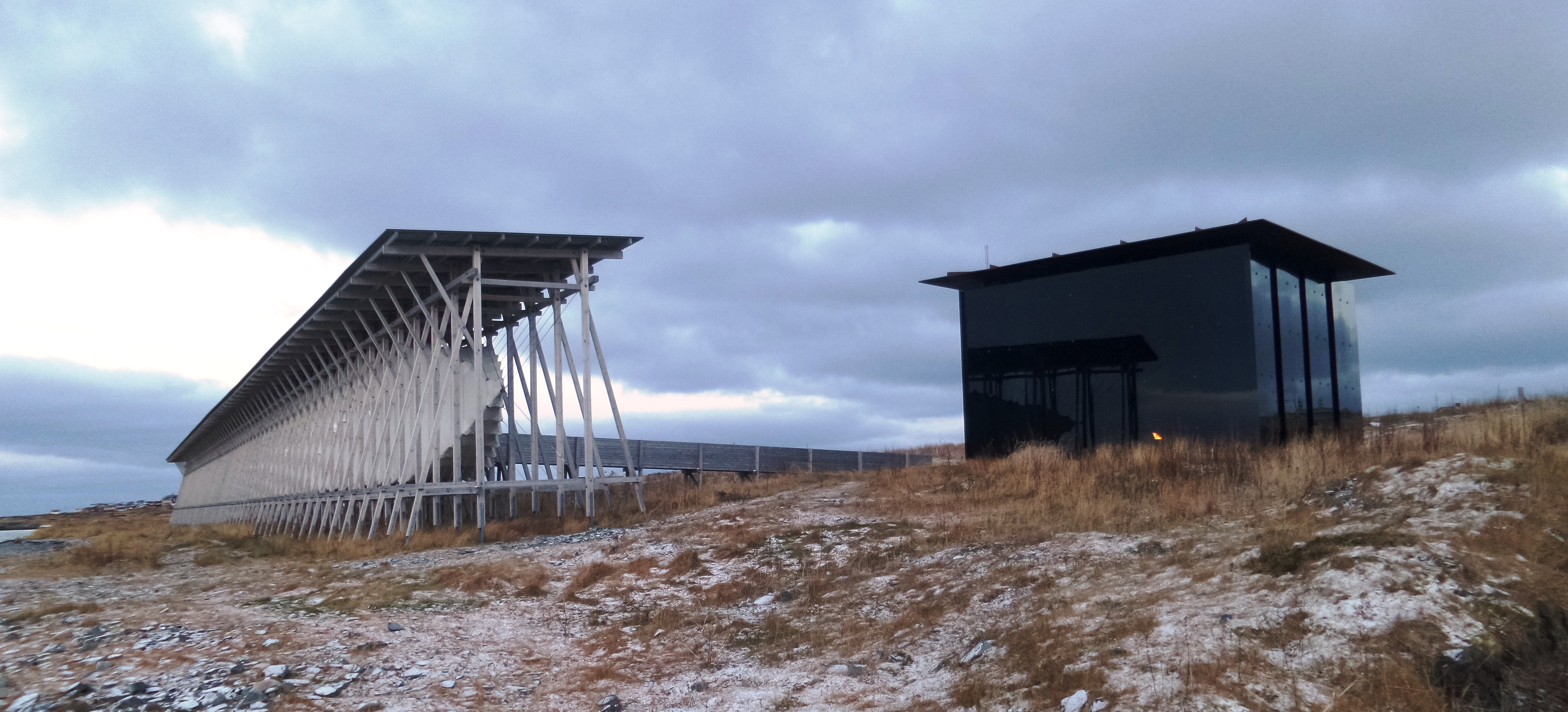
Steilneset Memorial
Ninety-one small windows glow in the Arctic darkness, one for each person burned at the stake. Inside each, a single lightbulb -- nothing more -- meant to evoke the lamps that once burned in the curtainless windows of Finnmark's houses. This is the Steilneset Memorial in Vardo, Norway, and it is unlike any war memorial or monument of conscience you have encountered. Designed by artist Louise Bourgeois and architect Peter Zumthor, it commemorates the Vardo witch trials of the seventeenth century, in which 77 women and 14 men were tried for witchcraft and executed. It was Bourgeois' last major work. She died in 2010, a year before Queen Sonja of Norway opened the memorial on June 23, 2011.
The Fires of Finnmark
Norway's witch trials were not a minor episode. Across the seventeenth century, hundreds of people were accused of witchcraft throughout the country, but nowhere was the persecution more concentrated than in Finnmark, the remote northern district where Vardo lies. The region experienced the highest rate of witchcraft accusations in all of Norway, and an unusually high proportion of those accused were executed. The Vardo trials peaked between 1662 and 1663, though accusations had been brought as early as 1621. The victims were overwhelmingly women from small fishing and farming communities -- people whose supposed crimes ranged from causing storms at sea to consorting with the devil. The confessions were extracted through methods that left little room for denial. In a landscape already defined by extremity -- polar night, brutal cold, the constant threat of the sea -- the witch trials added a man-made terror to the natural ones.
Two Visions, One Memorial
The memorial is actually two structures, each expressing a different dimension of the tragedy. Peter Zumthor designed a long, narrow wooden hall suspended on a framework of poles, its fabric-covered exterior rippling in the Arctic wind like a tent or a sail. Inside, 91 windows line the corridor, each with its lightbulb, each accompanied by a plaque naming a victim and describing their accusation. Walking the length of the hall is a measured experience -- slow, repetitive, the names accumulating until the scale of the killing becomes impossible to abstract. Zumthor's architecture insists on individual recognition. Louise Bourgeois contributed the second structure: a smoked-glass pavilion housing a single installation titled The Damned, The Possessed and The Beloved. Inside, a steel chair burns with five perpetual gas flames. Writer Donna Wheeler observed that this fire "is devoid of any redemptive quality, illuminating only its own destructive image." It is fire as instrument of death, not comfort.
A Place That Demands the Journey
Vardo is not easy to reach. It is Norway's easternmost town, accessible by a long drive along the Finnmark coast or by the Hurtigruten coastal steamer, and it feels as remote as its coordinates suggest. The memorial sits near the waterfront, exposed to the same winds and cold that defined the lives of the people it commemorates. Design commenced in 2006, and the five years of construction reflected both the complexity of the project and the difficulty of building anything in the Arctic. The choice of location was deliberate: Steilneset sits where history happened, not in a capital-city museum or a tourist-friendly southern location. You must come to the edge to witness what the edge endured. The memorial was built 348 years after the trials peaked -- a long silence finally broken by architecture, art, and the simple, persistent glow of 91 lightbulbs in the dark.
Seen from the Sky
From altitude, the Steilneset Memorial appears as two distinct forms near Vardo's waterfront: the long, narrow cocoon of Zumthor's wooden hall and the darker glass cube of Bourgeois' pavilion. The structures are intentionally modest in scale, designed to sit within the landscape rather than dominate it. Approaching from the east over the Barents Sea, the town of Vardo resolves first on Vardoya island, with the memorial visible on the Steilneset promontory. The surrounding terrain is flat tundra, treeless and wind-scoured, making the memorial's forms easy to distinguish. In winter, when polar night shrouds Finnmark in continuous darkness, the 91 lit windows of the memorial offer a faint but persistent glow -- a detail visible from lower altitudes that gives the structure an almost spectral presence against the surrounding blackness.
From the Air
Located at 70.37N, 31.09E on the Steilneset promontory near Vardo, Finnmark, Norway. The memorial consists of two structures near the waterfront. Vardo Airport (ENSS) on Svartnes is the nearest airfield. The town of Vardo on Vardoya island is the primary visual reference. Terrain is flat, treeless tundra. Polar night in winter; midnight sun in summer. Extreme wind conditions common. The memorial's lit windows may be visible from lower altitudes in darkness.