Steinvikholm Castle
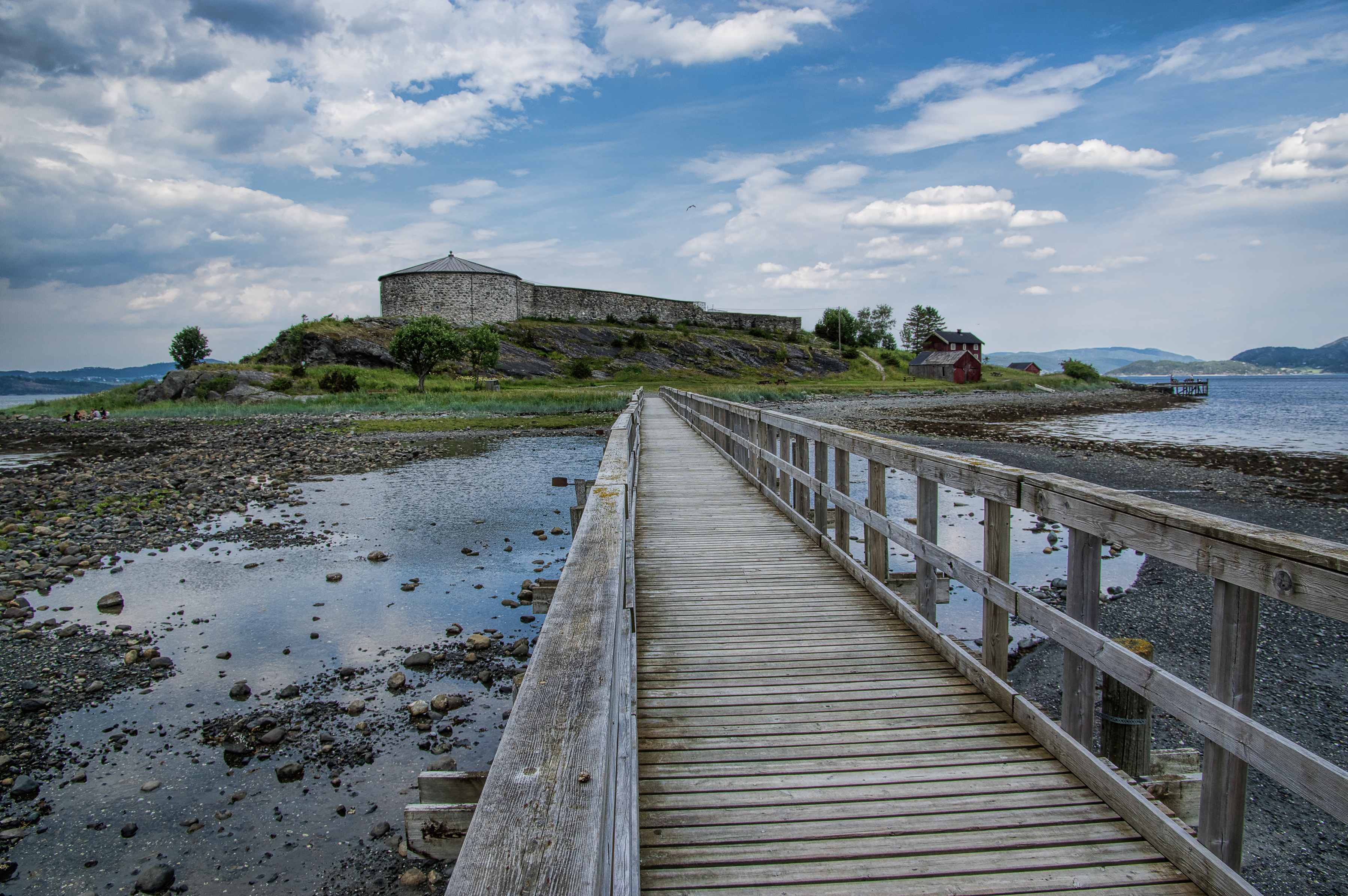
The largest construction raised in the Norwegian Middle Ages sits on a rocky island off the Skatval peninsula, connected to the mainland by a single bridge. Steinvikholm Castle was not built by a king or a warlord but by an archbishop -- Olav Engelbrektsson, the last Roman Catholic Archbishop of Norway, who returned from a meeting with the Pope in Rome sometime around 1525 and began constructing a fortress he suspected he would need. He was right. Within twelve years the castle would shelter the most sacred objects in Norway, withstand a siege, and watch its builder sail into exile.
Built for a Fight That Was Coming
Construction ran from 1525 to 1532, seven years of hauling stone to an island with no fresh water spring -- every drop had to be ferried from the mainland. The castle occupied roughly half the island's surface, a substantial fortification by any standard, and the largest construction project of the Norwegian Middle Ages. Its design was typical of European fortifications of the era, though already becoming obsolete as gunpowder and cannon rendered medieval walls increasingly vulnerable. A wooden bridge provided the only dry approach; otherwise, you came by boat. The archbishop had returned from meeting the Pope in Rome with a clear sense of the religious conflict ahead. He built Steinvikholm as the Catholic Church's military stronghold in Norway, a place from which to resist the encroachment of Danish Protestant rule under first King Frederick I and then his successor Christian III. Together with Nidarholm Abbey, Steinvikholm formed the backbone of Catholic resistance in the north.
Refuge for the Sacred
As the Reformation crisis deepened, Engelbrektsson moved the treasures of Nidaros Cathedral to Steinvikholm for safekeeping -- among them the shrine of St. Olav, the silver-covered resting place of Norway's patron saint. The original coffin containing St. Olav's body remained at the castle long after the archbishop himself had gone. In April 1537, with Protestant forces closing in, Engelbrektsson fled to Lier in the Netherlands, where he died on 7 February 1538. The garrison he left behind surrendered the following month. The saint's coffin stayed at Steinvikholm until 1564, when it was returned to Nidaros Cathedral. Within four years, the location of St. Olav's grave had been forgotten entirely -- a mystery that persists to this day.
Dismantled by Design
What siege could not accomplish, bureaucratic vindictiveness eventually did. From the seventeenth through the nineteenth century, the Danish-Norwegian authorities permitted the castle to be used as a quarry. Its masonry was sold off and carted away, stone by stone. This was not neglect but policy -- the authorities deliberately encouraged the destruction of a monument that symbolized resistance to the Danish-Norwegian Union. The castle that Archbishop Engelbrektsson had spent seven years building became a convenient source of pre-cut stone for anyone willing to haul it away. Walls that had withstood cannon fire were reduced to building material for barns and farmhouses across the region. Somewhere in the farms of Skatval and the surrounding countryside, the stones of Steinvikholm were absorbed into the landscape, their origin forgotten. By the time preservation efforts began, much of the original structure had been scattered across Trondelag.
Opera on the Ruins
Today Steinvikholm is owned by Fortidsminneforeningen, the Society for the Preservation of Norwegian Ancient Monuments, and the island has found an unexpected second life. Since 1993, the ruins have served as the stage for a midnight opera titled Olav Engelbrektsson, telling the story of the archbishop who built the castle and lost everything defending his faith. The libretto is by Edvard Hoem, with music by Henning Sommerro, and performances take place each August under the long Nordic twilight. What was built as a last redoubt of medieval Catholicism now hosts audiences who come by the same bridge the defenders once crossed, sitting among the walls that sheltered Norway's most sacred relics, watching the story of the man who raised those walls performed in the space he created.
From the Air
Located at 63.54N, 10.81E on a small rocky island off the Skatval peninsula in the Trondheimsfjord. The castle ruins are clearly visible from the air, occupying roughly half the island. A bridge connects to the mainland. Best viewed at 1,500-2,500 ft AGL. Nearest airport: Trondheim Airport Vaernes (ENVA), approximately 5 nm southwest. The Trondheimsfjord and surrounding farmland provide strong visual references.