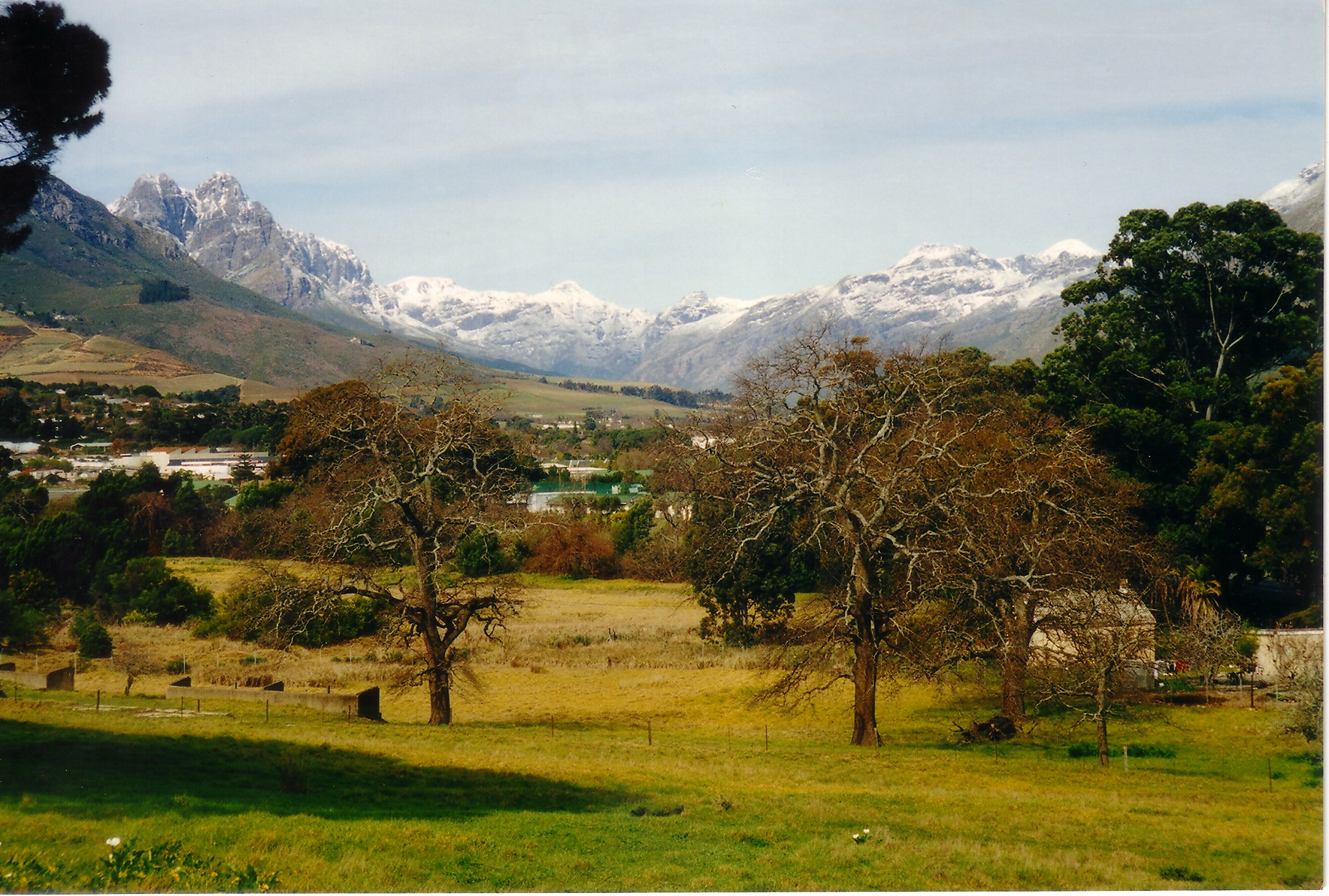
Stellenbosch
There are no street signs in Stellenbosch. Look down and you will find the names painted in yellow along the edges of the sidewalks, in Afrikaans. It is a small detail, but it captures something essential about the place: Stellenbosch does things its own way, has been doing so since 1679, and does not feel the need to explain itself. South Africa's second-oldest town sits on the banks of the Eerste River -- the "First River" -- about 50 km east of Cape Town, its streets canopied by the ancient oaks that earned it the nickname Eikestad, the Oak City. Governor Simon van der Stel, who gave the town his name, recognized the valley's potential for agriculture. The settlers who followed, from the Netherlands, Germany, and France, recognized something more specific: these hills were ideal for growing vines.
Cape Dutch Geometry
A walking tour of Stellenbosch is a lesson in architectural persistence. The Cape Dutch style -- whitewashed walls, thatched roofs, ornamental gables -- has survived here for over three centuries, not as museum pieces but as functioning buildings on functioning streets. The Stellenbosch Tourism Bureau on Market Street organizes guided walks that thread past these structures, but even without a guide, the evidence is everywhere: the VOC Powder Magazine dating from 1776, the elaborate homesteads along Dorp Street, the churches whose proportions reflect a time when this was a frontier outpost disguised as a European village. It is worth noting that the elegance of these buildings was sustained by labour systems that ranged from enslavement in the early colonial period to exploitative farm work that persisted for centuries. The beauty of Cape Dutch architecture is real, but so is the history embedded in its walls.
The Wine That Put a Valley on the Map
Stellenbosch wines are known internationally and rank among the best in the world. The claim is not idle boasting. Over 150 vineyards cluster in the surrounding hills, producing Cabernet Sauvignon, Pinotage, Shiraz, and Chenin Blanc that compete with and often beat their Old World counterparts. Estates like Rust en Vrede, Meerlust, and Beyerskloof have built international reputations. The Vine Hopper minibus picks up anywhere in central Stellenbosch and makes circular routes around 12 local vineyards, six each on alternate days -- a system that acknowledges both the quantity of wine available and the likelihood that visitors will want to taste rather more than they should drive after. For those who prefer their wine with altitude, the Simonsberg and Helderberg areas offer vineyards with mountain settings that make the tasting experience feel earned.
University Town, After Dark
Stellenbosch University, one of South Africa's oldest and most prestigious institutions, brings over 25,000 students into a town of roughly 100,000 residents. The effect on the town's character is considerable. During term time, the area around Church Street -- informally known as the restaurant district, with approximately 19 venues within a four-block radius -- hums with the particular energy of a place where distinguished Cape Dutch architecture coexists with student nightlife. The university's history is complicated; it was a historically Afrikaans-medium institution with deep ties to the political establishment that built and maintained apartheid. Its transformation since 1994 is an ongoing process, one that mirrors the broader reckoning happening across South Africa. Today the campus blends into the town so thoroughly that it is hard to tell where one ends and the other begins.
Oom Samie's Shop and the Art of Browsing
Near the lower end of Dorp Street sits Oom Samie se Winkel -- Uncle Samie's Shop -- a cluttered, eccentric institution that has been selling everything from local wines to antiques to sweets for generations. It is the kind of place where you walk in for a jar of jam and emerge 45 minutes later with a piece of antique furniture and no clear memory of how that happened. The shop captures Stellenbosch's talent for turning commerce into atmosphere. The town is not short of tourist shops, but the best ones feel less like retail and more like excavation -- digging through layers of Cape Winelands culture compressed into storefronts. Beyond the main street, the vineyards themselves function as destinations, offering not just tastings but restaurants, cheese platters, and picnic spots among the vines, making Stellenbosch a place where even the most committed sightseer eventually surrenders to the slower rhythms of food, wine, and oak-shaded afternoons.
From the Air
Located at 33.94S, 18.86E in the Eerste River valley, approximately 50 km east of Cape Town. The town is surrounded by vineyards and framed by the Simonsberg, Helderberg, and Stellenbosch Mountain ranges. Cape Town International Airport (FACT) is approximately 35 minutes by car. Stellenbosch has its own small airfield. The N1 and N2 highways provide access from different directions. Recommended viewing altitude: 3,000-6,000 ft to see the vineyard patterns and mountain backdrop.