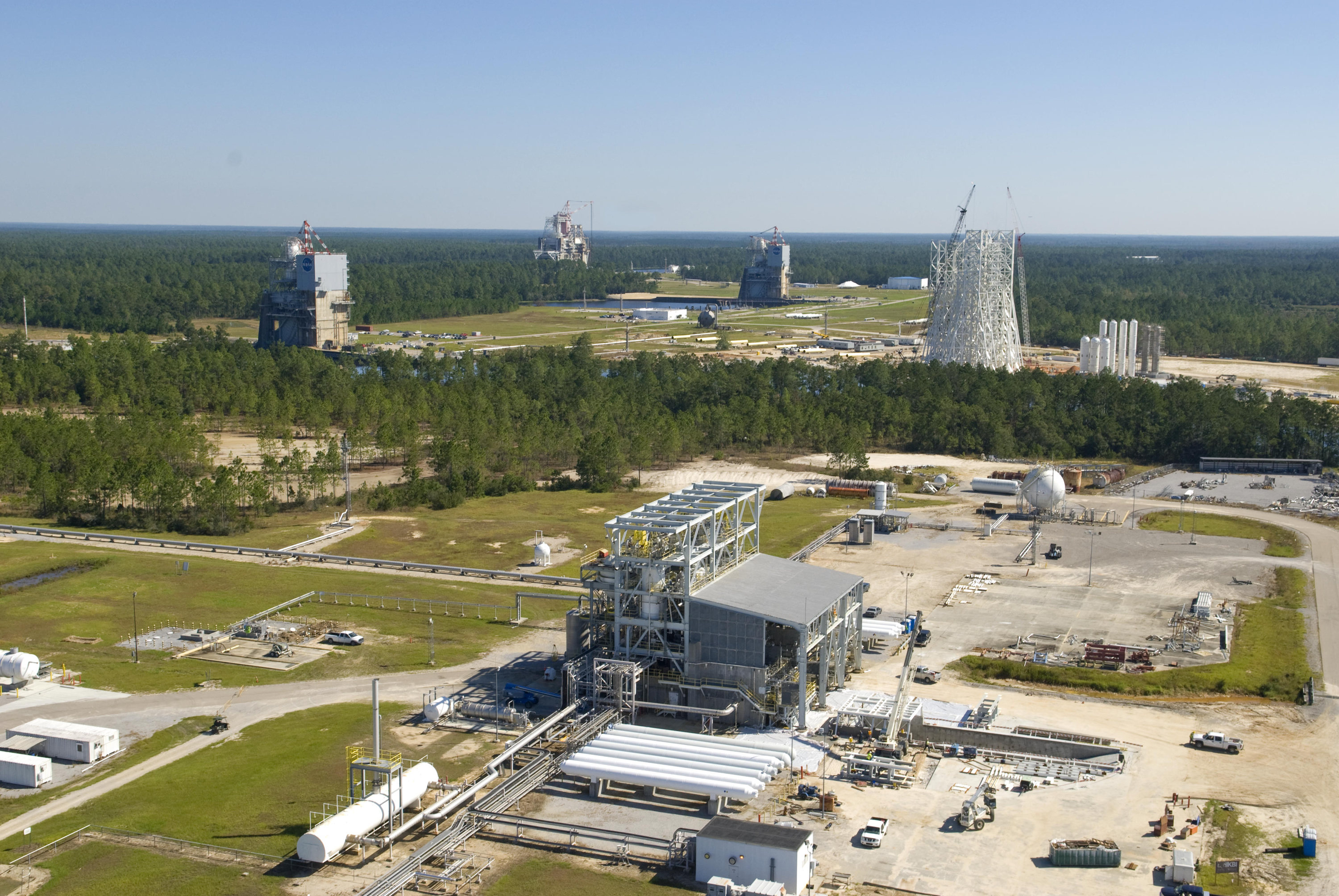
Stennis Space Center
Five towns once stood here. Gainesville, Logtown, Napoleon, Santa Rosa, Westonia -- small Mississippi communities along the Pearl River where families ran shops, attended sixteen churches, and sent children to three schools. In 1961, NASA needed a place loud enough and remote enough to test the engines that would carry astronauts to the Moon. The Army Corps of Engineers arrived with purchase orders for 3,200 parcels of land, relocating 700 families to make room for the thundering future of American spaceflight. Today, city streets and a one-room schoolhouse still lie hidden in the pine forests within the facility's perimeter, ghost remnants of the communities that gave way to the roar of rocket engines.
Where the Moon Began
NASA announced the Mississippi Test Facility on October 25, 1961, choosing this patch of Hancock County for a precise set of reasons. The site sat between the Michoud Assembly Facility in New Orleans, where Saturn V stages were built, and the Kennedy Space Center in Florida, where they would launch. Barge access along the Pearl River was essential -- the rocket stages were simply too massive for highway transport. And the engines were far too loud for testing near populated areas like Huntsville, Alabama. Construction began in 1963 on what would become NASA's largest rocket engine test facility. The Rocket Propulsion Test Complex, completed in 1965, featured towering steel-and-concrete test stands designed to contain forces that defied intuition: over one million pounds of thrust and temperatures that could melt most metals.
Fire on the Stand
On April 23, 1966, the A-2 test stand came alive for the first time when technicians captive-fired the S-II-T stage for 15 seconds -- one million pounds of thrust from five Rocketdyne J-2 engines. A month later, on May 20, the same stage fired for a full 354.5 seconds, proving the most powerful liquid hydrogen-liquid oxygen stage ever built. But eight days after that triumph came disaster. On May 28, a second-shift crew, unaware that hydrogen pressure sensors had been disconnected, attempted to pressurize the fuel tank. Believing a vent valve was leaking, they blocked all valves. The tank burst. Five North American Aviation technicians suffered injuries. The Board of Inquiry, led by Kennedy Space Center director Kurt Debus, determined the tank had been pressurized beyond its design limits. The accident forced NASA to extend the S-II test program by over a year.
From Apollo to Artemis
The massive B-1/B-2 test stand, capable of withstanding 11 million pounds of dynamic load, tested complete Saturn V first stages with their five thunderous F-1 engines from 1967 to 1970. When Apollo ended, the stands were adapted for Space Shuttle Main Engine testing beginning May 19, 1975, and continued through the program's conclusion with a final scheduled test on July 29, 2009. The A-1 and A-2 stands, along with B-1/B-2, were declared a National Historic Landmark in 1985. In March 2020, the A-1 stand was renamed the Fred Haise Test Stand, honoring the Apollo 13 astronaut and Biloxi, Mississippi, native. In early 2021, the B-2 stand hosted hot-fire tests of the Space Launch System core stage with four RS-25 engines -- the same stand that once shook the earth with Saturn V boosters now preparing hardware for humanity's return to the Moon.
A City Within a City
Stennis is not just NASA. By 2005, over 50 agencies and companies shared the facility, with U.S. Navy personnel numbering 3,500 -- dwarfing the NASA civil service contingent. The Naval Oceanographic Office operates here with roughly 1,000 personnel. NOAA's National Data Buoy Center designs and maintains its ocean monitoring network from the campus. Rolls-Royce built an outdoor aero-engine test facility on the old H-1 test area in 2007, driven overseas by noise complaints at its UK facility near Derby. Rocket Lab selected Stennis for testing its Archimedes reusable engine. Blue Origin tested components of its BE-3 engine here in 2012. The INFINITY Science Center, opened in 2012 near the Mississippi-Louisiana border, displays the Apollo 4 command module, a full-sized International Space Station module, and an F-1 rocket engine among its outdoor exhibits.
Echoes in the Pines
Drive the roads within the Stennis buffer zone and you pass through what feels like ordinary Mississippi piney woods. But look closely and you find crumbling foundations, overgrown streets, and the ruins of Logtown, a community that dates to the 1700s, or Gainesville, once the seat of Hancock County, founded in 1810. The 125,000-acre buffer zone -- larger than many national parks -- exists because rocket engines at full thrust can be heard for miles. That enforced emptiness has created an accidental wildlife preserve. It has also preserved, in amber, the footprint of communities that traded their homes so that human beings might walk on the Moon. The schoolhouse still stands. The streets still run to nowhere. And when the engines fire, the ground still trembles.
From the Air
Located at 30.36N, 89.60W on the Mississippi-Louisiana border in Hancock County. The massive test stands (A-1/A-2 and B-1/B-2) are visible from altitude as large steel structures surrounded by cleared zones. The facility's 125,000-acre buffer zone creates a distinctive patch of undeveloped forest along the Pearl River. Nearest airport: Stennis International Airport (KHSA), located on-site. Gulfport-Biloxi International (KGPT) is 42nm east. Louis Armstrong New Orleans International (KMSY) is 60nm west. Best viewed at 3,000-5,000 ft AGL for the test complex layout. The Pearl River and surrounding bayous are prominent visual references.