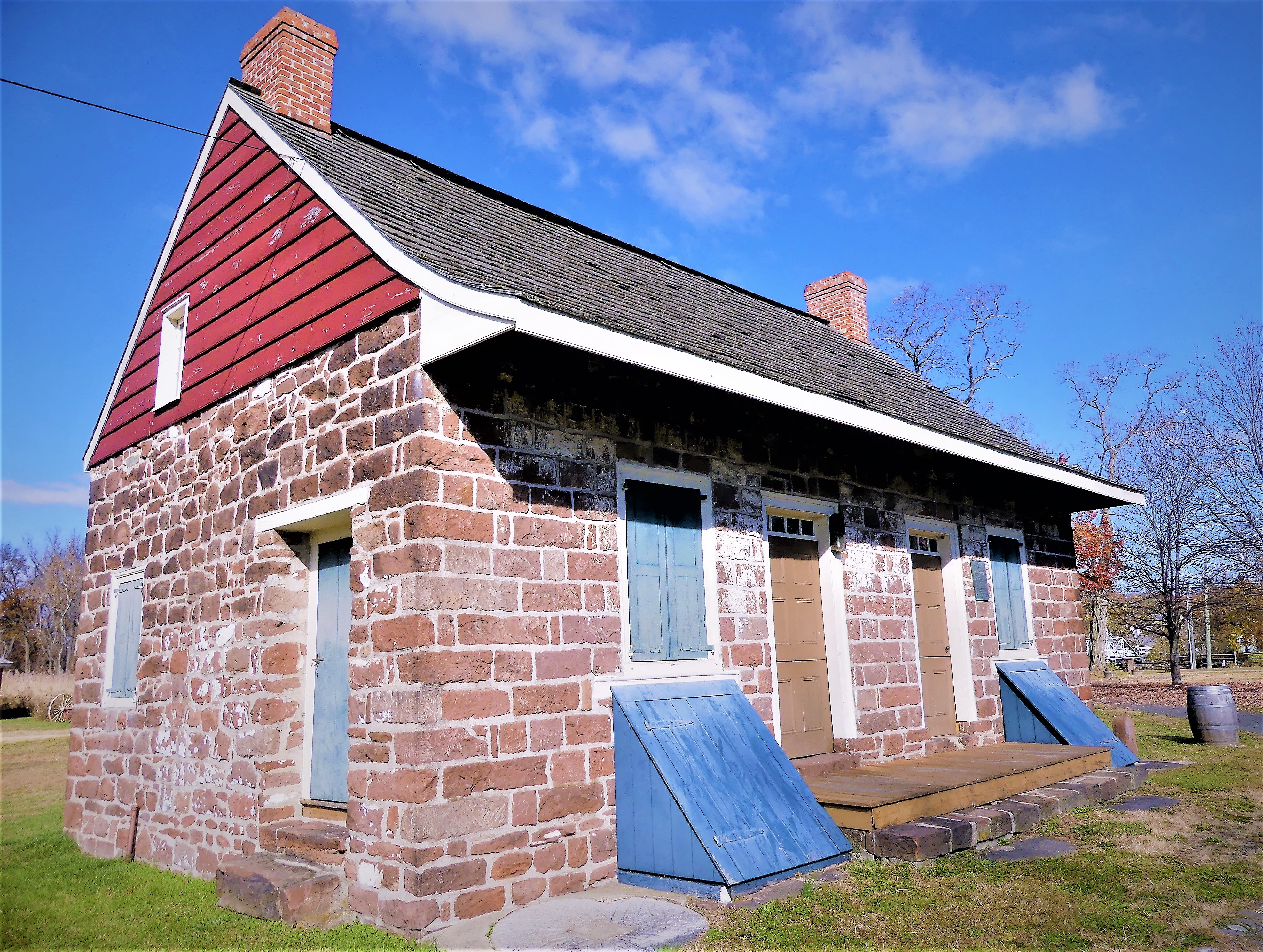
Steuben House
On November 20, 1776, with 5,000 British and Hessian troops bearing down on Fort Lee, George Washington marched his retreating army to a wooden bridge over the Hackensack River and crossed to safety. Thomas Paine, who witnessed the desperate flight, sat down to write the words that would rally a faltering revolution: "These are the times that try men's souls." The bridge he described in The American Crisis -- "Our first object was to secure the bridge over the Hackensack" -- stood at a place called New Bridge Landing, right beside a sandstone house that still stands today. That house, built by a family who chose the wrong side of the war, would eventually be handed to the Prussian baron who turned Washington's ragged army into a fighting force.
Sandstone and Tidal Power
The house traces its origins to 1682, when a Swedish land-clearer named Cornelius Mattyse acquired 420 acres at the junction of Cole's Brook and the Hackensack River, a spot the local Hackensack people called Aschatking, meaning "where the river narrows." The land passed through several hands before Jan Zabriskie purchased it in 1745 and built the oldest portion of the house in 1752, cutting sandstone blocks from the nearby Kinderkamack Ridge. On the road-facing sides, the stone was carefully dressed; on the others, it was laid as rough rubble. A tidal gristmill on the riverbank powered itself through an ingenious system: a dam trapped the high tide in Cole's Brook, and as the tide receded, the impounded water released slowly through a waterwheel. Sloops as large as 50 tons pulled alongside the mill at New Bridge Landing, loading iron hauled by ox-cart from furnaces in the Ramapo Mountains.
A Crossroads at War
New Bridge Landing's strategic value was immense. Because the vast Hackensack Meadowlands downstream made crossing impossible, New Bridge remained the nearest river crossing to Newark Bay until 1790. Every farm wagon, stage coach, and military column moving between New York City and the interior had to pass through this spot. The American Revolution turned it into a constant arena of conflict. After Washington's harrowing retreat across the bridge in November 1776, the British seized it the very next day. Over the following years, battles and skirmishes erupted repeatedly. In May 1780, British soldiers were killed by their own friendly fire while attacking Bergen Militia sheltering inside the Zabriskie house. That September, Washington himself returned, making the house his headquarters for 14 days while nearly 14,000 Continental troops encamped on the Kinderkamack Ridge above.
A Loyalist's Loss, A Baron's Gain
Jan Zabriskie had grown wealthy from the French and Indian War trade boom, doubling his house from five to twelve rooms around 1765 and capping it with a fashionable gambrel roof. But he backed the British, and that bet cost him everything. New Jersey confiscated the mansion in 1781. Two years later, the state legislature gave the entire Zabriskie estate to Major General Baron Friedrich Wilhelm von Steuben, the Prussian drillmaster who had transformed the Continental Army at Valley Forge. There was a catch: Steuben had to actually live there, not simply rent it out. His aide-de-camp, Captain Benjamin Walker, took up residence to meet the terms, operating the mill and dock in partnership with Zabriskie's son. Steuben renovated the war-damaged house but sold it back to the Zabriskie family in 1788. It is the only extant 18th-century building the baron ever owned.
Preservation Against the Odds
The Zabriskie descendants held the property until 1909. In 1926, New Jersey created the Steuben House Commission, and the state took possession of the house and one acre of ground for $9,000 in 1928. The Bergen County Historical Society opened it as their museum headquarters in 1939 and has fought for the site ever since, purchasing land to buffer it from an encroaching auto parts yard in 1944 and persuading the county to divert a planned four-lane highway north of the property in 1954. Today the Steuben House anchors Historic New Bridge Landing Park, a state historic site that includes three additional buildings relocated from nearby towns: the Demarest House from New Milford, the Westervelt-Thomas Barn from Washington Township, and the Campbell-Christie House. The one-lane 1889 swing bridge, closed to vehicles when the highway bridge opened in 1956, still carries pedestrians across the Hackensack.
From the Air
Located at 40.914N, 74.031W on the Hackensack River in River Edge, Bergen County, New Jersey. Look for the historic New Bridge Landing site along the tree-lined river. Best viewed at 1,500-2,500 ft AGL. Nearby airports: KTEB (Teterboro, 8nm SE), KCDW (Essex County/Caldwell, 12nm W).