Steven F. Udvar-Hazy Center
In 1958, a twelve-year-old boy crawled through minefields along the Hungarian border, fleeing Soviet-controlled Budapest with his family. He arrived in New York knowing two English words: "yes" and "okay." As a child in Budapest, while Stalin's portrait hung in his classroom, he had built model aircraft from matchsticks and chewing gum. Decades later, Steven Udvar-Hazy would build the world's largest aircraft leasing company and then write a $65 million check to the Smithsonian Institution -- the single donation that made it possible to construct the massive hangar complex at Dulles Airport where the Space Shuttle Discovery, the Enola Gay, a Concorde, and an SR-71 Blackbird all share the same air.
Too Big for the Mall
The National Air and Space Museum on the National Mall is the most visited museum in the Smithsonian system, but for decades it had a problem that no amount of popularity could solve: most of its collection did not fit inside the building. The museum's holdings vastly outstripped its exhibition space, and the overflow -- hundreds of aircraft, spacecraft, and rockets -- sat unseen in the Paul E. Garber Preservation, Restoration, and Storage Facility in Silver Hill, Maryland. The public had no access. Masterpieces of engineering collected dust in anonymous warehouses. Udvar-Hazy's 1999 donation transformed the situation entirely. Designed by Hellmuth, Obata, and Kassabaum -- the same firm behind the original National Air and Space Museum -- the center opened on December 15, 2003, with two enormous hangars: the Boeing Aviation Hangar and the James S. McDonnell Space Hangar. A private taxiway connects the facility directly to Dulles International Airport's runways, meaning aircraft can be flown straight into the museum without disassembly.
A Hangar of Firsts
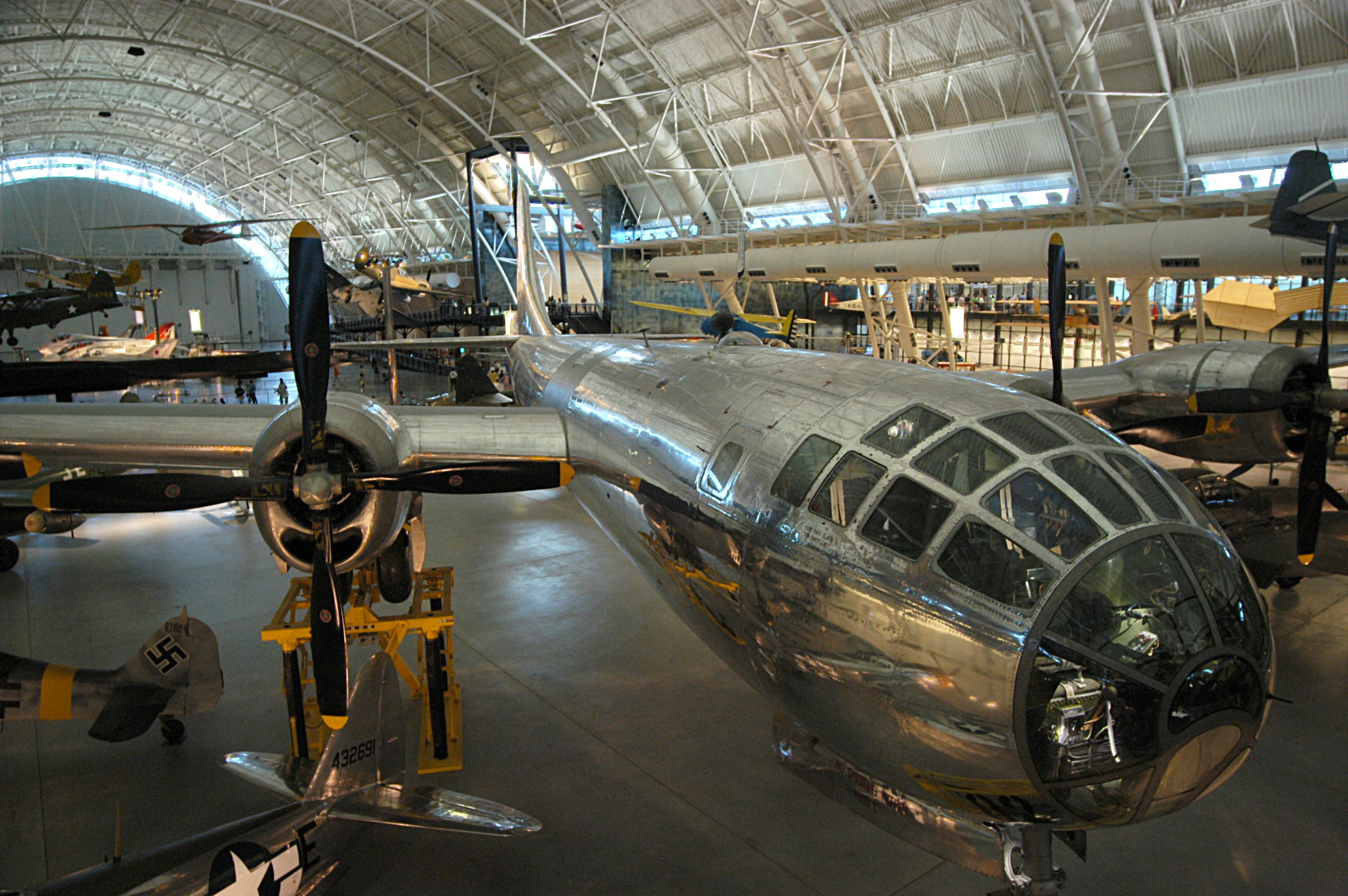
Walk into the Boeing Aviation Hangar and the density of history is almost disorienting. The Enola Gay, the B-29 that dropped the first atomic bomb on Hiroshima, dominates the central floor. Nearby hangs the Boeing 367-80, the "Dash-80" prototype that gave birth to both the KC-135 tanker and the Boeing 707 airliner -- essentially the aircraft that created the jet age of commercial travel. The Lockheed SR-71 Blackbird, still the fastest air-breathing manned aircraft ever built, stretches long and dark in its corner. An Air France Concorde stands as the last word in supersonic passenger flight. The Spirit of Columbus, flown by Jerrie Mock in 1964 to become the first woman to fly solo around the world, hangs overhead. The Gossamer Albatross, the first human-powered aircraft to cross the English Channel, floats nearby. Even a piece of fabric from the Hindenburg survived to find a home here, alongside the filming miniature of the "Mothership" from Close Encounters of the Third Kind.
Beyond the Atmosphere
The James S. McDonnell Space Hangar anchors the collection's reach beyond Earth. The Space Shuttle Discovery, which flew 39 missions over 27 years and delivered the Hubble Space Telescope to orbit, arrived on April 19, 2012, replacing the atmospheric test vehicle Enterprise. A first-generation tracking and data relay satellite hangs directly above it. The Gemini 4 capsule, from the mission that included the first American spacewalk, and the Friendship 7 capsule that carried John Glenn on the first American orbital flight sit in the same hall. A balloon from the Soviet Vega probes to Venus -- the first aircraft flown on another planet -- represents the other side of the space race. A PGM-11 Redstone rocket and a Pegasus XL air-launched rocket trace the evolution of launch vehicles from the earliest days of the missile age to modern orbital delivery systems.
Ghosts of World War
Some of the most remarkable aircraft in the collection are the sole survivors of their kind. The Horten Ho 229, a German prototype flying-wing jet fighter that looked like something from science fiction, exists nowhere else on Earth. The same goes for the Dornier Do 335 Pfeil, a push-pull twin-engine German fighter, the Arado Ar 234 Blitz jet bomber, and the Kyushu J7W Shinden, Japan's canard-wing interceptor built in the final desperate months of the war. A Japanese balloon bomb -- the type that killed six American civilians in Oregon in 1945, the only enemy-caused fatalities on the U.S. mainland during the war -- hangs as a reminder of the conflict's global reach. One of only three surviving aircraft from the Attack on Pearl Harbor, a Sikorsky JRS-1, shares space with a General Atomics MQ-1 Predator, one of the first three drones to fly combat missions over Afghanistan after September 11, 2001.
Still Growing
The Udvar-Hazy Center draws over 1.2 million visitors annually, and it is still expanding. The Donald D. Engen Observation Tower gives visitors a view of landing operations at adjacent Dulles Airport, blurring the line between museum exhibit and living airfield. In 2008, Airbus contributed $6 million toward phase two construction, and in 2010, conservation facilities moved on-site with observation windows so the public could watch restoration work in progress. A further expansion approved in September 2025 will increase the museum's space by 20 percent, adding room for newly restored aircraft including Flak-Bait, the most-bombed Allied bomber to survive World War II, and the B-17 Shoo Shoo Shoo Baby. Over 5,800 objects out of the Smithsonian's 60,000-piece aviation collection are now on display. The boy from Budapest who built matchstick airplanes gave American aviation its largest showcase -- and it still is not big enough.
From the Air
Located at 38.91N, 77.44W, directly adjacent to Washington Dulles International Airport (KIAD) on the south side of the field. The enormous hangar complex with its distinctive observation tower is visible on approach, sitting just off Runway 1R/19L. A private taxiway connects the museum directly to the Dulles runway system. Manassas Regional Airport (KHEF) is approximately 12 miles south. Leesburg Executive Airport (KJYO) is about 15 miles northwest. Best viewed at 2,000-3,000 feet AGL from the south or west. The long, low profile of the Boeing Aviation Hangar is the most prominent feature; the observation tower provides a useful landmark.