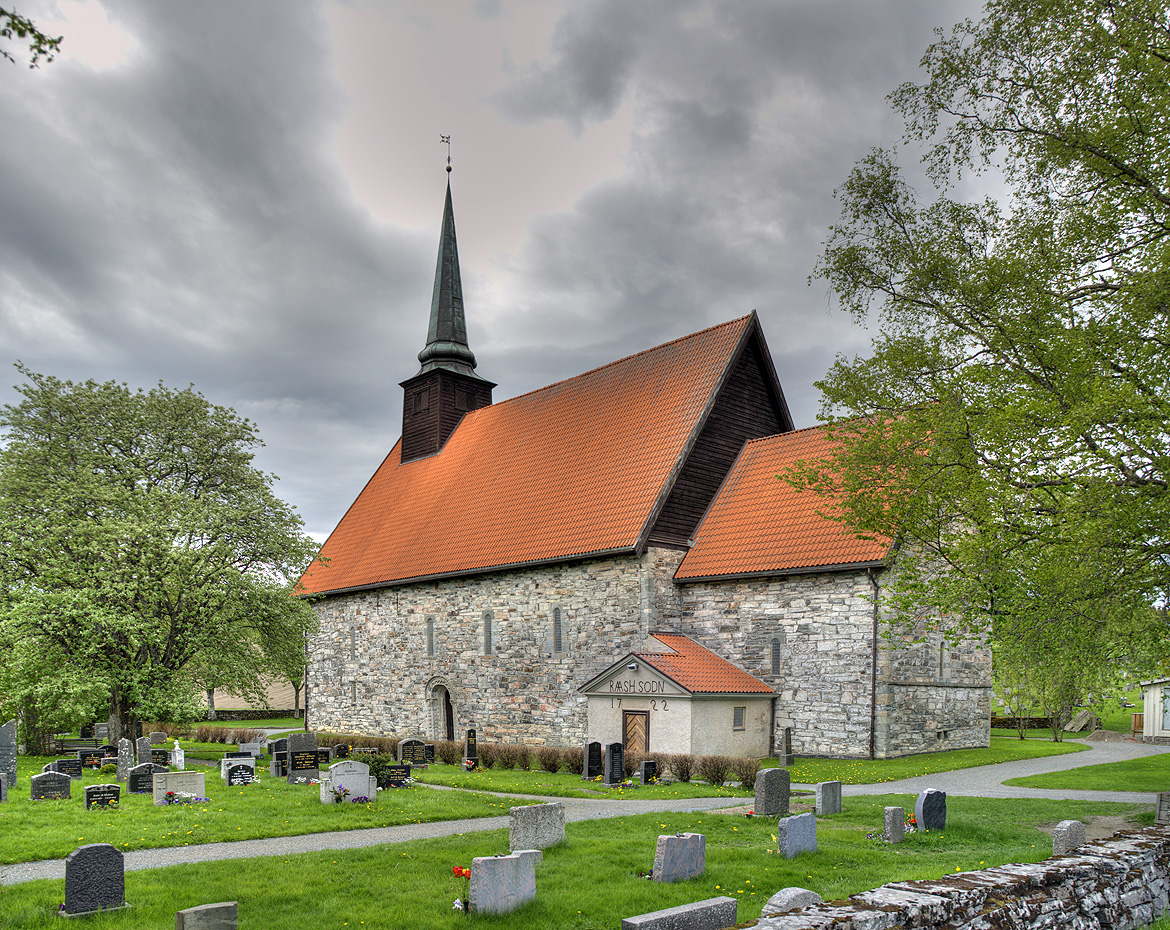
Stiklestad Church
Somewhere inside the altar of Stiklestad Church lies, according to centuries of tradition, the Olavssteinen -- the stone against which King Olaf II of Norway leaned as he bled to death on July 29, 1030. No archaeological excavation has ever confirmed or denied it. The gray Romanesque church was built directly over the place where the king fell, as if the very ground demanded consecration, and the stone has remained sealed in its sanctuary ever since. For nearly nine hundred years, worshippers have knelt within arm's reach of one of Scandinavia's most potent relics without any way to verify what the walls contain.
Raised Over a Killing Field
Construction began with the chancel between 1150 and 1180, directed by Archbishop Oystein Erlendsson of the Diocese of Nidaros. The nave followed closer to 1200, completing a long church design in stone that could seat about 520 people. The builders chose their site with deliberate symbolism: this was where Olaf had received the three wounds that killed him -- axe to knee, spear to belly, axe to neck. By the time the church rose, Olaf had been a saint for decades, and his cult was drawing pilgrims from across Scandinavia. The church did not merely commemorate the battle; it sanctified the ground, transforming a place of violence into a place of worship.
Centuries of Settling and Repair
During the 15th century, the nave was extended westward using stone salvaged from a nearby church that had been torn down. By the 16th century, the ground beneath the foundation had settled enough to threaten the structure, and two heavy retaining walls were added along the west end. A baroque altarpiece carved by Johan Johansen and painted by Johan Hanssonn arrived in 1655, adding ornamental warmth to the austere interior. In 1814, Stiklestad Church served a different kind of purpose altogether: it became one of more than 300 parish churches across Norway used as polling stations for elections to the Norwegian Constituent Assembly, the body that wrote Norway's constitution at Eidsvoll Manor. A church built to honor a medieval king thus played a small part in the birth of modern Norwegian democracy.
Stripped to Stone
The major restoration of 1928 to 1930, timed to coincide with the 900th anniversary of the Battle of Stiklestad, was led in part by architect Jakob Holmgren. The exterior plaster was removed to reveal the natural stone beneath -- the rough, honest surface the medieval builders had laid. The tower was rebuilt, walls were reinforced against continuing settlement, and the interior was renewed: new floors, new benches, a rebuilt second-floor gallery. Most dramatically, frescoes hidden beneath later coverings were uncovered on the walls, and the artist Alf Rolfsen painted new frescoes on the choir's walls and vault, creating a visual connection between the medieval and the modern. No archaeological dig accompanied the work, leaving the question of earlier structures -- and the contents of the altar -- unanswered.
Echoes Across an Ocean
Norwegian emigrants carried Stiklestad's name to Minnesota, where in 1897 they established the Stiklestad United Lutheran Church -- a small act of transplanted identity that speaks to what this place meant to people who left Norway but never fully left its history. Back in Trondelag, the church remains an active parish within the Diocese of Nidaros, still holding services, still receiving visitors who come as much for the battle's memory as for Sunday worship. The annual Saint Olav Drama, performed on the adjacent field each July, turns the church into a backdrop for the story it was built to preserve. Whether the Olavssteinen truly rests inside its altar, no one alive can say. But the church itself is monument enough -- a stone vessel holding a thousand years of Norwegian faith, loss, and national becoming.
From the Air
Located at 63.80N, 11.56E in the village of Stiklestad, Verdal Municipality, Trondelag, Norway. The gray stone church is visible in the cultural center complex at the battlefield site. Nearest major airport is Trondheim Airport, Varnes (ENVA), approximately 80 km southwest. Adjacent to the Stiklestad National Cultural Center with its outdoor theater and museum buildings. Best viewed at 2,000-3,000 feet AGL. The Verdalen valley provides clear terrain context, with the Trondheimsfjord visible to the west-northwest.