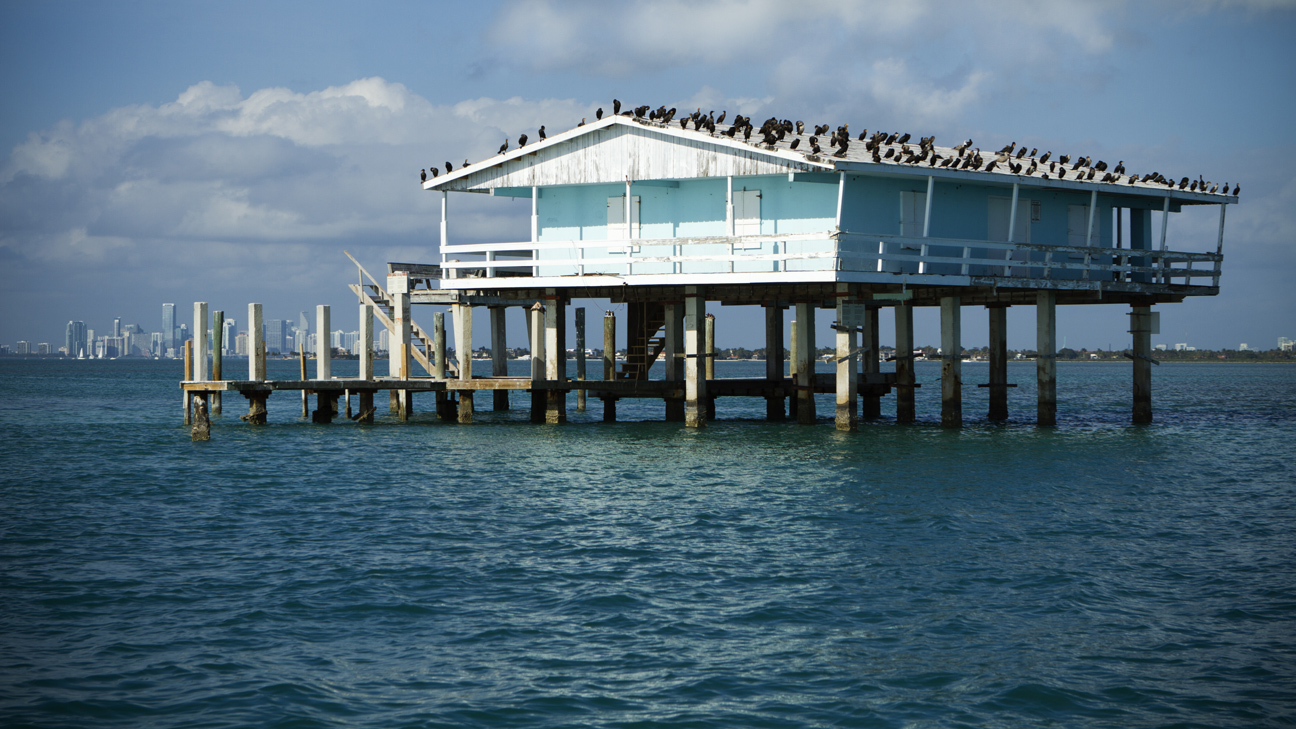
Stiltsville
Life magazine called it "an extraordinary American community dedicated solely to sunlight, salt water and the well-being of the human spirit." One mile south of Cape Florida, where the shallow turquoise waters of Biscayne Bay thin out over sandbars known as the Safety Valve, a handful of wooden houses stand ten feet above the waterline on concrete pilings. They are the last survivors of Stiltsville, a floating neighborhood that once numbered 27 buildings and attracted everyone from Florida's governor to a con man named Pierre who ran a bikini club on a grounded yacht. The houses have no addresses, no roads leading to them, and no logical reason to exist -- which is precisely why they endure.
Crawfish Eddie's Kingdom
Most sources trace Stiltsville's origins to the early 1930s, though some Dade County historians place a dozen shacks in "the flats" as early as 1922. The name that stuck belongs to "Crawfish" Eddie Walker, who built a shack on stilts above the shallow water and turned it into a gathering spot popular enough to warrant picture postcards. By 1940, Commodore Edward Turner had floated a barge out and built the Quarterdeck Club, a $100,000 play-palace equipped with a bar, lounge, bridge deck, dining room, and dock slips for yachts. Celebrities arrived by boat. Tourists in Miami Beach considered it a must-see attraction. Florida Governor LeRoy Collins became a regular visitor in the 1950s, writing to his host Jimmy Ellenburg: "When the time comes when I say so long to this life, I hope the great beyond seems alot like your cabin in the sea."
Bikinis, Raids, and Renegades
Stiltsville's wildest chapter began in 1962 when Harry Churchville -- a businessman and scam artist who went by "Pierre" -- grounded a 150-foot yacht named Jeff in the mudflats and converted it into the Bikini Club. Women wearing bikinis drank free. A sun deck offered nude sunbathing. Staterooms could be rented for any purpose. The Florida Beverage Commission raided the club in the summer of 1965 and shut it down for selling liquor without a license. Months later, Hurricane Betsy destroyed what remained. The May 1967 edition of Argosy magazine ran a feature titled "BIKINIS ON STILTS," describing "a renegade village on stilts where weekend residents live by their own laws." By the time the story was published, the Bikini Club had already been gone for over a year.
Hurricanes and Hard Limits
Nature has been Stiltsville's most relentless editor. Hurricane Donna damaged most structures in 1960. The Quarterdeck Club was rebuilt, only to be destroyed by fire in 1961 -- rumor has it the owner's wife torched it in a jealous fit. Hurricane Betsy in 1965 ended the frontier era entirely. Florida began requiring building owners to pay $100 annually to lease their quarter-acre circular "campsites," banned new construction, and prohibited rebuilding any structure that sustained more than 50 percent damage. At its peak in 1960, Stiltsville consisted of 27 buildings. By 1992, fourteen remained. Then Hurricane Andrew struck on August 24, 1992. When the water receded, only seven buildings were left standing.
The Fight to Stay Above Water
As lease termination dates approached in the late 1990s, the National Park Service told leaseholders it lacked authority to renew. Twice, Stiltsville failed to earn National Register of Historic Places status because the surviving houses were not yet 50 years old. Dr. Paul George of the Historical Museum of Southern Florida captured the stakes: "It really is an only-in-Miami kind of thing. It had an aura, a rascally mischievous past. But it was also just a place people could go to enjoy getting away. It would be a terrible loss." Life magazine returned 57 years after its original feature to document the struggle. A petition drive gathered more than 75,000 signatures. In August 2000, the Park Service reversed its decision and approved a Stiltsville amendment to the General Management Plan for Biscayne National Park. The seven surviving structures were placed under the Stiltsville Trust in 2003.
A Floating Landmark
Today, Stiltsville's seven remaining houses stand as improbable monuments to Miami's defiant spirit. Their architectural styles span decades of evolution -- from the A-frame house to the Leshaw House with its distinctive Mansard roof to the Baldwin, Sessions & Shaw House, once featured in a national ad campaign for Pittsburgh Paints. Nearly all include full wrap-around porches that hang over open water. The structures occupy one of the most unusual positions in American geography: within Biscayne National Park, a facility that is 95 percent water and essentially inaccessible to non-boaters. Stiltsville has seeped into popular culture, appearing in Miami Vice, Dexter, Grand Theft Auto: Vice City, and novels by Carl Hiaasen and Karen Russell. Twelve blue-collar workers once bought a sunken barge for one dollar to build their club here. That spirit -- scrappy, stubborn, salt-cured -- still hovers above the flats.
From the Air
Stiltsville is located at 25.65N, 80.17W, one mile south of Cape Florida on the edge of Biscayne Bay. The stilted structures are visible from low altitude as a cluster of small buildings standing in open shallow water over sandbars. Look south of Key Biscayne and Bill Baggs Cape Florida State Park. Nearest airports: Miami International (KMIA), Miami-Opa Locka Executive (KOPF), and Homestead Air Reserve Base (KHST). Best viewed at 1,000-2,000 feet AGL for individual structure detail. The shallow turquoise water contrasts sharply with the deeper blue of Biscayne Bay.